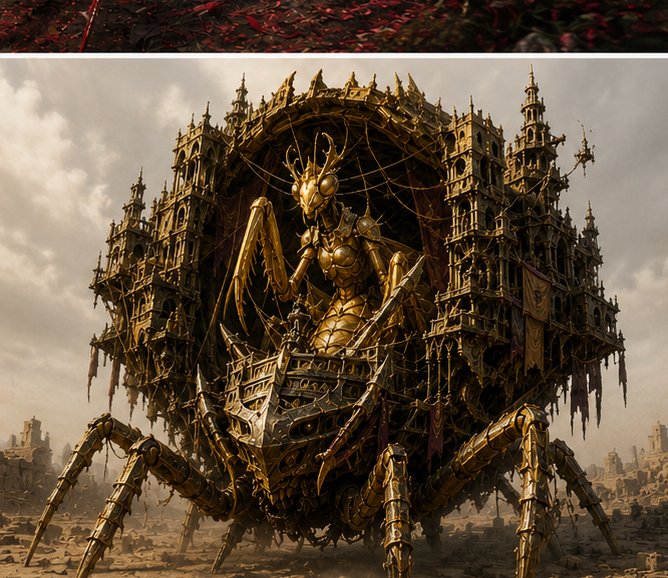
In one sentence: Ahtal-Ka is the golden, mantis-like final boss of Monster Hunter Generations Ultimate — a "Neopteron" that turns gold by eating males and builds, then pilots from the inside, a fortress of scavenged metal bound with its own silk.
A giant praying mantis, plated in gold, sits inside a walking castle she built herself from the rubble of the towns she flattened, steering it with threads like a puppeteer. It is one of the most over-the-top creatures in Monster Hunter — and, like the best of them, it is welded together from real biology and one deliberate impossibility. This is the rare monster where I can tell you exactly which part the designers knew was a lie, because they said so.
Tagging each claim by how solid it is.
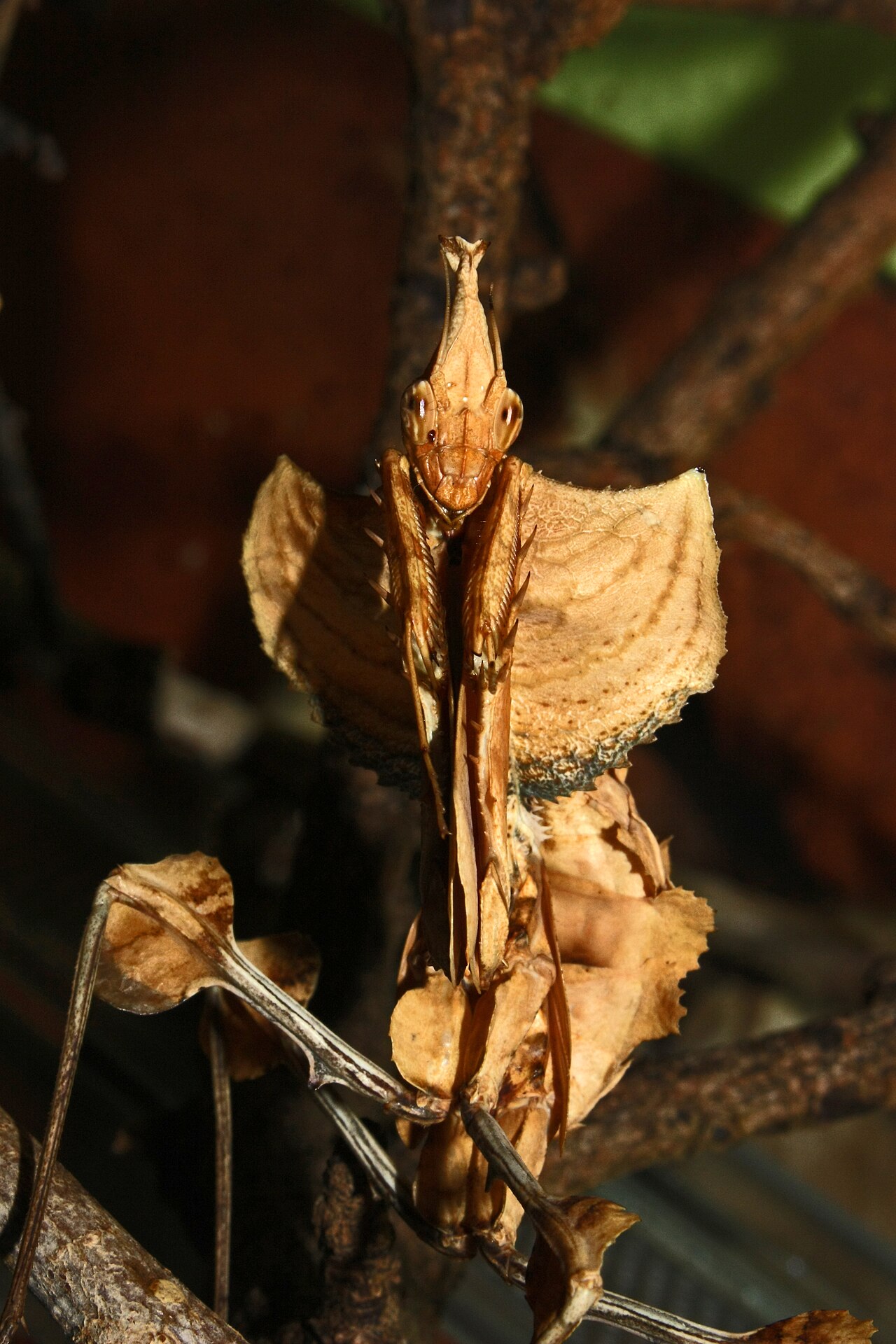
Canon, official design. Unlike most "what is it based on" questions, this one has a primary source, and the English wikis usually skip it. In a making-of interview in the Japanese magazine Nintendo Dream (September 2017), director Ichihara explained Ahtal-Ka's design; the commentary was later reprinted in Capcom's official setting book (The Laws of Inspiration 2 / Hatsō no Hōsoku 2). Two things are dev-confirmed there: the body is built on a real mantis, the devil's flower mantis (Idolomantis diabolica, called ニセハナマオウカマキリ in Japanese), chosen because its flared, collar-like thorax read as regal; and the whole monster is themed on ancient Egypt and "death and rebirth" — the gold references a pharaoh, and the dark banding references mummy wrappings and a necromancer. An earlier, rejected concept paired a scarab (sacred in Egypt) with a spider, for silk. So mantis + pharaoh + mummy is documented intent, not fan guesswork.
Canon, in-game flavor. The localized game text frames her as a golden "empress of praying mantises" who flattens settlements and builds her lair ever larger from the wreckage — her throne is strewn with golden threads and stolen treasures. (I am paraphrasing the localized flavor as transcribed by the community wikis; treat it as in-game lore rather than a verified Capcom document.)
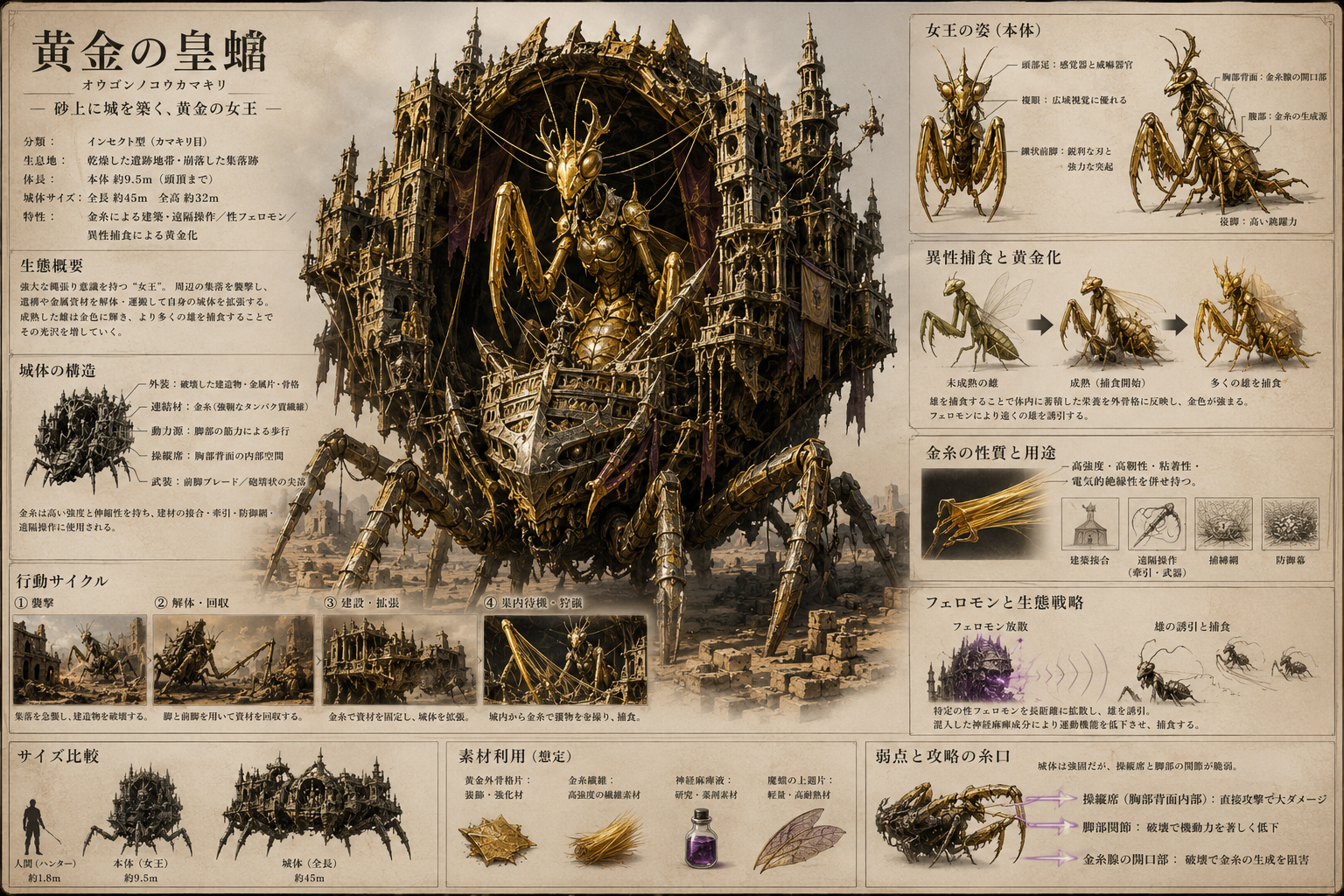
Canon, behavior. She produces golden thread from her abdomen and uses bladed forelegs mainly as tools to weave scavenged metal, stone, and ruins-debris into the Ahtal-Neset, a mobile fortress she pilots from inside via her threads. Her control hazards in the fight are a long-range pheromone that lowers a hunter's defense and sticky silk that immobilizes — not venom. Females are gold and males are not; in lore a female becomes more golden the more males she consumes.
Three myths to drop. (1) The widely quoted "Rarely seen Neopterons famed for their golden carapace…" blurb is not real in-game text — it is an AI/fan paraphrase; I will not quote it. (2) "Ahtal-Ka is Arabic for 'soul of the ruins'" is unverified fan lore and not linguistically sound (the soul element "ka" is ancient Egyptian, not Arabic); I will not assert an etymology, though the Egyptian theme is real and the nest "Ahtal-Neset" echoes Egyptian nst, "throne." (3) Fan taxonomy boxes that file her under "Order: Coleoptera" (beetles) are inconsistent flavor; her class is the game's catch-all insectoid label "Neopteron," and her morphology and dev-stated model are mantis (order Mantodea). One charming, accurate detail the English wikis garble: the "queenly" read came from the mantis's resemblance to an Elizabethan ruff collar, not, as often mistranslated, a necklace.
I work on animal coloration and on predator–prey ecology, and Ahtal-Ka hands me both. The gold is a coloration problem; the male-eating is a predator–prey and sexual-selection problem; and the "silk" is a question about arthropod materials that I can answer precisely. So rather than ask "is she realistic," I will do three things in order: explain the parts that are real, reason out how a creature like her could evolve, and predict what she would do if she were real and we only ever saw her in a boss arena.
Ahtal-Ka's model, the devil's flower mantis, belongs to a famous guild of flower-colored mantises — but "flower-colored" hides two opposite strategies, and getting them mixed up is the usual mistake.
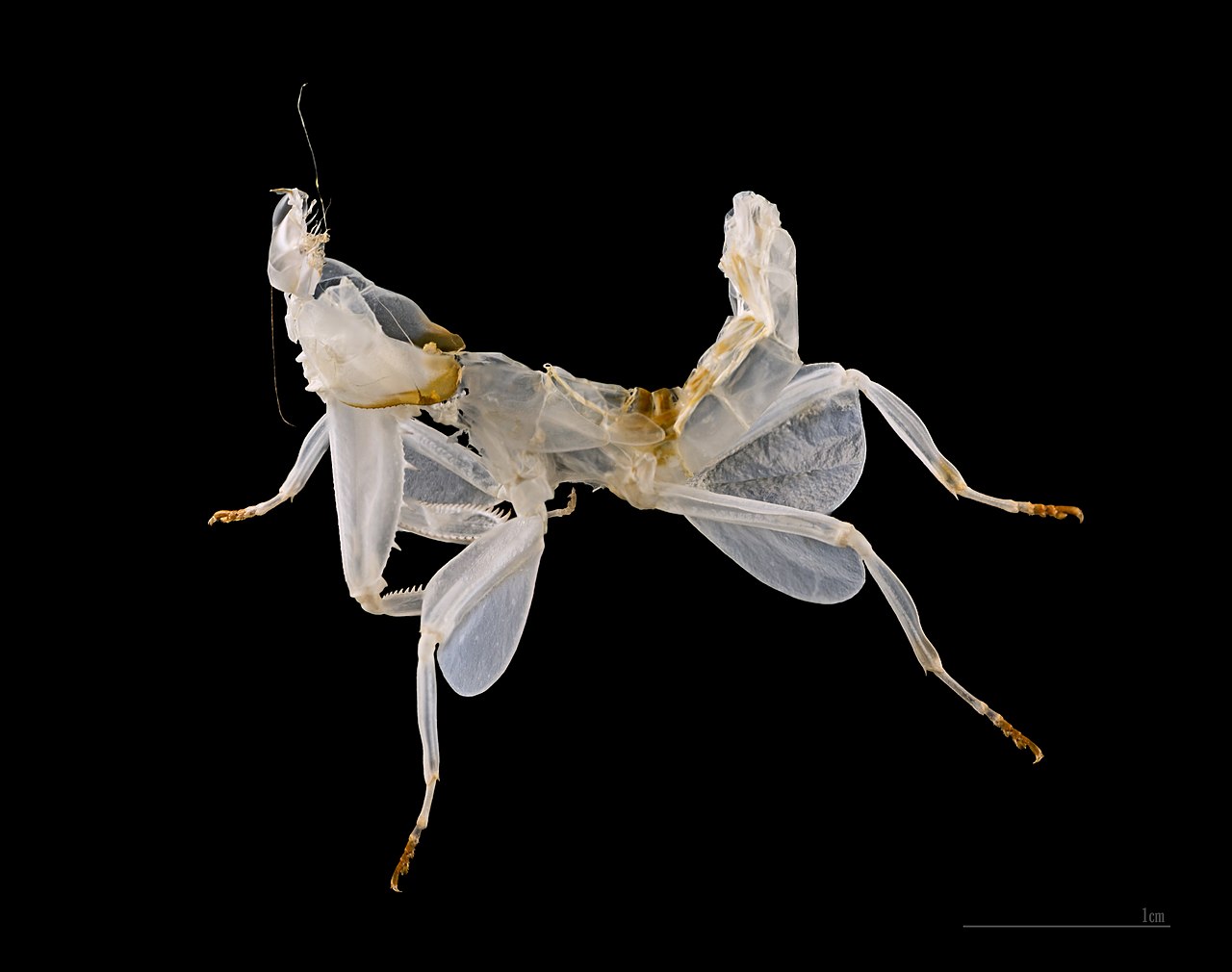
One strategy is the lure. The orchid mantis (Hymenopus coronatus, family Hymenopodidae — a different family from Ahtal-Ka's model) is the first animal experimentally shown to mimic a flower in order to attract pollinators as prey. Its color is indistinguishable from real flowers to bee and wasp vision, and in field trials isolated mantises drew in wild pollinators at higher rates than actual flowers did (O'Hanlon, Holwell & Herberstein 2014, The American Naturalist). Juveniles even add a chemical trick, emitting honeybee-like compounds, pushing capture success higher (Mizuno et al. 2014, Zoological Science). That is aggressive mimicry: the predator is a sensory trap.
The other strategy is the startle. Ahtal-Ka's actual model, the devil's flower mantis (Idolomantis diabolica, family Empusidae), uses its color the opposite way — defensively. It rears up and throws open its forelegs and wings to flash sudden red, white, blue, and black, a deimatic display that works by triggering a predator's reflexive recoil to an abrupt sensory change, without the predator needing to have learned that the color means danger (Umbers et al. 2017, Biology Letters). Across mantises, the choreography of these displays is evolutionarily flexible while the color component is more conserved — startle displays are old, roughly 60 million years (Vidal-García et al. 2020, Proceedings of the Royal Society B).
This matters for reading Ahtal-Ka honestly: her sudden golden reveal is best understood through the deimatic lineage she was actually modeled on, not the orchid-mantis lure she is often confused with. Capcom even extended the idea past the animal — in the developer commentary, the Ahtal-Neset's dragon-like silhouette is intentional, so other creatures keep away. That is, in effect, a built deimatic structure: threat as architecture.
Two real phenomena sit under "she eats males and turns gold."
First, the eating. Sexual cannibalism in mantises is real and, in several species, adaptive for the female: cannibalistic females end up in better condition and lay heavier egg cases, and poorer-condition females are likelier to cannibalize (Barry, Holwell & Herberstein 2008, Behavioral Ecology), with consumed males making a measurable material contribution to the offspring (Brown & Barry 2016, Proceedings of the Royal Society B). So "eating males improves a female's reproductive output" is sound. What is not real is the pigment story: eating males does not paint an animal gold. Treat the gilding as a stylized signal of female condition, not a pigmentation mechanism.
Second, the gold itself. A metallic gold in a real insect is almost never a pigment — it is structural color, produced by light interference in nanoscale multilayers of the cuticle. This is exactly my corner of coloration research: many beetles generate metallic colours with multilayer reflectors, and beetle metallic gold and iridescence are a well-reviewed phenomenon (Seago et al. 2009). So if you want Ahtal-Ka's gold to be biologically real, the honest mechanism is a multilayer photonic cuticle, not melted treasure or absorbed male pigment.
Here is the one part the designers knew was impossible — and it is the most interesting part.
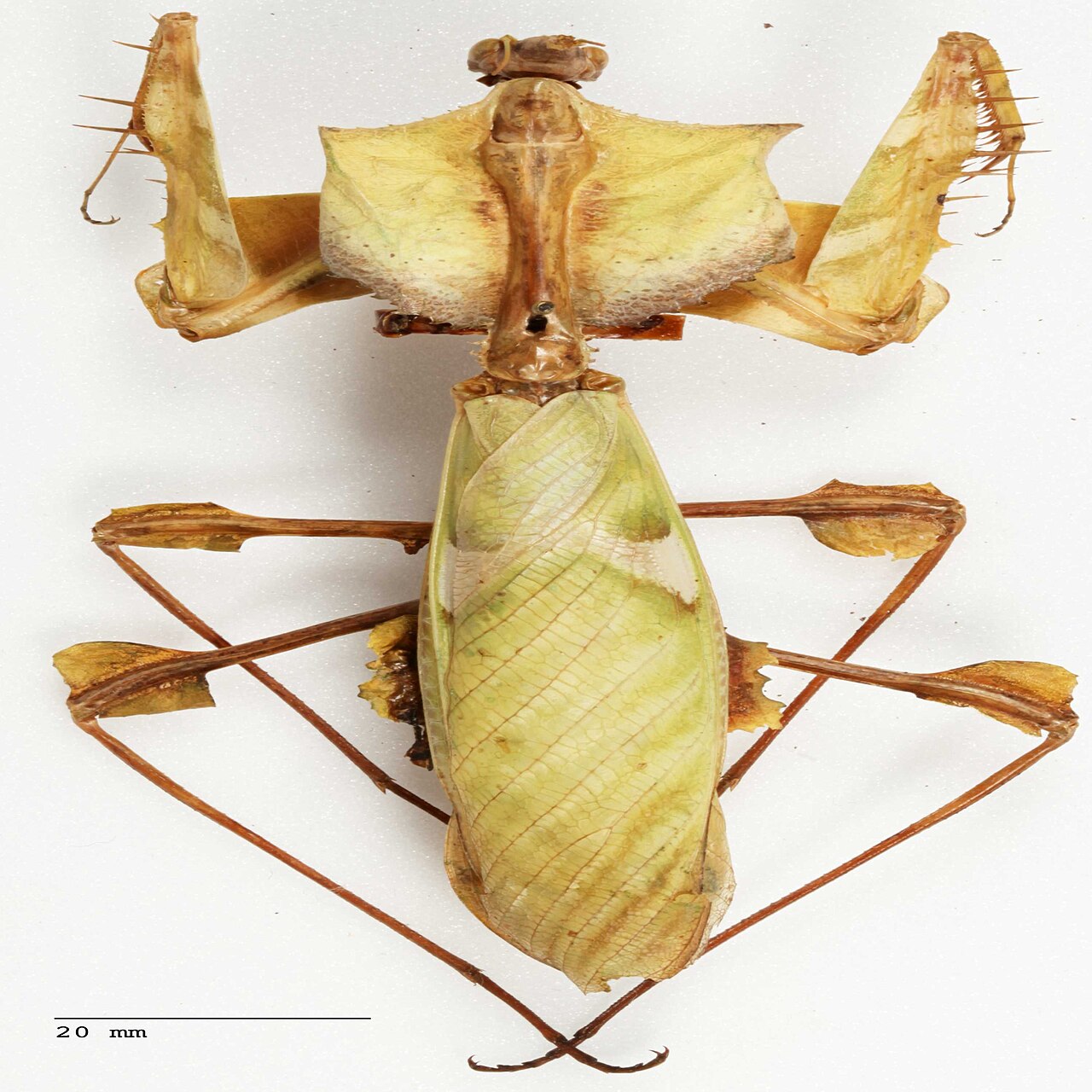
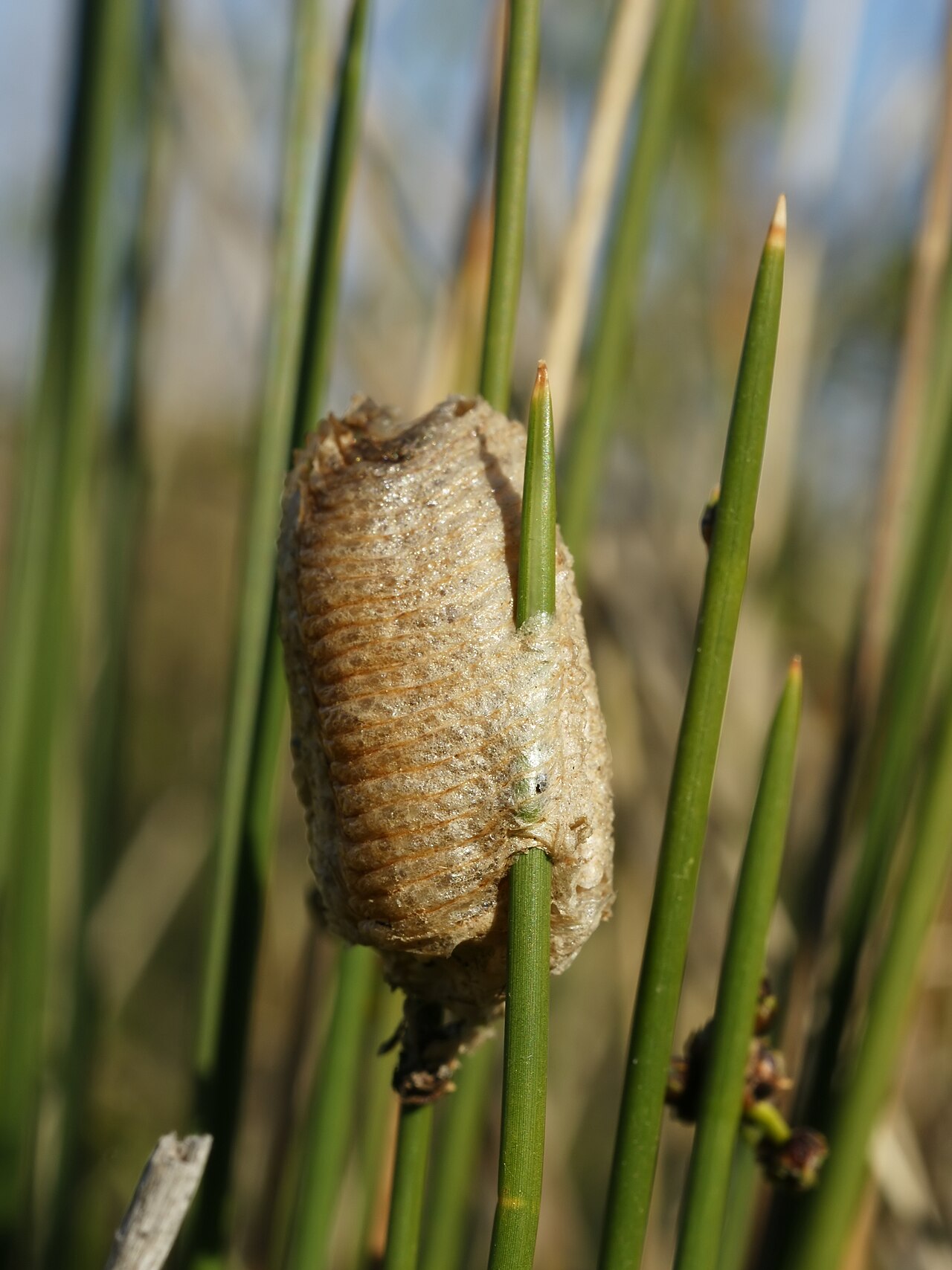
Real praying mantises do not spin silk. They do not make spider draglines or silkworm thread. What a mantis makes is an ootheca: a foam, whipped from glandular secretion and hardened, in which it encases its eggs. And that material is chemically distinct from spider silk: the ootheca proteins (named Mantis Fibroin 1 and 2) are built predominantly as alpha-helical coiled-coils, whereas spider dragline and silkworm silk are beta-sheet materials (Walker et al. 2012, Biomacromolecules). Different proteins, different molecular architecture, different organ. A mantis spinning a high-tensile silk fortress is therefore a true chimera.
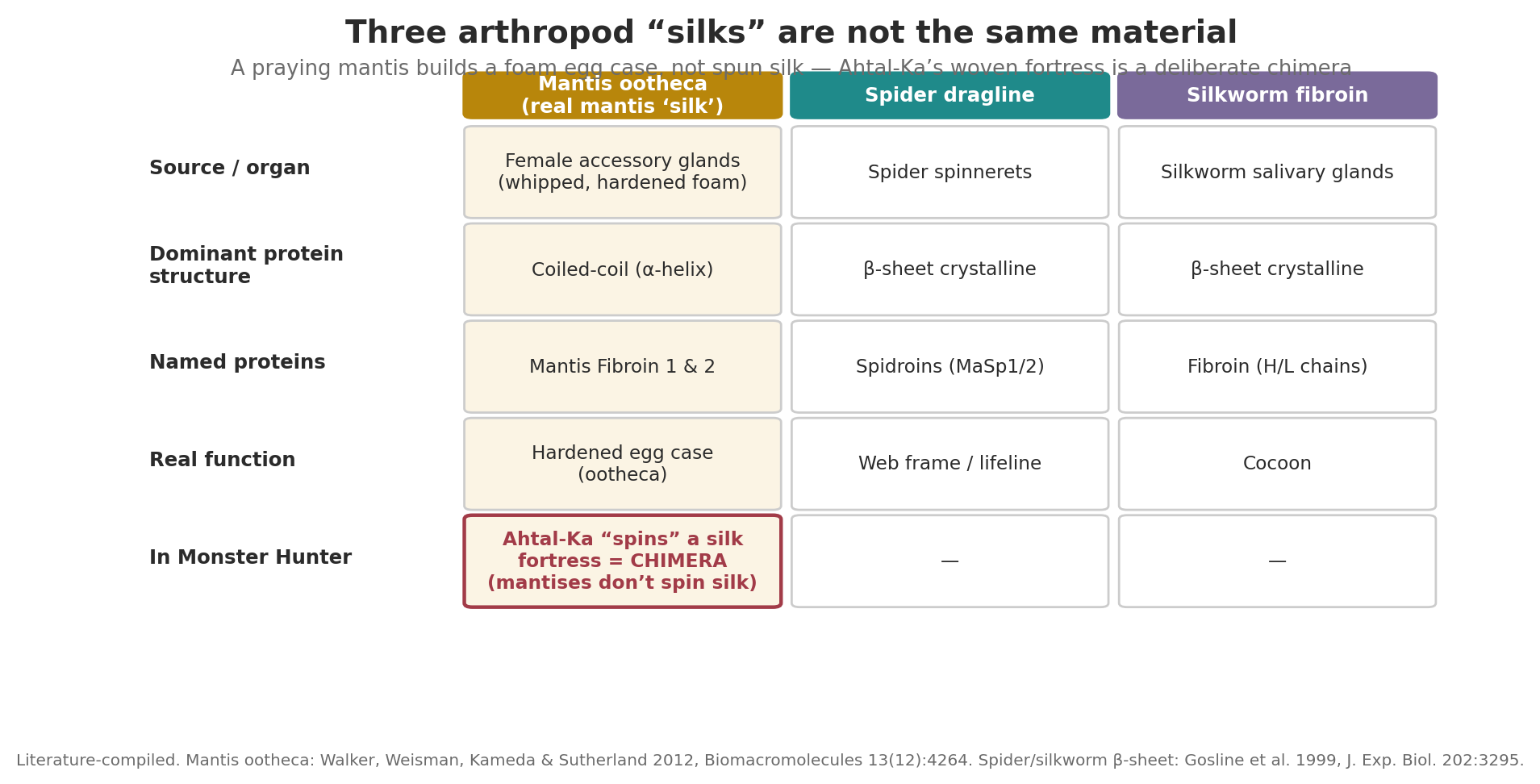
And we know why, because the developers told us: the monster began as a spider (which really does spin building silk) combined with a scarab, then switched to a mantis — but kept the silk. The seam between the abandoned spider and the final mantis is visible in the one trait that does not belong. The honest way to frame Ahtal-Ka's thread is: a mantis given a spider's job.
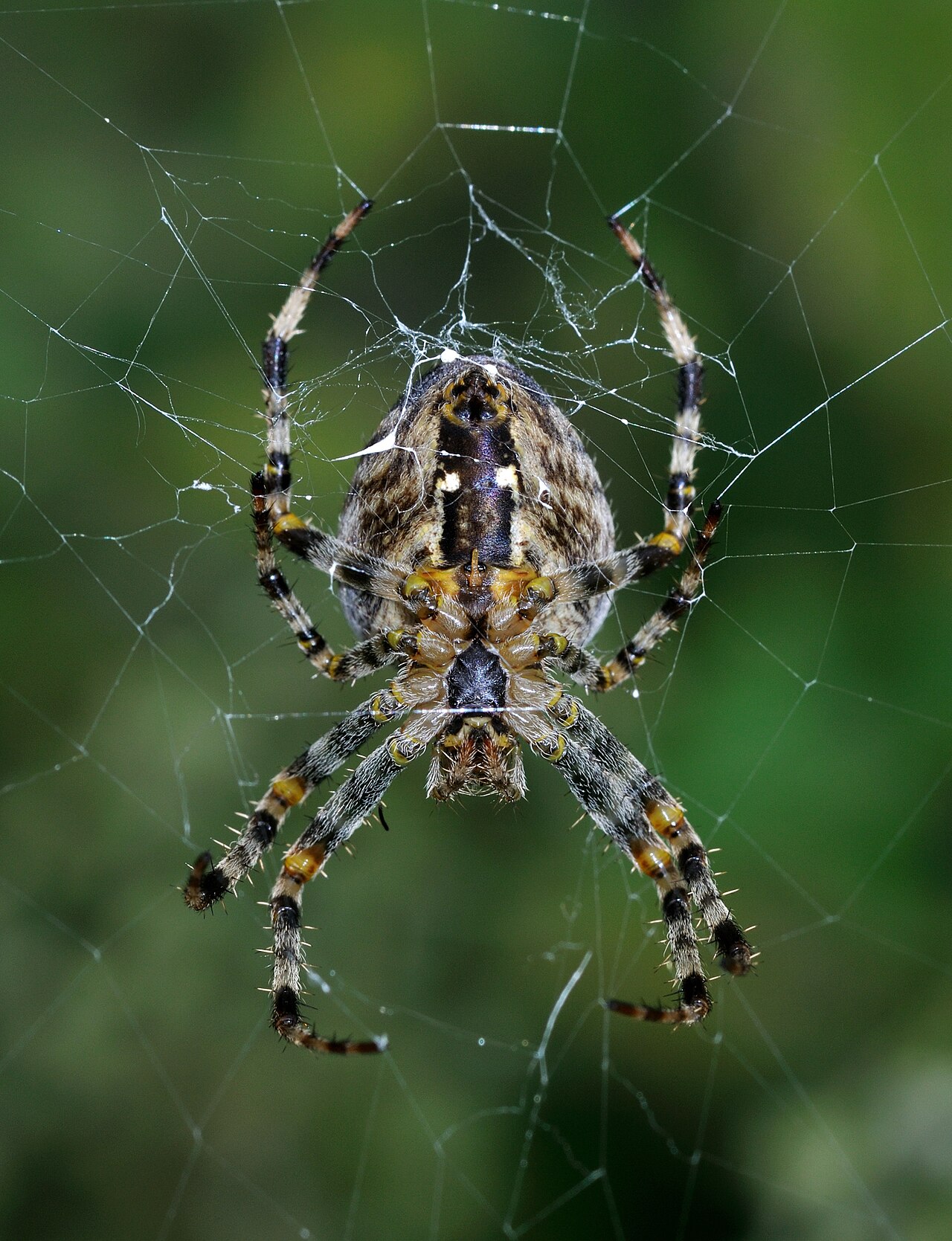
The building itself, though, has real grounding. Animal-built structures — webs, cases, nests — are what Richard Dawkins called the extended phenotype: heritable products of genes reaching outside the body, shaped by selection (Dawkins 1982; Hansell 2005). The closest real analog to "assemble armor and a shelter from selectively chosen environmental debris glued with self-made material" is a caddisfly larva, which builds a protective case from particles it actively selects and binds with its own silk (Okano et al. 2010). Ahtal-Ka scavenging the strongest man-made metal for her fortress is a scaled-up, intelligence-flavored version of a real, documented building behavior.
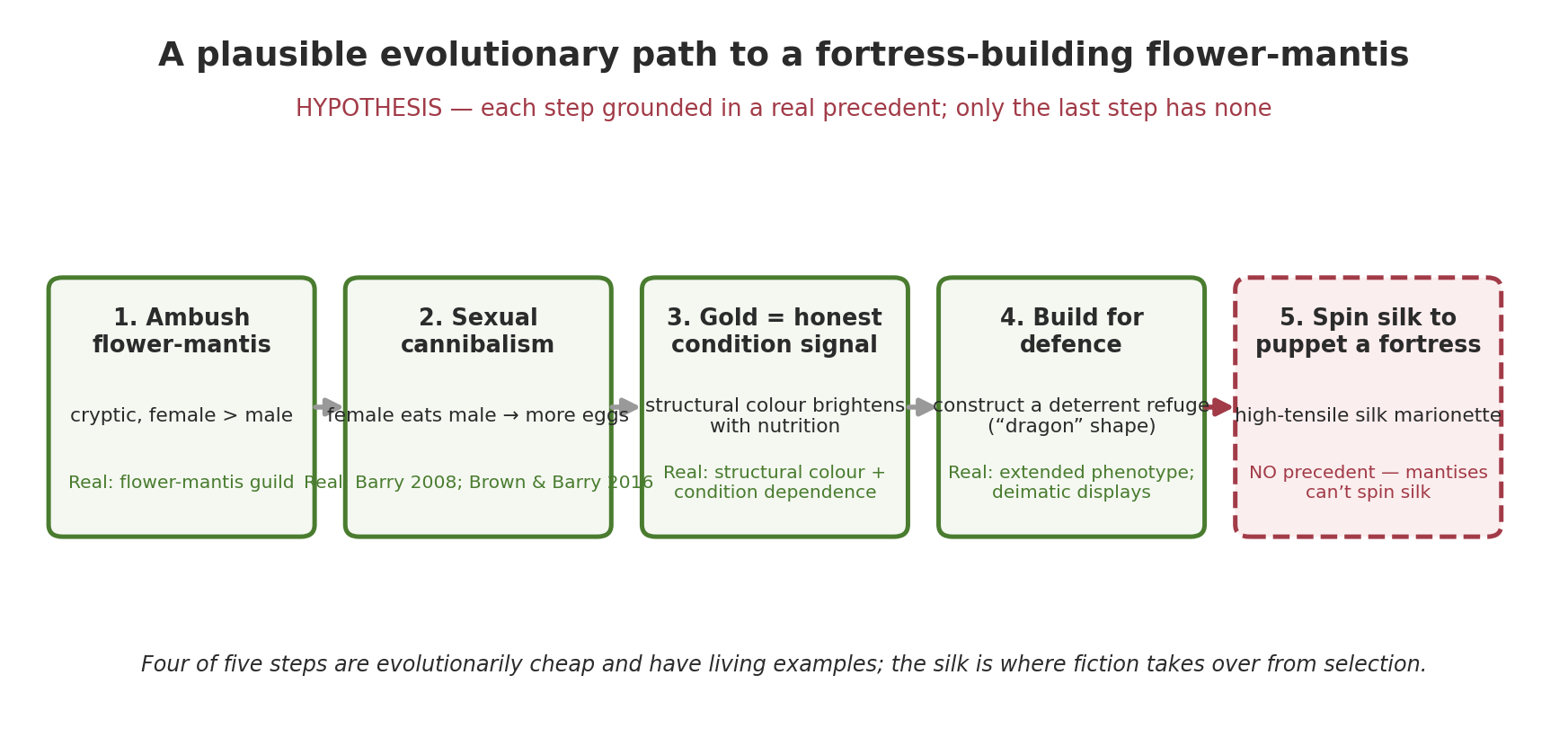
This section is explicitly speculative — a hypothesis built from known mechanisms, not a claim about a real species. The question I find more interesting than "is she real" is "what sequence of ordinary evolutionary steps could produce something like her?" Here is a defensible path, each step resting on a real precedent.
That is the value of running the creature as a hypothesis: four of the five steps are evolutionarily cheap and each has living examples; only the silk requires magic. It tells you precisely where fiction had to take over from selection.
Also speculative — but these are the behaviors I would bet on if Ahtal-Ka were a real animal and we only ever met her in a fight. Each is extrapolated from a general rule in related animals.
None of this is in the game. All of it follows from how her real relatives live — and that gap between the boss arena and the inferred natural history is, to me, the whole point.
The two figures above (the silk-comparison table and the five-step evolutionary path) are built the same way as the Seltas size-dimorphism chart: original, citable, and honest about which cells are measured fact versus reasoned speculation. The silk comparison (Figure 1) is literature-compiled (Walker et al. 2012; Gosline et al. 1999) and shows why Ahtal-Ka's mantis "silk" is biologically a chimera. The evolutionary path (Figure 2) lays out the section-6 scenario, with each step labeled by its real precedent and the final silk step flagged as the break from biology — clearly marked as hypothesis.
What Capcom got right, knowingly: the mantis body and raptorial forelegs; the deimatic logic of a sudden conspicuous reveal (and, cleverly, a built deimatic structure); sexual cannibalism as real mantis biology; female-biased size; and even the choice to make her intelligent in a way modeled on real animals that exploit human objects.
What they bent, knowingly: the silk. They started with a spider precisely because spiders spin, switched to a mantis, and kept the thread — a documented, deliberate chimera. And the gold-from-eating-males is a signal dressed as a pigment.
The real cast is worth meeting. The devil's flower mantis (Idolomantis diabolica) performs the flash display Ahtal-Ka's reveal is built on. The orchid mantis (Hymenopus coronatus) shows the opposite, luring strategy. A mantis ootheca shows what a mantis actually builds. And the metallic gold has its real explanation in the photonic cuticles of beetles.
A praying mantis — specifically the devil's flower mantis (Idolomantis diabolica). This is dev-confirmed: in a Nintendo Dream interview (September 2017), reprinted in Capcom's official setting book, director Ichihara explained the body was built on that species and themed on ancient Egypt (a pharaoh's gold and mummy banding).
No. Mantises make a foam ootheca to encase their eggs, whose proteins (Mantis Fibroin 1 and 2) are predominantly alpha-helical coiled-coils, not the beta-sheet material of spider dragline or silkworm silk (Walker et al. 2012). A mantis spinning a high-tensile silk fortress is a chimera — the designers began with a spider and kept the silk after switching to a mantis.
No — that part is stylized. Sexual cannibalism is real and adaptive: cannibalistic females reach better condition and lay heavier egg cases (Barry et al. 2008; Brown & Barry 2016). But diet does not paint an animal gold. A metallic gold in a real insect is structural color from multilayer cuticle, not absorbed pigment (Seago et al. 2009).
They use flower-like color in opposite ways. The orchid mantis (Hymenopus coronatus, family Hymenopodidae) is an aggressive mimic that lures pollinators as prey (O'Hanlon et al. 2014). Ahtal-Ka's model, the devil's flower mantis (Idolomantis diabolica, family Empusidae), uses color defensively in a deimatic startle display (Umbers et al. 2017).
Yes, in several species. Cannibalistic females end up in better condition and lay heavier egg cases, poorer-condition females are likelier to cannibalize (Barry et al. 2008), and consumed males make a measurable material contribution to the offspring (Brown & Barry 2016).


.jpg)
