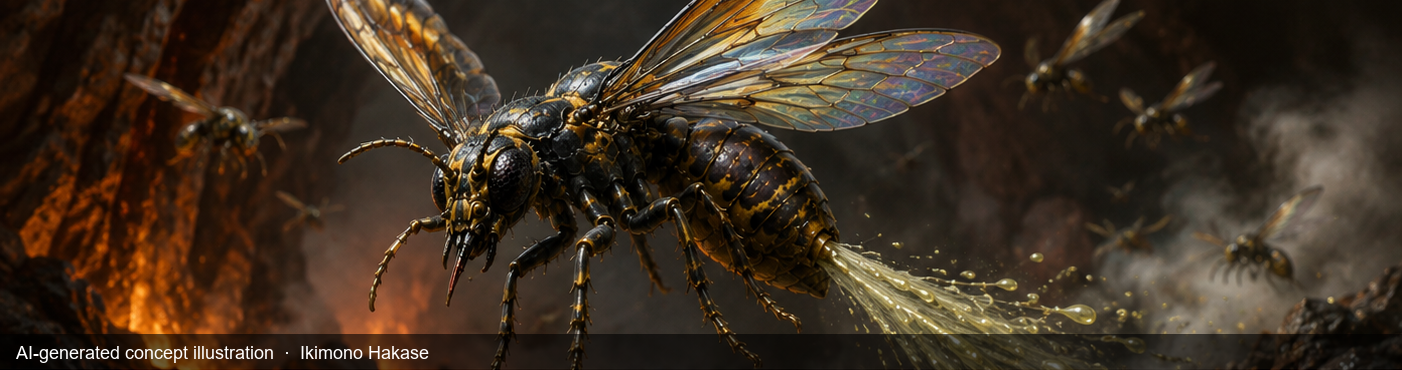
In one sentence: Bnahabra is a small flying Neopteron (Monster Hunter's true-insect class) that debuted in Monster Hunter 3 (2009), occupies nearly every region from volcanic caverns to tundra in queen-led swarms, and defends itself with a paralytic neurotoxin sting and a region-specific corrosive spray that lowers a hunter's elemental resistance, while its larvae develop on carrion.
Bnahabra is the monster everyone swats and nobody thinks about — a buzzing nuisance that paralyzes you, sprays acid on your armor, and dies in one hit. But buried in its in-game notes is one line that turns it into the most quietly profound creature in this whole series: its larvae feed on carrion, and nobody knows what the adults eat. That sentence describes the single most important event in the history of animal life — the moment insects learned to live two completely different lives in one body, joined by the strange pause we call a pupa. The grub in the corpse and the stinging thing in the air are the same animal, and the fact that they are not the same animal is why insects rule the planet. Let me take the little pest apart, and then do the two things a wiki won't: reason out how it could evolve, and predict what it would do when no hunter is watching.
Tagging each claim by how solid it is.
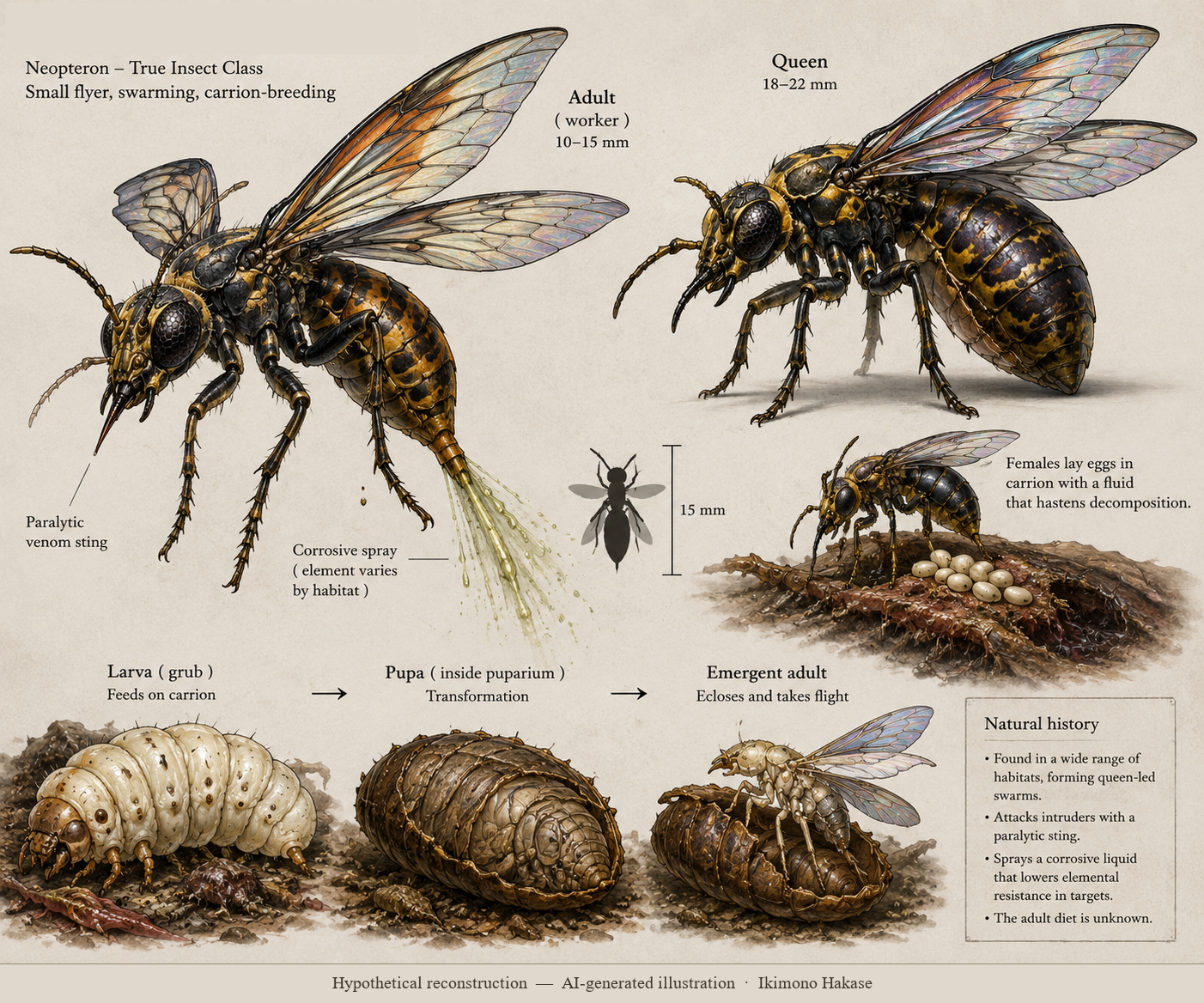
Canon. Bnahabra (ブナハブラ) is a Neopteron — Monster Hunter's true-insect class (six legs, winged) — and it debuted in Monster Hunter 3 ("Tri"), in 2009 (the Third Generation, not the older Second Generation; that was the wasp Neopteron Vespoid). It is a small, flying, swarming nuisance that attacks with a paralytic venom sting and sprays a corrosive liquid that lowers a hunter's elemental resistance, with the element keyed to the region (Fire in volcanic zones, Ice in the tundra, Water in the desert, Thunder elsewhere) and wing colour that varies by habitat. Its swarms are described as led by larger "queens." And the line that matters most, from its Hunter's Notes: "Pervasive flying insects that attack invaders with paralyzing venom and lay eggs in carrion along with a fluid that hastens decomposition." So canon gives it a carrion-feeding larva and an adult whose own diet it explicitly leaves unknown.
Canon relationships. In Monster Hunter's own in-fiction taxonomy, Bnahabra sits in the small-flyer ("Shell Bug") group alongside Vespoid — they are framed as related, ecologically equivalent insects (Bnahabra fills Vespoid's nuisance niche in the Moga region), not as the same species. It is a different group from the grasshopper-like Hornetaur. Don't conflate it with Vespoid (covered earlier), Konchu, or Seltas.
What is inference, not stated. No developer source names a real insect, so I will not declare it "a mosquito" or "a wasp." Its design is a chimera: the venom sting is a wasp's trait, the carrion-breeding larvae and swarming are a fly's. And note one precise gap — canon mentions a larva but never mentions a pupa, so I'll treat full metamorphosis as the real-biology lens I'm applying to a true insect, not as a stated fact of the monster. The element-matched acid and the "queen" are, as we'll see, the fictional parts.
I work on the evolution of coloration and mimicry and on predator–prey ecology, and three threads meet in this pest. Metamorphosis is the deep hook: beetles, like flies, are holometabolous — a feeding larva and a separate flying adult, the same two-lives-in-one-body that Bnahabra's carrion grub and winged adult describe. Mimicry is the surface hook: a wasp's warning colours are the most copied signal in the insect world, and the animals that copy them best are flies — which is exactly Bnahabra's wasp-or-fly ambiguity made flesh. And carrion gives a clean beetle bridge, because some beetles are the carcass specialists that arrive right after the flies. So I get metamorphosis, mimicry, and a beetle, all from a monster you'd normally ignore.
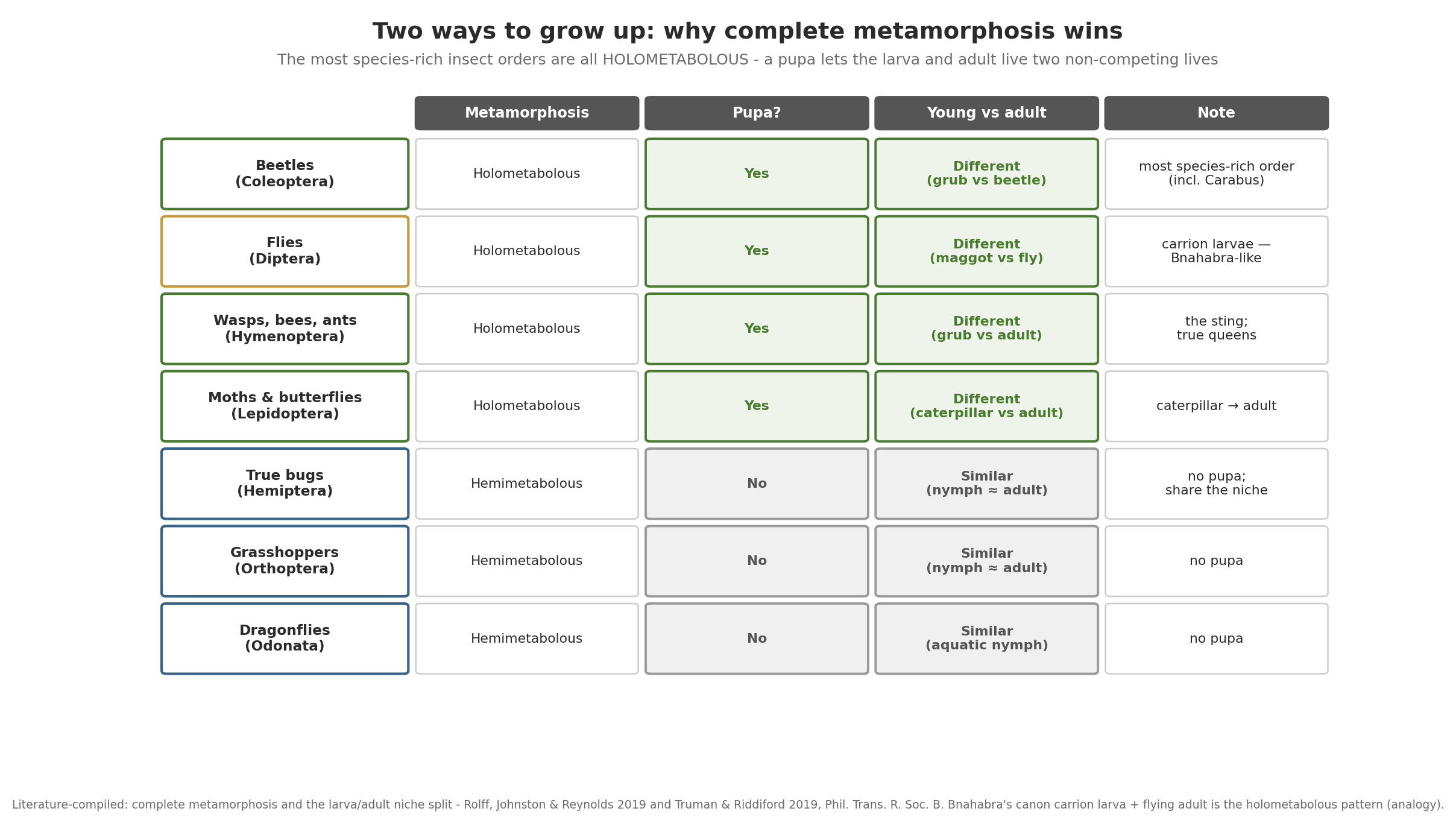
Here is the idea the game stumbled onto. A holometabolous insect — one with complete metamorphosis — does not grow up gradually. It lives as a larva (a feeding, growing machine), seals itself into a pupa, and dissolves and rebuilds its body almost from scratch into an adult (a dispersing, mating machine). The larva and the adult can look like, and live like, two entirely different animals, because developmentally they very nearly are — the pupa is the hinge that lets one genome build two bodies (Rolff et al. 2019; Truman & Riddiford 2019).
Why does that matter? Because it lets the two stages stop competing. A maggot in a carcass and a fly in the air want different food and different space, so a single species can exploit two worlds instead of one — a decoupling that is the leading explanation for why holometabolous insects are the most successful group of animals on Earth: beetles, flies, wasps, and butterflies together make up the great majority of all described insect species, and a large share of all described animal species (Rolff et al. 2019). Bnahabra's canon — a carrion-feeding larva and a flying, stinging adult that eats something else entirely — is a perfect, if accidental, illustration of the most important life-history strategy in the animal kingdom.
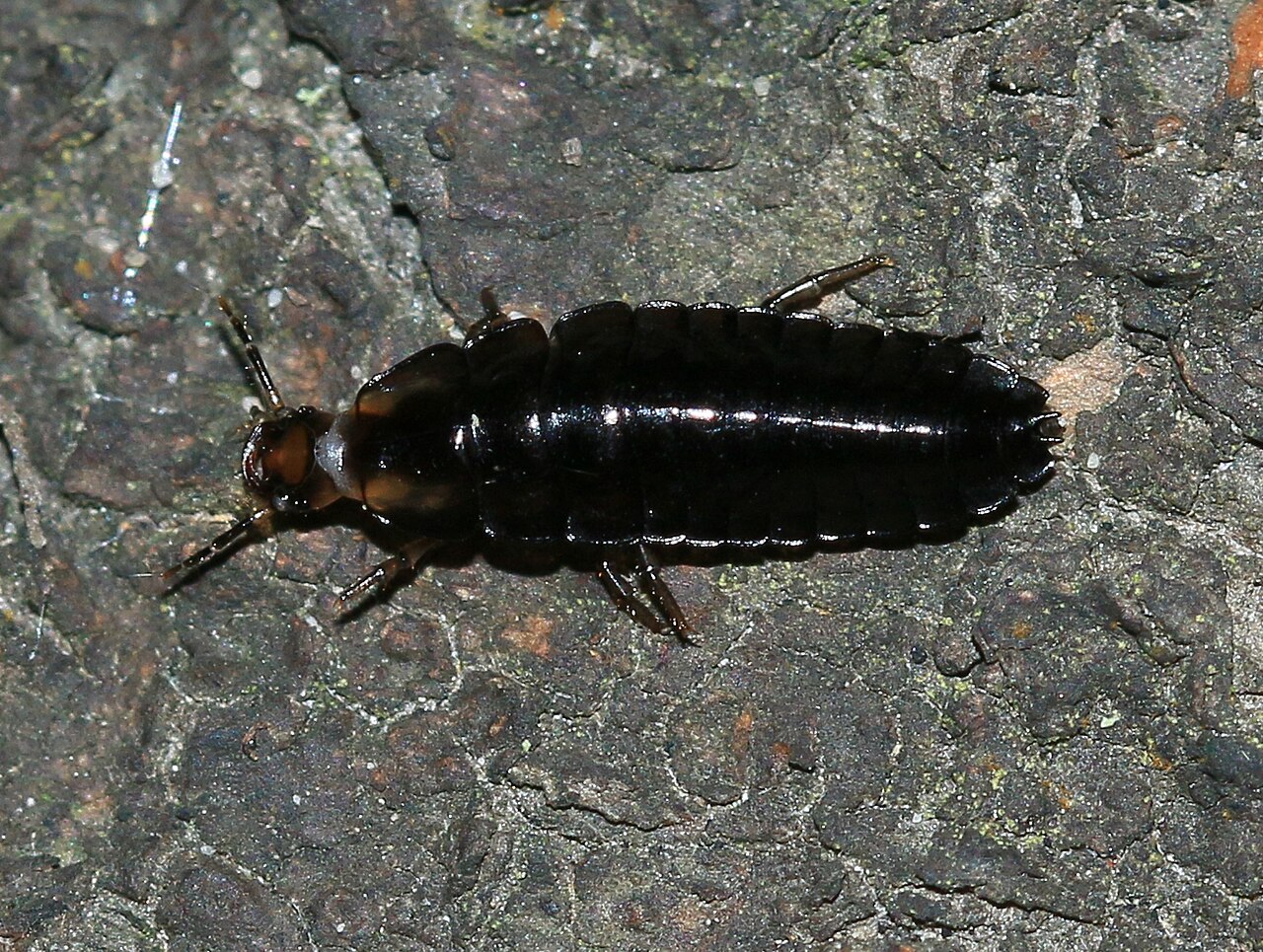
And it is squarely the biology I work on. A ground beetle, for instance, spends its youth as a long, fast, predatory larva hunting in the soil, then rebuilds in a pupa into an armored adult. Same animal, two lives, one pupa between them. (Zero-error footnote: the game confirms Bnahabra's larva, not a pupa — so I'm reading real holometaboly onto a true insect, by analogy, not quoting the game.)
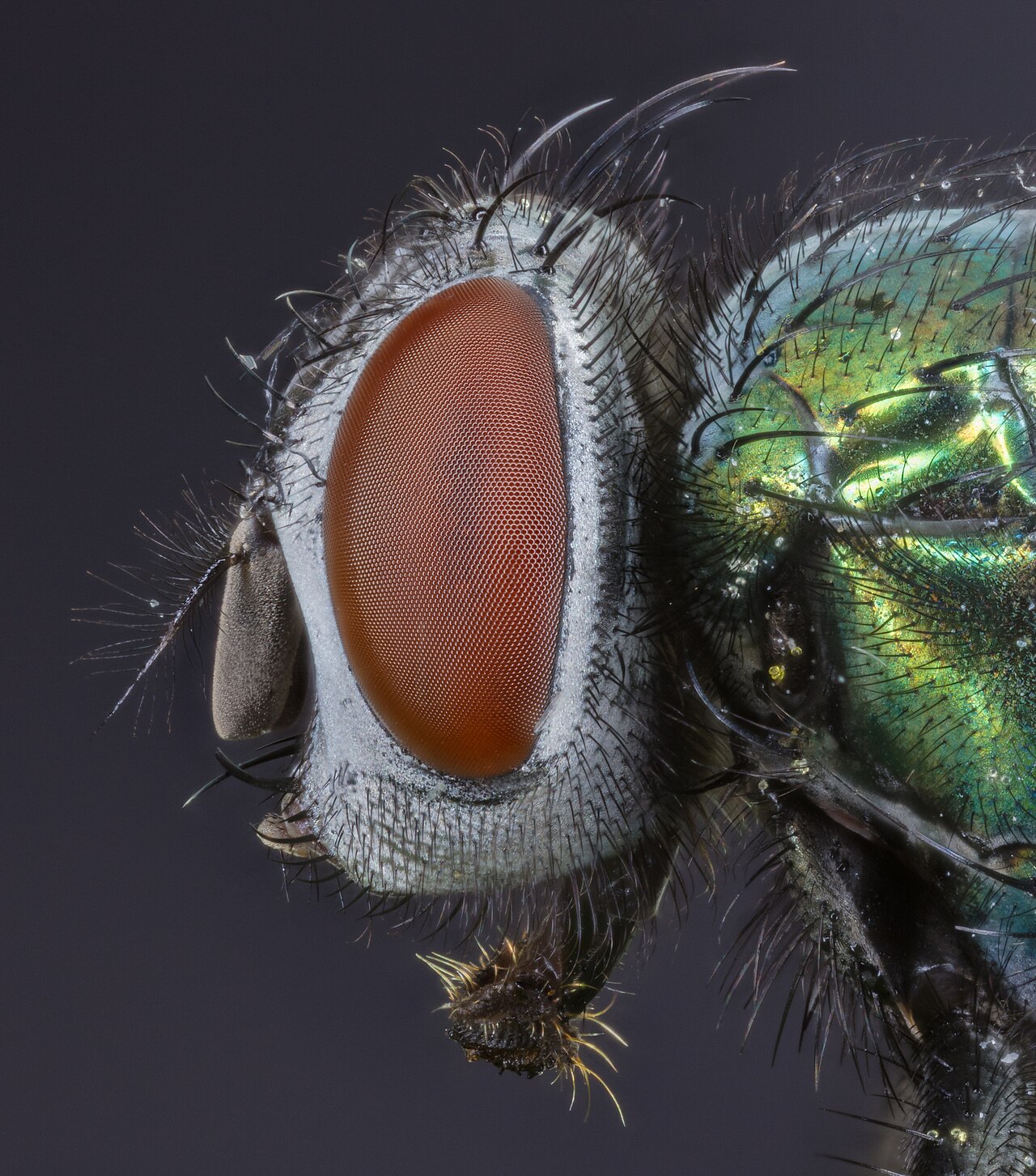
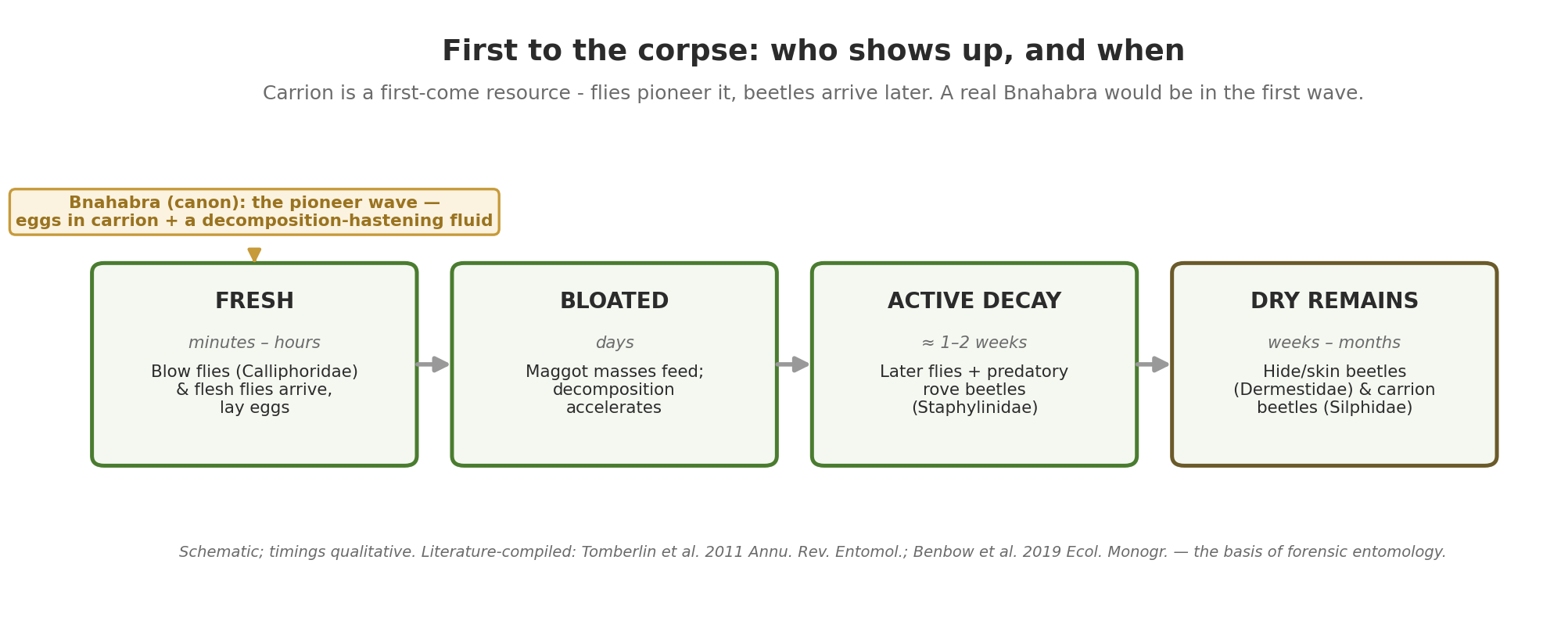
That "lays eggs in carrion with a fluid that hastens decomposition" line is not flavor — it is a remarkably accurate description of a real strategy. Blow flies (family Calliphoridae) are typically the first animals to find a fresh corpse, often within minutes; they lay eggs, and the maggots' feeding and digestive secretions, together with the microbes they carry, genuinely accelerate decomposition (Tomberlin et al. 2011; Benbow et al. 2019). This is the foundation of forensic entomology — the predictable succession of insects on a body is used to estimate time of death. Bnahabra's "decomposition-hastening fluid" is just a fantasy version of what real maggots and their microbes already do.
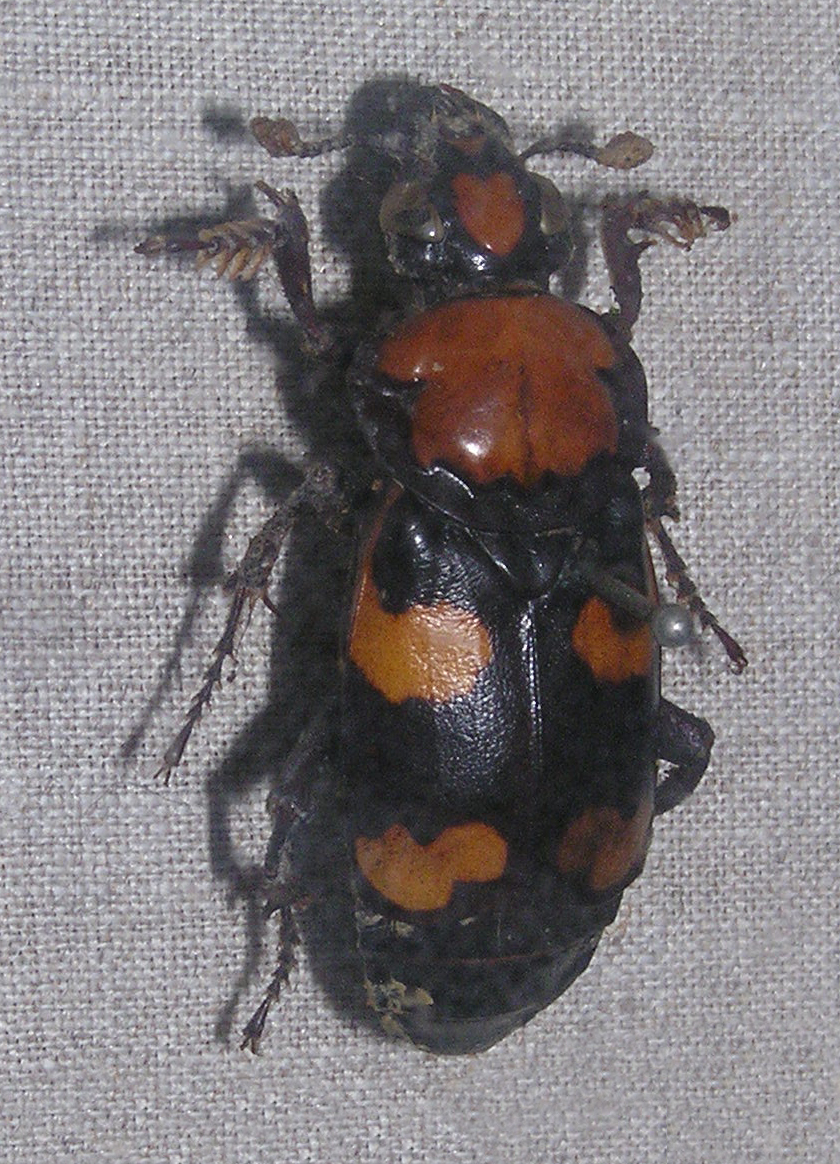
And here is my beetle bridge. Flies get there first, but the next shift belongs partly to carrion beetles — the burying beetles, Nicrophorus (family Silphidae), which actually bury a small carcass, treat it with antimicrobial secretions, and raise their larvae on it with biparental care. Same resource, my lineage, a different chapter of the same recycling crew. A real Bnahabra would be the pioneer wave of that crew — and an ecosystem's carcasses would vanish a great deal slower without animals exactly like it.
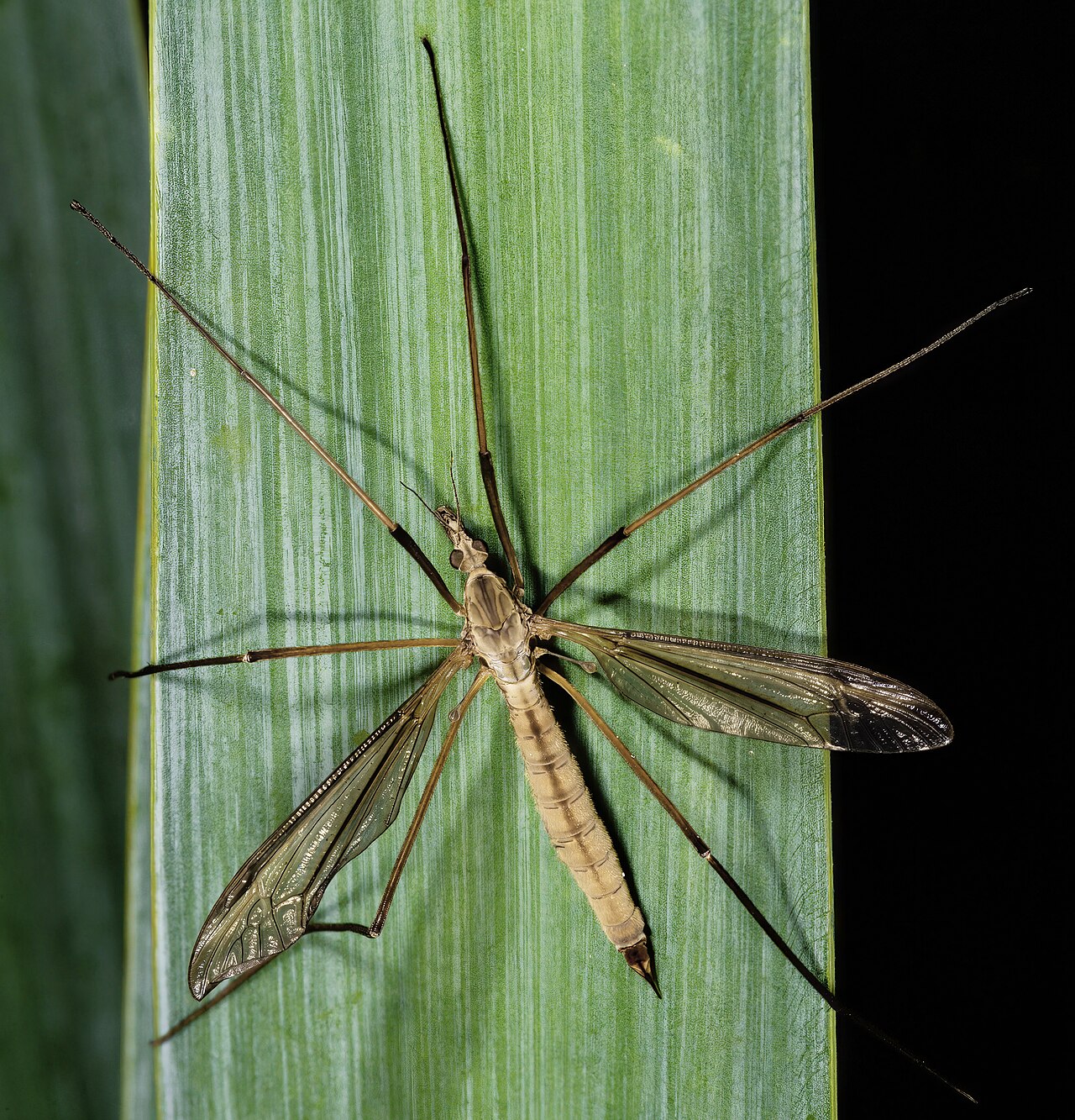
The internet wants to know whether Bnahabra is a wasp or a fly, and the honest answer is both, on purpose. Its weapon is pure Hymenoptera: a true sting is a modified egg-laying tube (ovipositor) that injects venom, the signature of wasps, bees, and ants. But its lifestyle is pure Diptera: carrion-breeding larvae and aerial swarms are fly traits. You could in principle tell the two orders apart on the monster's own body — true flies have one pair of wings plus little gyroscopic stubs called halteres, while wasps have two pairs — but the game never commits, so neither will I. Bnahabra is a designer's composite of "things that bite and sting in a swarm."
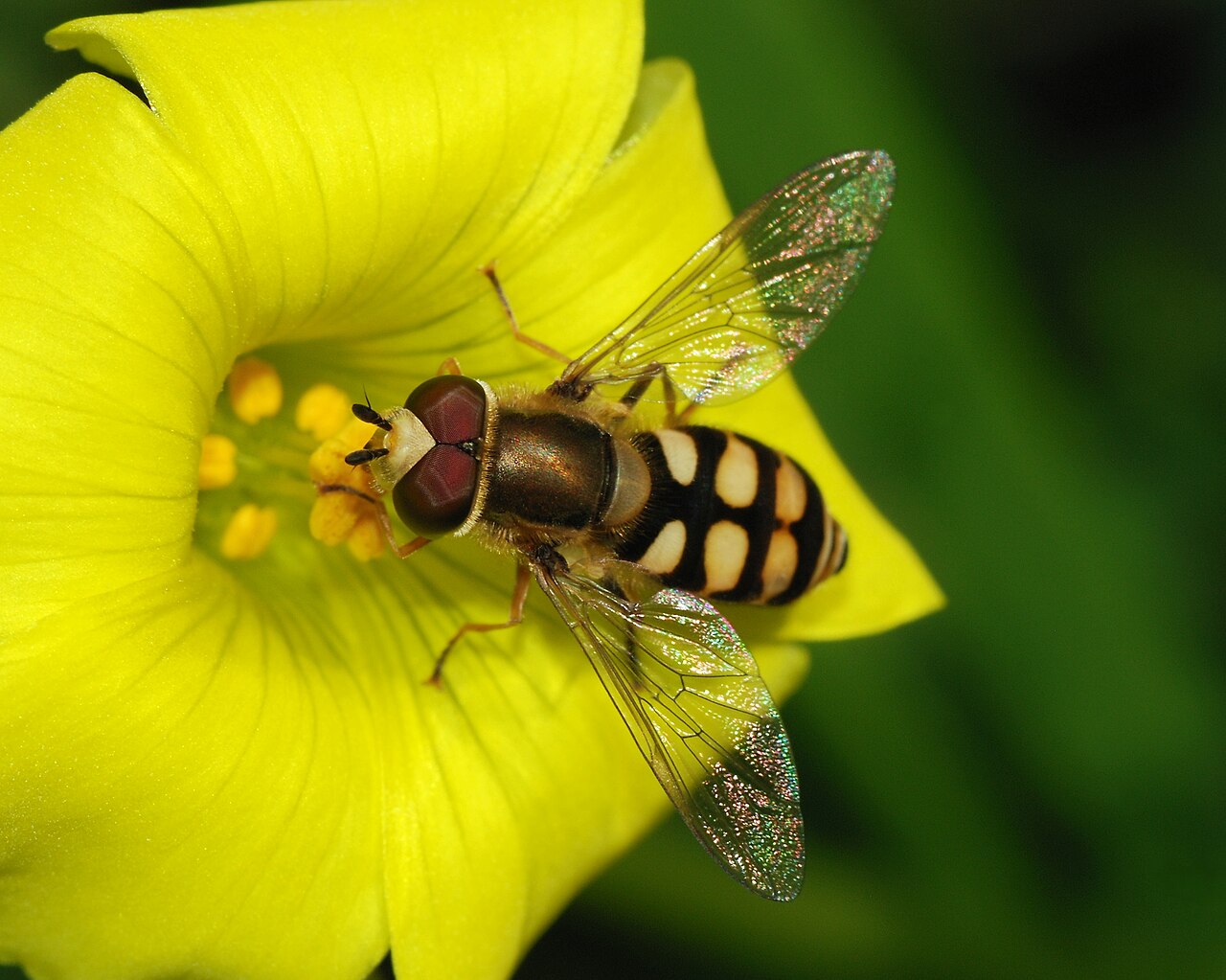
This is also where my mimicry research walks in. A wasp's black-and-yellow is one of the most-copied warning signals on Earth, and its most accomplished copycats are hoverflies (family Syrphidae) — harmless true flies that mimic stinging wasps so well they fool predators, and even buzz at the right pitch (Rashed et al. 2009). A hoverfly is a fly pretending to be a wasp; Bnahabra is a monster that is genuinely unsure which it is. The lineage that contains the planet's best wasp-impersonators is, fittingly, the same one Bnahabra half-belongs to.
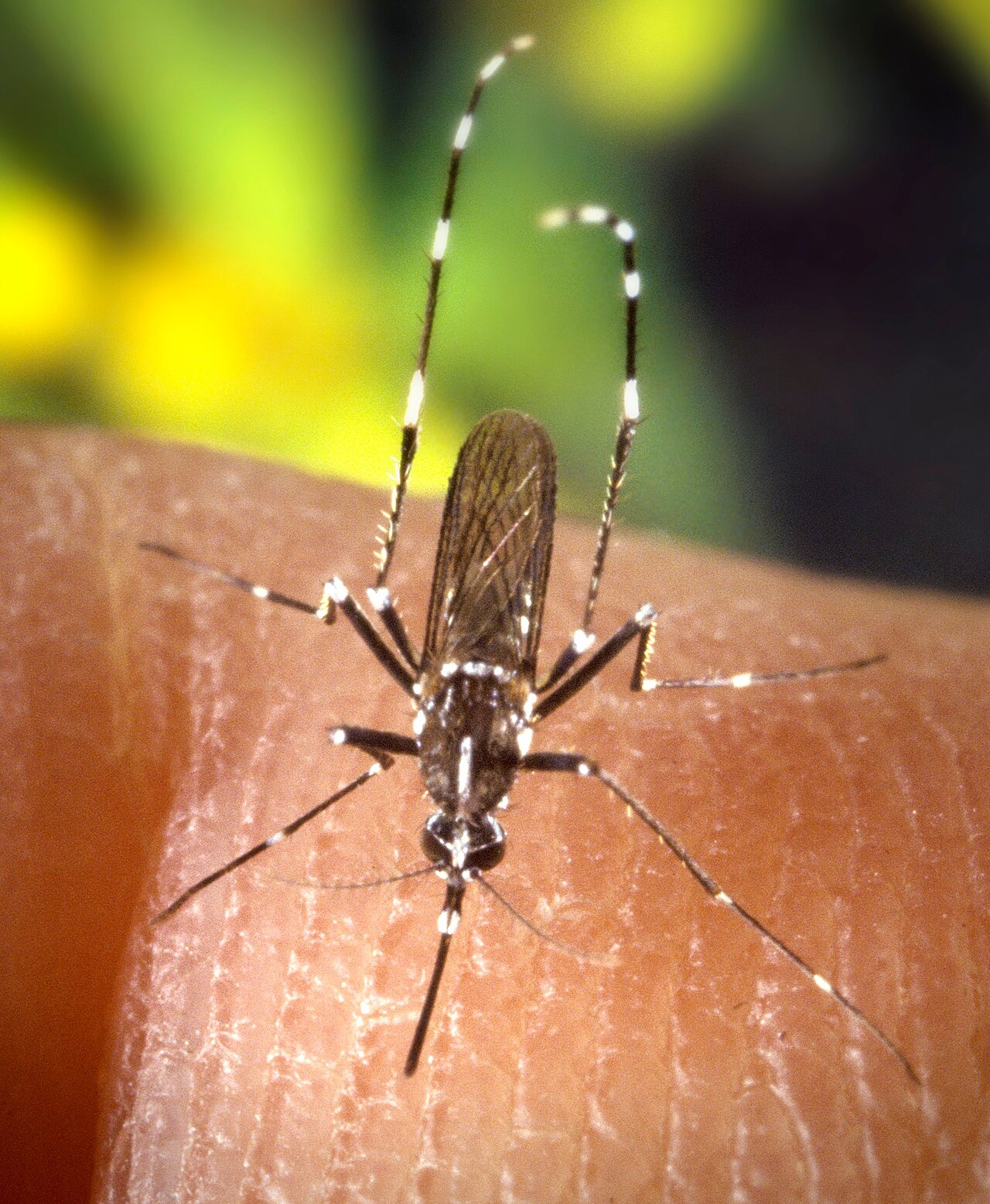
Canon says Bnahabra swarms are led by larger "queens," and here I have to make a precise correction, because "queen" is a loaded word. A queen — in the biological sense, a single reproductive individual supported by sterile workers — means eusociality, and eusociality is a wasp/bee/ant (and termite) phenomenon. It is not something flies do. Real fly swarms — the columns of midges and mosquitoes you see at dusk — are mostly male mating swarms that gather over a landmark and wait for females; nobody is in charge, and there is no caste (Downes 1969). Group living buys them safety by the dilution effect — in a crowd, any one individual is less likely to be the one eaten (Krause & Ruxton 2002) — not by a command structure.
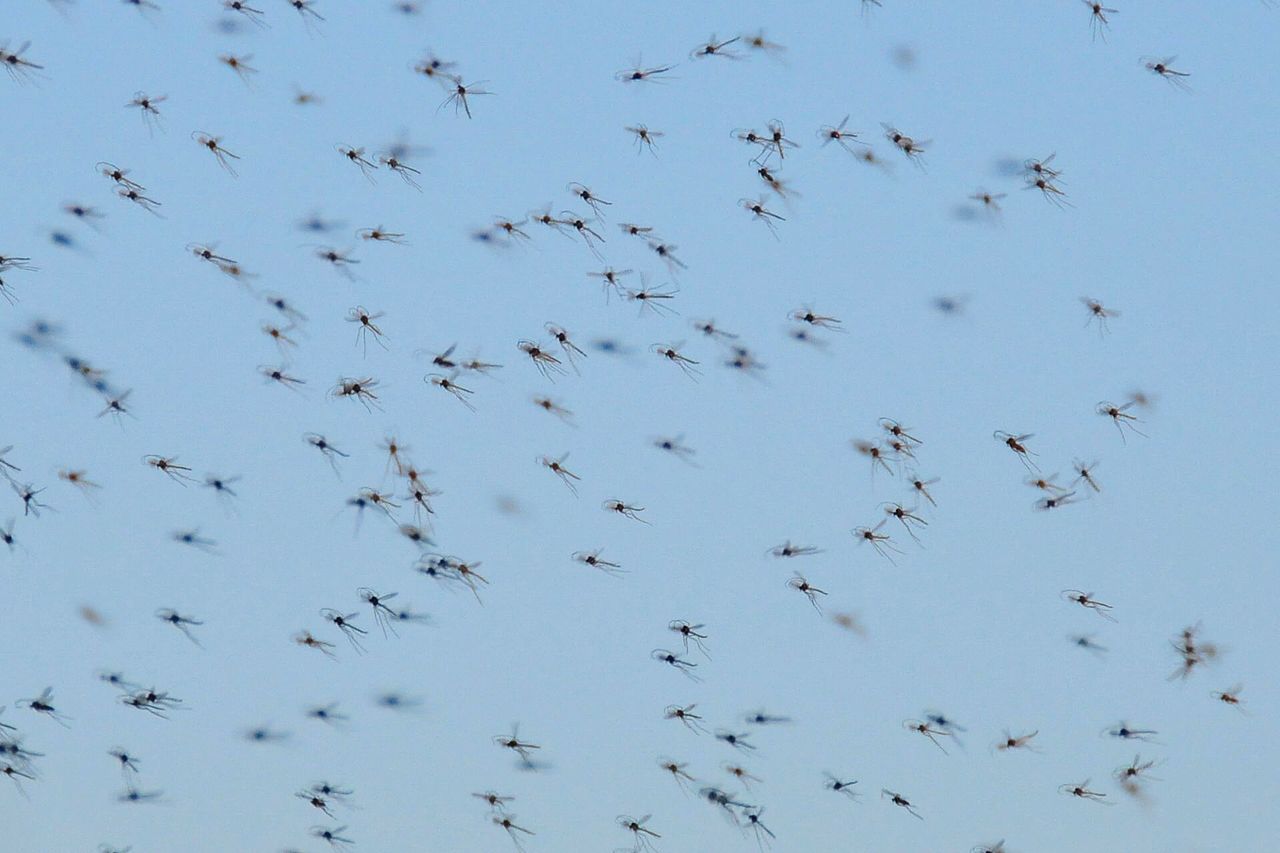
So Bnahabra's "queen-led swarm" is one more chimera: the swarm is fly-like, the queen is borrowed from the wasps. A real Bnahabra "queen" would almost certainly be just a large, egg-heavy female that the swarm orbits — a focal point, not a monarch. I would not call it eusocial without a lot more evidence than "some of them are bigger."
Bnahabra comes in regional colour forms whose corrosive spray matches the local element — red and fiery in the volcano, dull and watery in the desert. Read charitably, that is a fantasy of adaptive radiation: a single lineage diversifying to fill different regional niches, with the phenotype tracking local conditions (Losos 2010). The real version of "colour tracks environment" is genuinely documented and is my home turf — in real insects, darker forms are often favored in colder, higher places (thermal melanism), a true climate cline written in pigment. What real biology does not do is tune a creature's chemistry to "match an element"; colour and physiology track temperature, humidity, and predators, not a Fire-versus-Water typing. The variation is real; the element-matching is the game's.
Explicitly speculative — a hypothesis from known mechanisms, each step with a real precedent.
So four of five steps are ordinary insect evolution; only the element-matched acid and the commanding queen are invented.
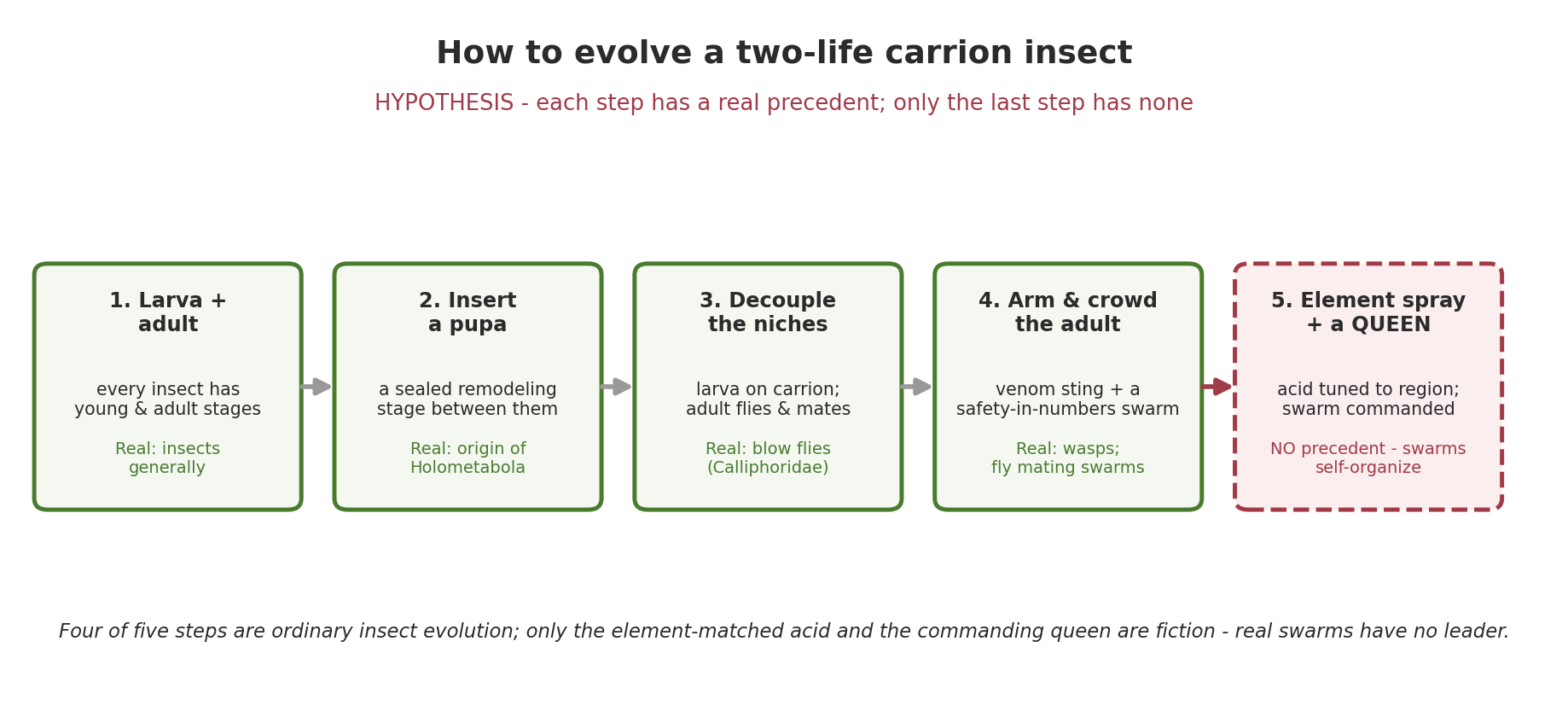
Speculative, each from a general rule in real holometabolous insects.
None of this is in the game. All of it follows from how real two-life insects live.
Built like the earlier figures: original, citable, and explicit about which cells are established biology versus reasoned speculation. The metamorphosis comparison (Figure 1), the carrion-succession schematic (Figure 2), and the evolutionary scenario (Figure 3) are placed inline above, each where the argument needs it.
What Capcom got right — and it is subtler than they probably intended. The throwaway line that Bnahabra's larvae feed on carrion while the adults eat something unknown is a genuinely accurate sketch of complete metamorphosis and of carrion-breeding flies: two lives in one body, the larva recycling the dead, the adult flying off to do something else. The wasp-style sting and the fly-style swarm are each real, too. For a monster designed to be a minor irritant, the biology underneath is unusually sound.
Where they bent it: the corrosive spray that conveniently matches the local element; the "queen" that implies a eusociality flies don't have; and the unstated leap to a pupa. None of these break the creature — they just mark where game design takes over from entomology.
The real cast is everywhere, and worth a second look. The blow fly at a picnic is the pioneer of a recycling crew that keeps the world from filling with carcasses. The hoverfly on a flower is a harmless fly wearing a wasp's warning colours, the same wasp-or-fly ambiguity Bnahabra is built on. The burying beetle in the leaf litter buries a mouse and raises its young on it with a care most insects never show. And a ground beetle in the soil is living its own two lives — larva then adult, joined by a pupa — exactly as Bnahabra does. The monster you swat without thinking is carrying the best idea in the history of insects.
No developer source names a real insect. Bnahabra is a designed chimera: its paralytic sting is a wasp's trait (Hymenoptera), while its carrion-breeding larvae and swarming are fly traits (Diptera). It is a Neopteron, Monster Hunter's true-insect class, and its carrion larva plus winged adult is a good accidental sketch of complete metamorphosis.
Both, on purpose. The sting (a modified ovipositor that injects venom) is pure Hymenoptera; the carrion-breeding larvae and aerial swarms are pure Diptera. True flies have one pair of wings plus halteres and wasps have two pairs, but the game never commits, so the order stays hypothetical.
Because the larva and the adult stop competing. A feeding larva and a dispersing, mating adult can exploit two different worlds — a decoupling, made possible by the pupa, that is the leading explanation for why holometabolous insects make up the great majority of described insect species (Rolff et al. 2019).
Biologically, no. A true queen with sterile workers means eusociality, a wasp/bee/ant/termite phenomenon, not a fly one. Real fly swarms are mostly leaderless male mating swarms (Downes 1969); Bnahabra's larger "queen" would just be a big, egg-heavy female the swarm orbits, not a commander.
Yes. Blow flies (Calliphoridae) are usually the first animals to a fresh corpse, and the maggots' feeding and the microbes they carry genuinely accelerate decay — the basis of forensic entomology (Tomberlin et al. 2011; Benbow et al. 2019). Bnahabra's "decomposition-hastening fluid" is a fantasy version of what real maggots already do.

,_Hartelholz,_M%C3%BAnich,_Alemania,_2020-06-27,_DD_362-380_FS.jpg)

_Tipula_paludosa_on_Iris_leave.jpg)


.jpg)