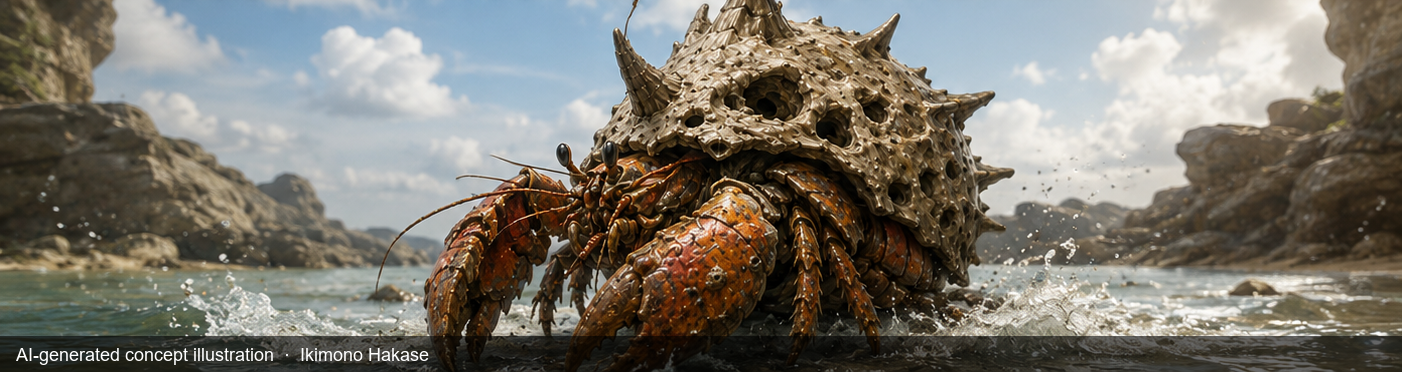
In one sentence: Daimyo Hermitaur (ダイミョウザザミ) is a Carapaceon — Monster Hunter's giant-crustacean class — that debuted in Monster Hunter 2 (2006) and recurs through MH4 Ultimate, Generations Ultimate and Rise: Sunbreak, a hermit-crab-type monster of sandy coasts and deserts that shelters its soft, unarmored hindquarters under a borrowed wyvern skull and uses broad, shield-like claws as both weapon and barricade.
For six monsters this series has worked through insects and spiders. Daimyo Hermitaur is the first crustacean — and it is the one monster in the franchise whose central, signature feature is not a weapon or a venom but a piece of real estate. It does not own its own armor. It wears a dead thing's skull on its back because its own body cannot protect itself, and when it outgrows that skull it goes looking for a bigger one. That is not horror-design or a power fantasy. It is the single most faithful piece of biology Capcom has ever drawn — the hermit crab's housing problem — and it opens onto an animal economy so strange that real hermit crabs run a queue-based housing market, evict each other from their homes, and, right now, are moving into our garbage. Let me take it apart, and then do the two things a wiki won't: reason out how such an animal could evolve, and predict what it would do when no hunter is watching.
Tagging each claim by how solid it is.
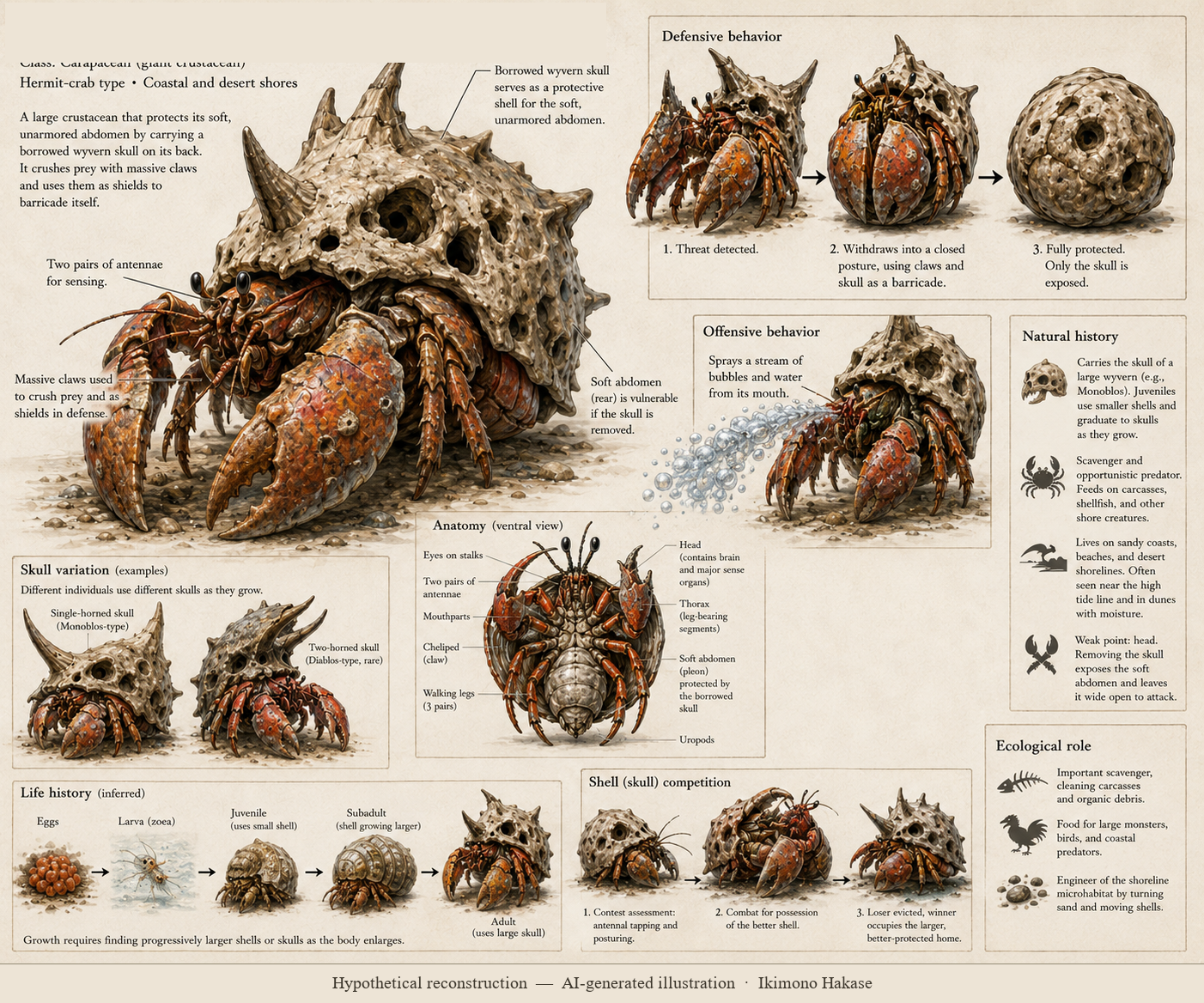
Canon. Daimyo Hermitaur is a Carapaceon — Monster Hunter's class for large crustacean-like monsters — and this is hard canon: the in-game bestiary opens "A large carapacean…," and Kiranico, the Fandom wiki and Gamer Guides all file it there. It debuted in Monster Hunter 2 (2006) and returned through Monster Hunter 4 Ultimate, Generations Ultimate, and Rise: Sunbreak. Its defining trait is canon and biologically pointed: its hindquarters are soft and unarmored, so it carries a borrowed skull on its back as a shell, and it wields two broad claws it uses both to crush prey and, held up like shields, to barricade itself. When threatened it withdraws into a closed defensive posture; the canonical weak point is the head, and breaking off the shell exposes the soft rear as a high-value target afterward. Its one ranged attack is a stream of bubbles/water it sprays from its mouth — note that, unlike the spider monster Nerscylla, it has no venom, no paralysis, and no mimicry in canon.
Canon, but read carefully — what is the skull? The official Hunter's Notes use only generic wording: MH4U calls it "the massive monster skull it wears on its back," and the later titles say "These creatures wear wyvern skulls on their backs, unlike the shells carried in their infancy." (That last clause matters — it means the lore itself describes a juvenile that wears a smaller shell and graduates to a skull on maturing.) The popular specific identification — that it is a Monoblos skull — is fan-wiki and visual reading, not a line in the in-game text: the skull is single-horned, matching the one-horned Monoblos, and the rare Plum Daimyo Hermitaur pointedly wears a two-horned Diablos skull instead, which is why the base form's skull "reads as" Monoblos. So: a borrowed wyvern skull is canon; "Monoblos specifically" is well-grounded wiki interpretation, and I'll flag it as such.
Where the design is stylization (so I won't overclaim). A real hermit crab's borrowed home is an empty gastropod (snail) shell, never a vertebrate skull or bone — the skull is Capcom's fiction, and a striking one. And the often-repeated "the soft rear houses its vital organs" is not stated canon (the lore actually attributes pearl-formation and an excretory function to the abdomen, and a separate crafting item, "Carapaceon Brains," puts the brain in the head); it is imported from real biology, and even there it is imprecise, as we'll see. Finally: do not confuse Daimyo Hermitaur (broad, heavy claws, sandy coasts) with its blade-clawed cave-dwelling cousin Shogun Ceanataur, the other hermit-crab Carapaceon.
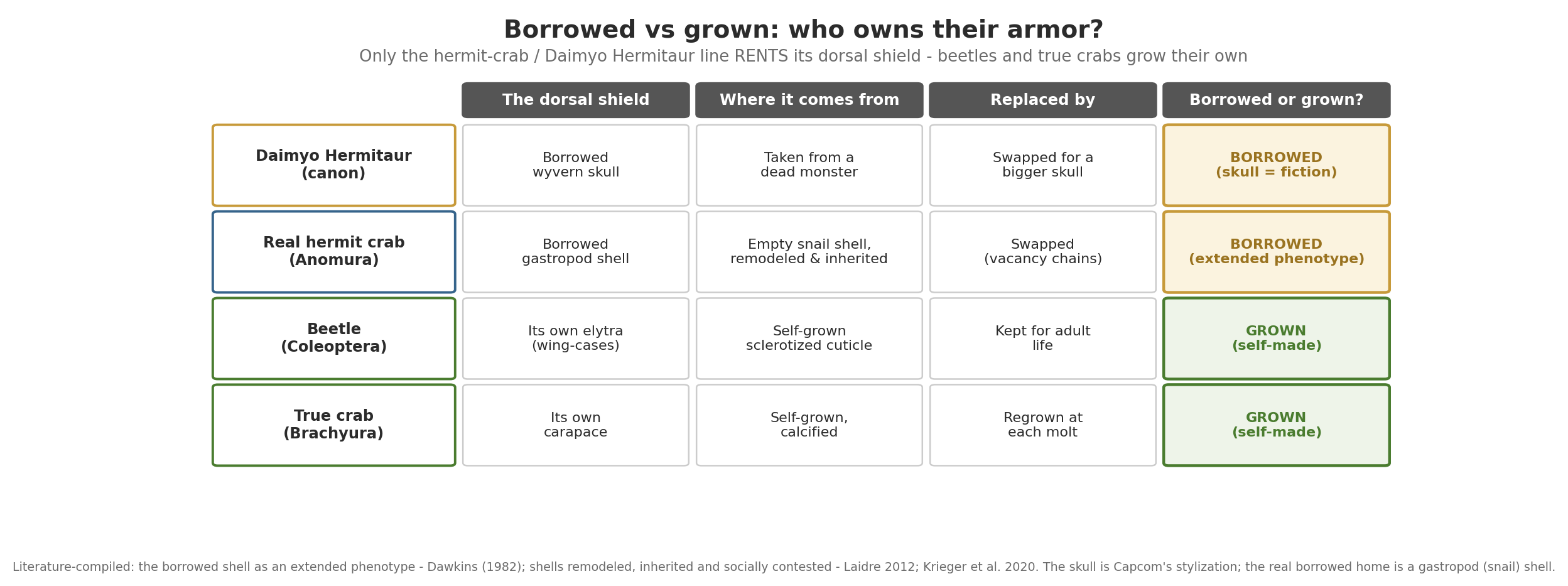
My field is the evolution of animal coloration and mimicry, and predator–prey ecology — the boundaries between hiding, lying, and defending. The hermit crab is a perfect foil. It faces the problem so many armored animals solve — protect a soft back — and solves it the opposite way: not by growing armor, but by renting it. (A beetle's hard wing-cases are the textbook grown version; the hermit crab is the borrowed one.) That distinction, grown versus borrowed, opens three things squarely in my field: the extended phenotype (a defensive structure that is not part of your body at all); borrowed defense (the crab that glues stinging anemones onto its shell — an animal acquiring a defense it did not evolve, right next door to the warning-colour and mimicry systems I study); and contest assessment (how two animals fight over a home and decide who wins). And it lets me correct a category error fans keep making: this is not the same thing as Nerscylla wearing its prey's skin. One is camouflage. The other is housing. They are not the same phenomenon, and the difference is the whole point.
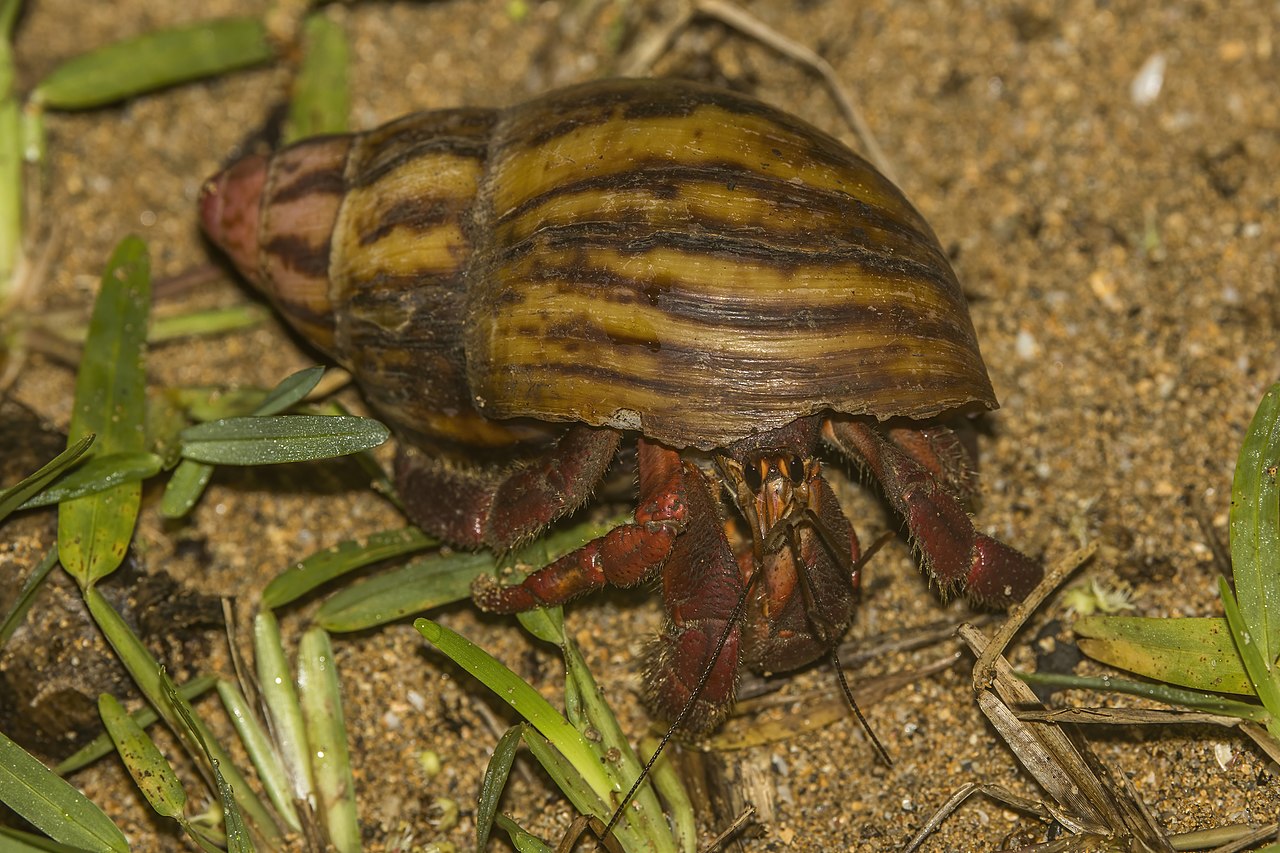
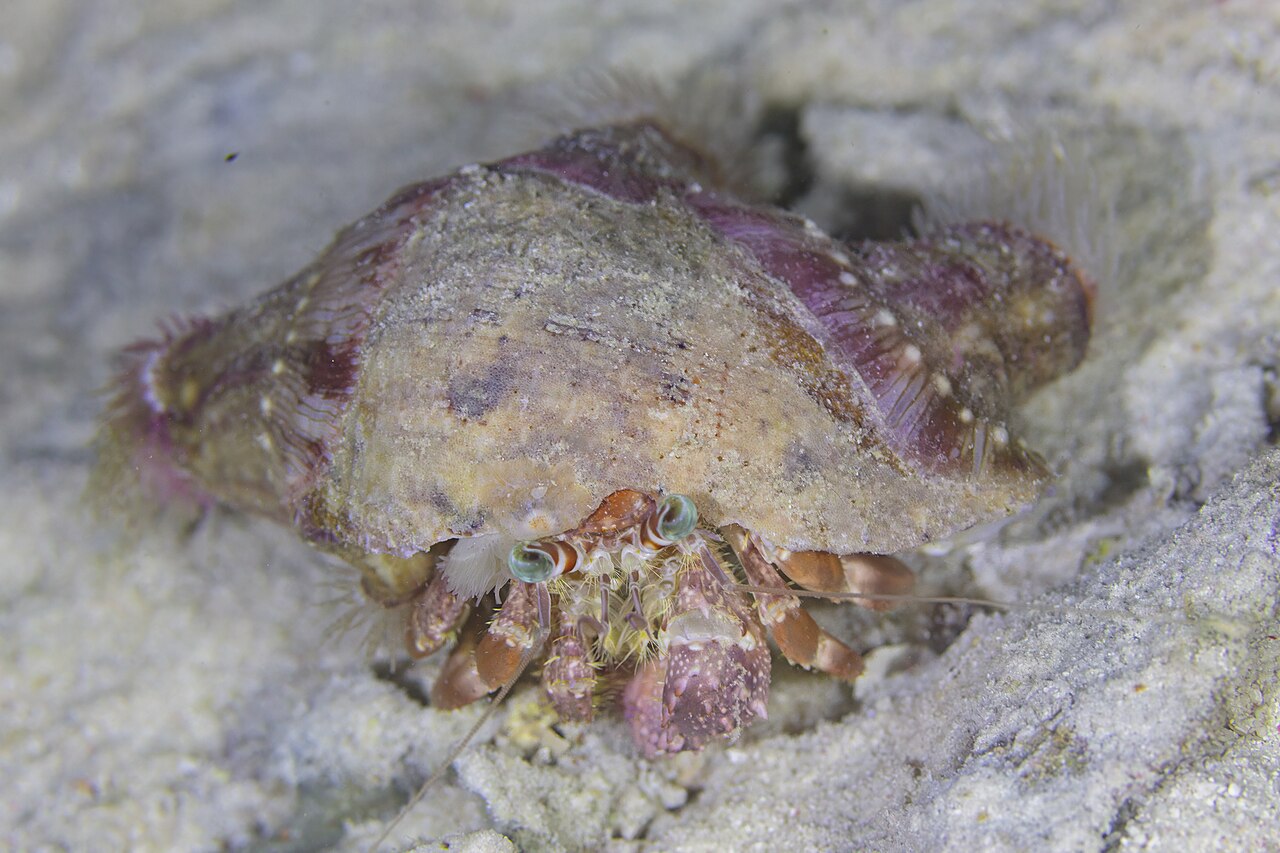
Start with the body. A hermit crab is a true crustacean — order Decapoda, ten legs, two pairs of antennae — but it is not a true crab. True crabs are Brachyura; hermit crabs are Anomura, the sister group. A true crab's whole back is a hard, calcified carapace it grows itself. A hermit crab's abdomen is soft, un-calcified, and coiled asymmetrically to the right — defenseless. So it does the only thing it can: it backs that vulnerable abdomen into an empty snail shell and carries it everywhere. (This is why "Daimyo Hermitaur" and its Japanese name Zazami both encode "hermit crab.")
That borrowed shell is a textbook extended phenotype — Richard Dawkins used the hermit crab's shell as one of his own examples (Dawkins 1982): a structure that does the job of a body part while being no part of the body at all. And it is not passive furniture. Mark Laidre's work on the Pacific land hermit crab Coenobita compressus shows the crabs remodel the interior of their shells — hollowing and enlarging them — and that these improved shells are so valuable they are effectively inherited down a line of occupants, so the crabs become socially dependent on one another to obtain them (Laidre 2012; Krieger, Hörnig & Laidre 2020). The shell is real estate, renovated and handed down.
This is the cleanest mirror in nature to a monster whose "armor" is an external object that grows obsolete as the body grows. A beetle grows its wing-cases once and they are permanently its own; a hermit crab's shield is detachable, swappable, and never truly owned. The wyvern skull is the fiction (the real home is a snail shell); the renting is the truth.
One honest caveat, because precision is the brand: the textbooks' line that hermit crabs are "obligately" tied to gastropod shells is a strong tendency, not an absolute law. A few lineages shelter in wood and bamboo cavities (Xylopagurus), in polychaete-worm tubes (Discorsopagurus), or in coral (Paguritta). The soft abdomen forces the need for shelter; a snail shell is merely the usual answer.
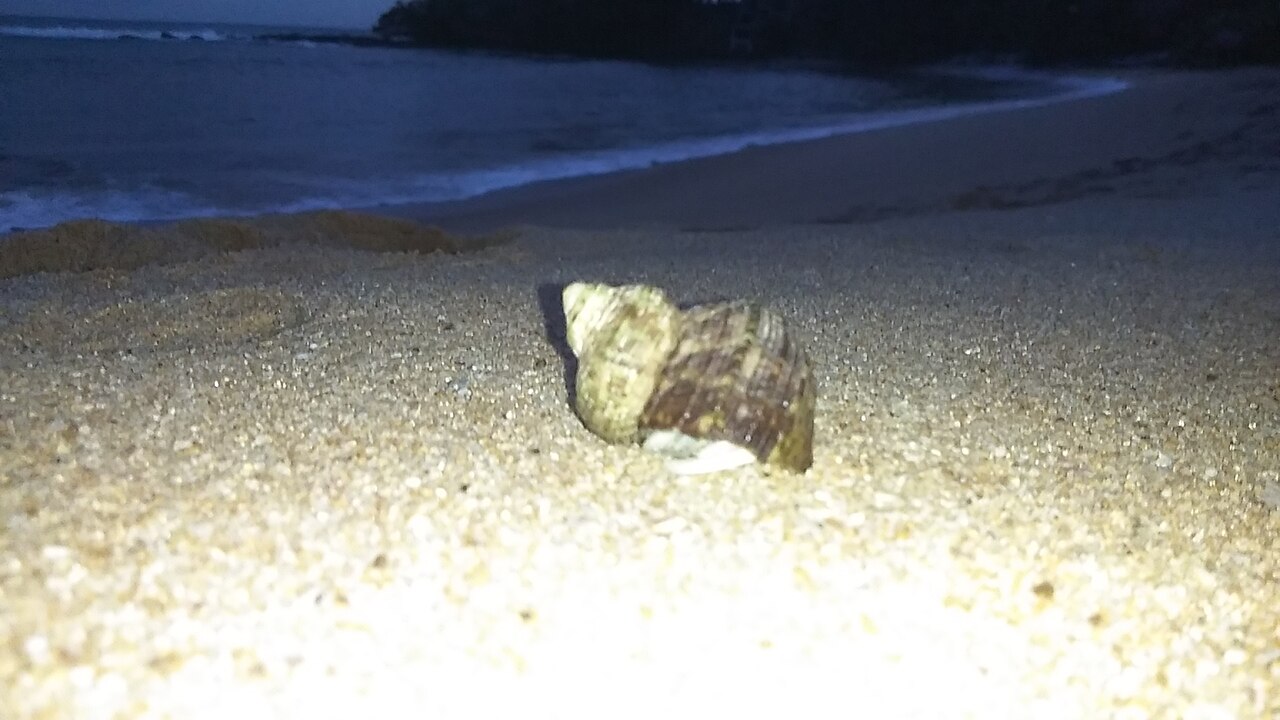
Here is the part that should genuinely surprise you, and the part no game-guide or lore-wiki touches. Empty shells of the right size are scarce, so a shell is a limiting resource — the thing that caps how big a crab can grow and whether it can breed. And when a single new, larger shell turns up, hermit crabs do not scramble for it at random. They line up.
Randi Rotjan, Jeffrey Chabot and Sara Lewis documented it in the Caribbean land hermit crab Coenobita clypeatus (Rotjan, Chabot & Lewis 2010): crabs queue by body size beside a vacancy and swap shells in sequence — the biggest takes the new shell, the next-biggest takes the home the biggest just vacated, and so on. Economists have a name for this, because human housing and job markets do the same thing: a vacancy chain. The crabs even wait beside a too-big shell for a bigger crab to arrive, and small crabs piggyback, riding a larger crab's shell so they're in position when the swap fires. A whole chain can rehouse a dozen animals in seconds, and it moves more crabs into better-fitting homes than random scrambling would (Lewis & Rotjan 2009; the framework is Chase 1988).
So the solitary-looking armored brawler you fight in the sand is, in real life, a participant in a resource economy — one that queues, waits, and trades. A real Daimyo Hermitaur "upgrading" from its juvenile shell to a wyvern skull is just the single most dramatic step of a chain every hermit crab spends its life running.
Shells aren't only found empty; they are also taken. In the European hermit crab Pagurus bernhardus, an attacker grips the defender and performs shell rapping — rhythmically slamming its own shell against the defender's in bouts — until the defender evacuates or the attacker gives up (Briffa, Elwood & Dick 1998). The outcome turns on assessment: each crab gathers information about the other's strength and the value of the shell at stake (Elwood & Neil 1992), and the decision is even tied to neurochemistry — attackers run higher on serotonin (Briffa & Elwood 2007).
And there's a beautiful match to the monster's signature pose. Many hermit crabs have one enlarged major claw that, when the animal withdraws, plugs the shell's opening like a door — an operculum. That is almost exactly Daimyo Hermitaur's canonical move: pull under the shell, raise the great claws as shields, become a sealed box. (The in-game Sonic Bomb to break the seal is the closest a video game gets to a real predator's problem of a crab that has bolted its own front door.)
Some hermit crabs go further and upgrade their borrowed home with a borrowed weapon. Dardanus crabs deliberately collect living sea anemones (Calliactis) and transplant them onto their shells; the anemones' stinging cells deter predators — Ross's classic experiments showed they specifically protect the crab from octopus attack — and the anemone gets transport and food scraps in return (Ross 1971; Ross & Sutton 1961). The crab carries its anemones over to each new shell when it relocates (Williams & McDermott 2004). It is the closest thing in nature to an animal that wears another animal's weapons.
This is where I have to stop a common fan claim. It is tempting to file Daimyo Hermitaur next to Nerscylla — "monsters that wear other things" — but they are doing opposite biology. Nerscylla wears its prey's flayed skin for masquerade: to be misread. The hermit crab's shell (and its anemones) is armor and a home — protective equipment, never camouflage. Masquerade is about deceiving an eye; the shell is about stopping a tooth. I'll say it the careful way: this is analogy, convergent function, not a shared evolutionary mechanism.
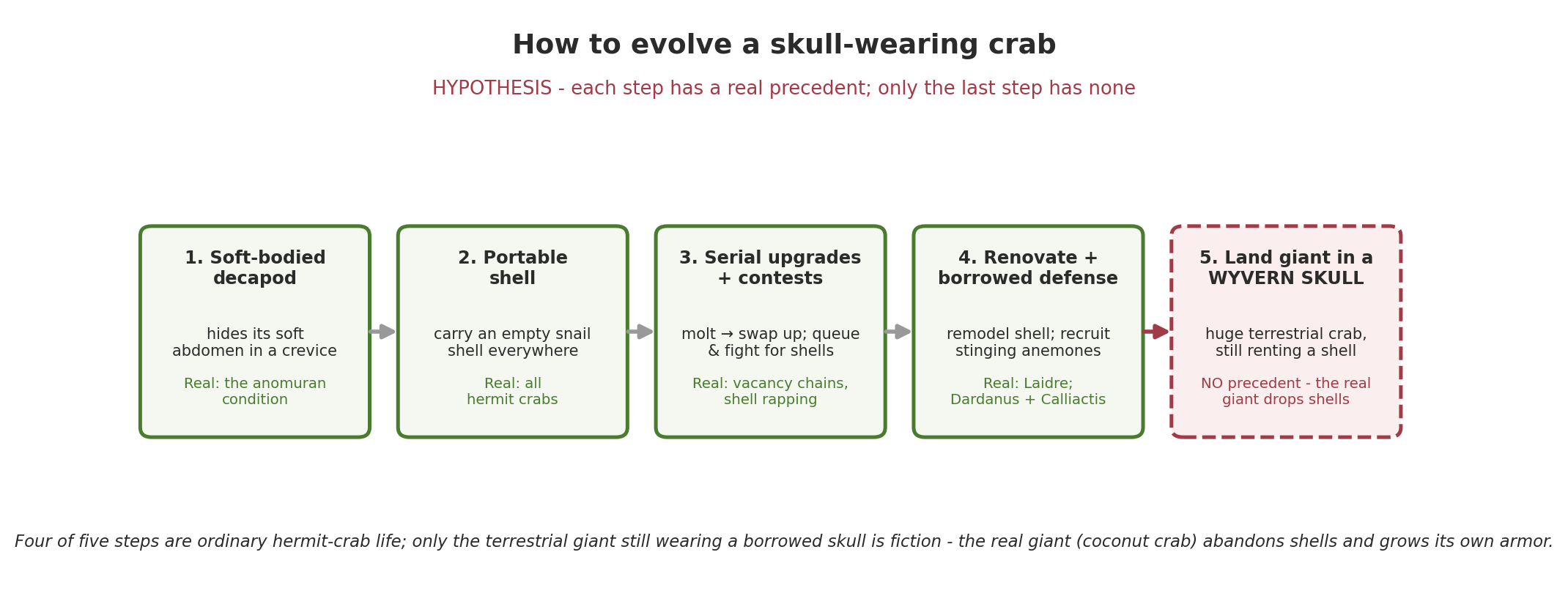
Explicitly speculative — a hypothesis assembled from known mechanisms, each step with a living precedent.
So four of five steps are ordinary hermit-crab life. Only the terrestrial colossus in a vertebrate skull is invented. Tellingly, the design even gets the ontogeny right: the lore's juvenile-in-a-small-shell growing into an adult-in-a-skull is precisely the serial upgrade every real hermit crab performs.
None of this is in the game. All of it is how real hermit crabs live.
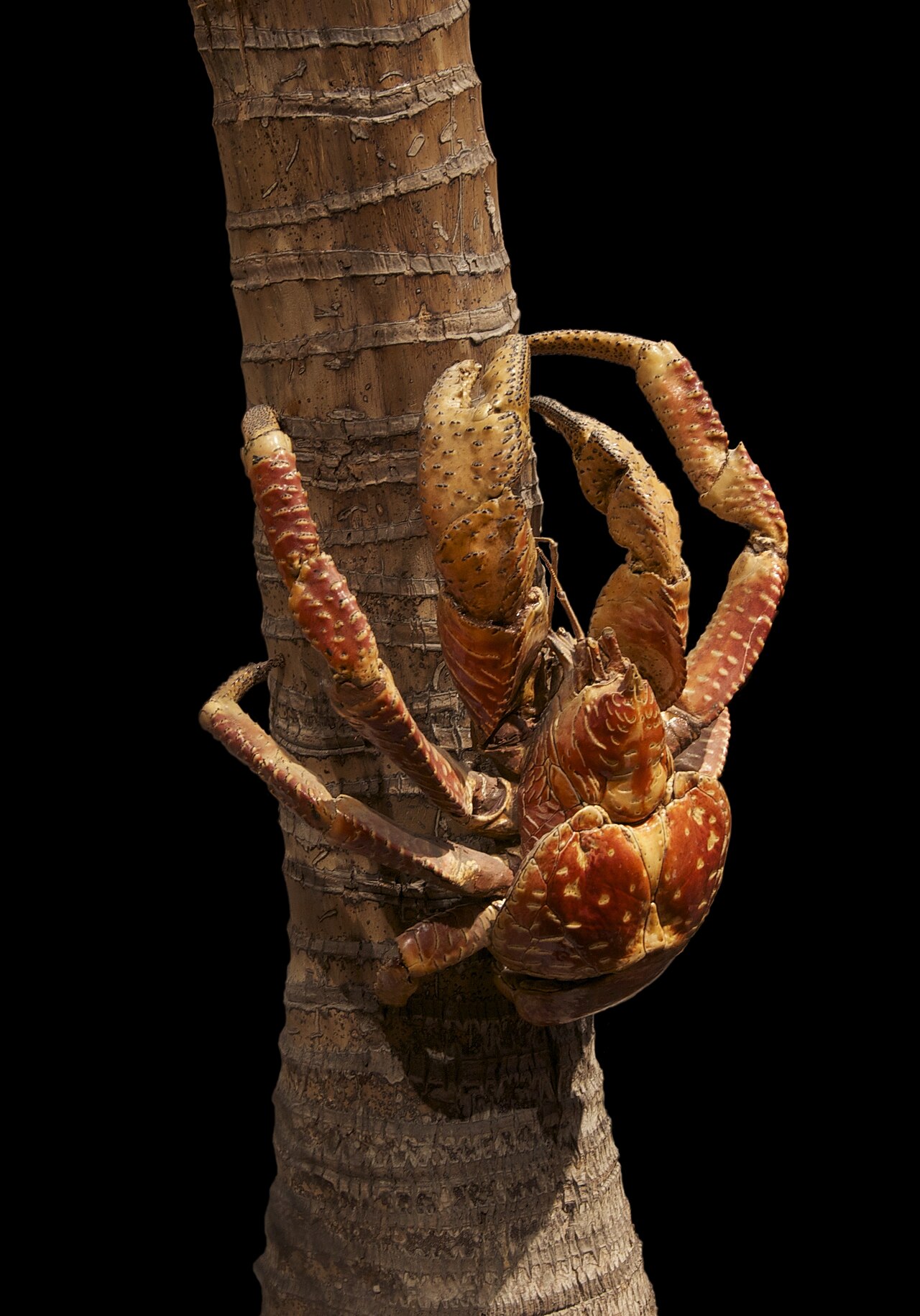
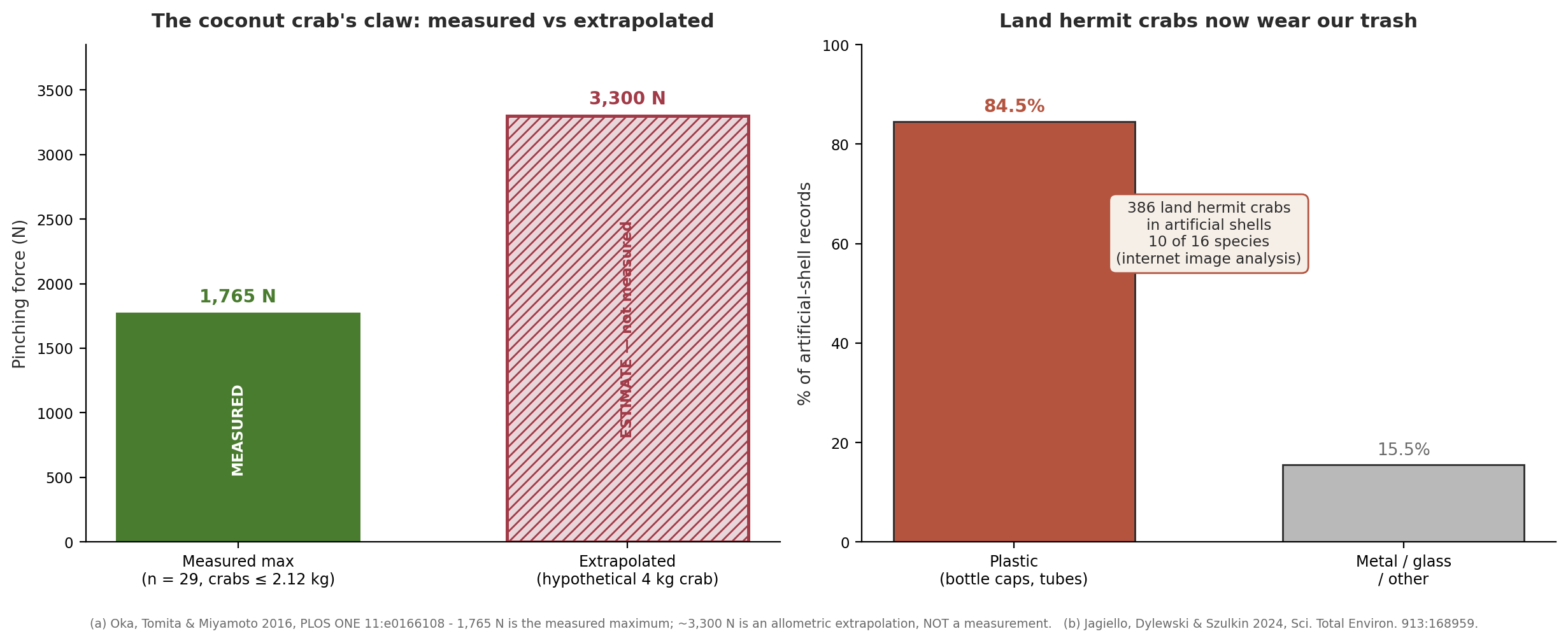
First, the giant. The coconut crab (Birgus latro) is a land hermit crab and the largest terrestrial arthropod alive — up to roughly a metre across the legs. It is the answer to "what happens when a hermit crab gets huge": only juveniles carry salvaged shells, and on maturing it hardens its own abdomen and abandons shell-wearing for good. Its claw is the most powerful pinch measured in any land animal — and the famous number is usually quoted wrong. Oka and colleagues actually measured a maximum of 1,765 N across 29 wild crabs (the largest a 2.12 kg animal); the widely repeated ~3,300 N is an extrapolation to a hypothetical 4 kg crab, not a measurement (Oka, Tomita & Miyamoto 2016).
Second, the headline. As natural shells grow scarce and plastic accumulates on tropical coasts, terrestrial hermit crabs are increasingly wearing our garbage. Using internet photographs as data, Jagiello, Dylewski and Szulkin documented 386 land hermit crabs in artificial shells — about 85% plastic — across 10 of the world's 16 land species, on every tropical coast (Jagiello, Dylewski & Szulkin 2024). An extended phenotype, rewritten by pollution.
What Capcom got right — and this is the most biologically faithful monster I have graded. The whole premise is real hermit-crab biology, drawn accurately: a crustacean with a soft, unarmored rear that must shelter in a borrowed hard shell; a juvenile that upgrades on maturing; a major claw raised as a shield and used to seal the shell; a vulnerable body the instant the shell comes off. They even put it, in fiction, in the correct real lineage (Anomura). The liberties are the wyvern skull rather than a snail shell, the land-giant scale, and the fan-imported "organs in the rear."
Where they bent it: the borrowed home is really a gastropod shell, not bone; a real hermit crab this huge and terrestrial (the coconut crab) gives shells up rather than scaling them up; and the soft abdomen holds the digestive gland and gonads, not the heart and brain.
The real cast is easy to meet, and stranger than the monster. The hermit crab in a Caribbean tide-pool is running a housing market. The Dardanus crab on a reef carries stinging anemones it recruited as bodyguards. The coconut crab is the giant that gave up renting and grew its own armor. And on a beach somewhere right now, a hermit crab is backing into a plastic bottle cap because the snail shells have run out. A beetle grows its armor and keeps it; the hermit crab rents, renovates, fights over, inherits, and — increasingly — improvises its home from our trash. That is the real story behind the crab in the skull.
A hermit crab. It is a Carapaceon (Monster Hunter's crustacean class) and its in-fiction taxonomy places it in Anomura, the real hermit-crab group. The soft hindquarters and borrowed shell are accurate; the wyvern skull is the fiction (real hermit crabs use empty snail shells).
No. Hermit crabs are Anomura, the sister group to true crabs (Brachyura). Their abdomen is soft, un-calcified and coiled, which is why they must shelter it in a borrowed shell.
Yes — a vacancy chain. When a larger shell appears, hermit crabs queue by body size and swap in sequence, even waiting and piggybacking, so a chain can rehouse many crabs in seconds (Rotjan, Chabot & Lewis 2010).
The measured maximum is 1,765 N across 29 wild crabs (Oka et al. 2016). The widely quoted ~3,300 N is an extrapolation to a hypothetical 4 kg crab, not a measurement.
Yes. Researchers documented 386 land hermit crabs in artificial shells — about 85% plastic — across 10 of the 16 land species (Jagiello, Dylewski & Szulkin 2024).
_shell_Giant_East_African_snail_(Archachatina_marginata)_Principe.jpg)

,_Zanz%C3%ADbar,_Tanzania,_2024-06-01,_DD_148.jpg)
.jpg)