In one sentence: Konchu is a small, hard-shelled Neopteron (Monster Hunter's insectoid class) found across nearly every habitat from steppe to volcano, which defends itself by curling its armored carapace into a tight ball and rolling — bowling — into threats, leaving only its soft underside vulnerable when flipped.
Most of the monsters in this series are chimeras of anatomy — a beetle spliced with an anglerfish, a spider given a stinger. Konchu is a chimera of behavior. It has the body of an insect and performs the single most famous trick of an animal that is not an insect: it rolls into a sealed armored ball, the way a roly-poly does. And here is the thing most people get wrong, the thing that makes this little monster worth an essay — a roly-poly is not a bug either. It is a crustacean, a relative of crabs and shrimp. Capcom, to their credit, figured this out and quietly reclassified Konchu accordingly. So this is the rare case where the video game is more taxonomically honest than your childhood. Let me take it apart, trace the sealed ball across half a billion years and six unrelated lineages, and then do the two things a wiki won't: reason out how such an animal could evolve, and predict what it would do when no hunter is watching.
Tagging each claim by how solid it is.
Canon. Konchu (コンチュウ, from 昆虫, "insect") is a Neopteron — Monster Hunter's insectoid class, the same class as Vespoid and Seltas. It is small, common, and low on the food chain, and its whole identity is one behavior: it curls its hard dorsal carapace into a tight ball and uses that ball both to shield its soft underside and to roll/"bowl" into hunters at speed — defense and attack in one move. Knock it around and it tumbles like a ball; flip it and the soft belly is exposed. Unusually for a small Neopteron, its shell (the carvable "Konchu Shell") is prized rather than shattering on death. The lore describes a scavenger of the undergrowth that travels in groups, and a shell whose colour shifts with habitat — greenish-yellow in humid country, paler in arid zones, bluish in the cold, deep red on volcanic ground. It debuted in Monster Hunter 4 (2013) and recurs through MH4 Ultimate, Generations / Generations Ultimate, the Stories spin-offs, and the latest title, Monster Hunter Wilds.
Canon, and a gift to a biologist. In the Monster Hunter Stories spin-offs, Capcom reclassified Konchu out of the insect class (Neopteron) and into its crustacean class, Carapaceon — the same class as the hermit-crab monster Daimyo Hermitaur — on the stated logic that it is modeled on woodlice, and woodlice are crustaceans. That is exactly the correction this article is built around, made canon by the developers themselves. (Even in its base design the game gives Konchu eight legs — four pairs — already one pair too many to be a real insect.)
What is inference, not stated. No developer interview names a real species, so "based on a pill bug" is a well-founded reading of its shape and behavior, not a sourced design citation — I'll treat all the real biology as analogy. The "glow impossible to describe" on its shell is flavor text, not a claim of real bioluminescence. And the detailed ecology (diet, the exact colour-by-habitat list) comes largely from fan-written ecology pages, so I'll lean on the behavior that is solid — the rolling ball — and flag the rest. (Don't confuse Konchu with Seltas, the larger rhinoceros-beetle Neopteron introduced in the same game and covered earlier in this series.)
This monster lands on three things I actually work on. First, coloration: a shell that is green in the wet, pale in the desert, and dark in the cold is not random — it is a climate cline, the kind of rule (darker and more pigmented in warm, humid places) that I spend my research life testing in real animals. Second, predator–prey: a sealed ball is a piece of anti-predator geometry — present armor, hide the soft parts — and the most interesting thing about any armor is the predator that evolves to defeat it, which is squarely my field. And third, beetles: almost no beetle can do this — but exactly one lineage of true beetles can, and that contrast is the most honest way to grade what Capcom drew. So I get to do coloration, an arms race, and a beetle correction in one small rolling package.
Curling into a sealed sphere has a name — conglobation, or volvation — and its defining feature is that the hard outer plates meet and lock, so only armor is exposed and the soft underside, gut, and legs are sealed inside. The remarkable thing is how many times, and in how many unrelated lineages, evolution has invented it:
A 2023 study put numbers on the convergence: trilobites, pill millipedes and terrestrial isopods independently evolved the same underside engineering — sternites that dip ventrally, an arthrodial-membrane arrangement — to pull off a tight, sealed enrollment despite being only distantly related (Losso et al. 2023). The same solution, found again and again.
Which is why Konchu is a chimera of behavior. Its body is an insect's; its signature move is an isopod's, a millipede's, a trilobite's. And, as noted, the developers agreed and moved it into the crustacean class. The monster is built on real convergent evolution — it just stacks the body of one lineage onto the famous trick of several others.
This is the section the search engines want, because almost everyone gets it wrong. Here is the honest version.
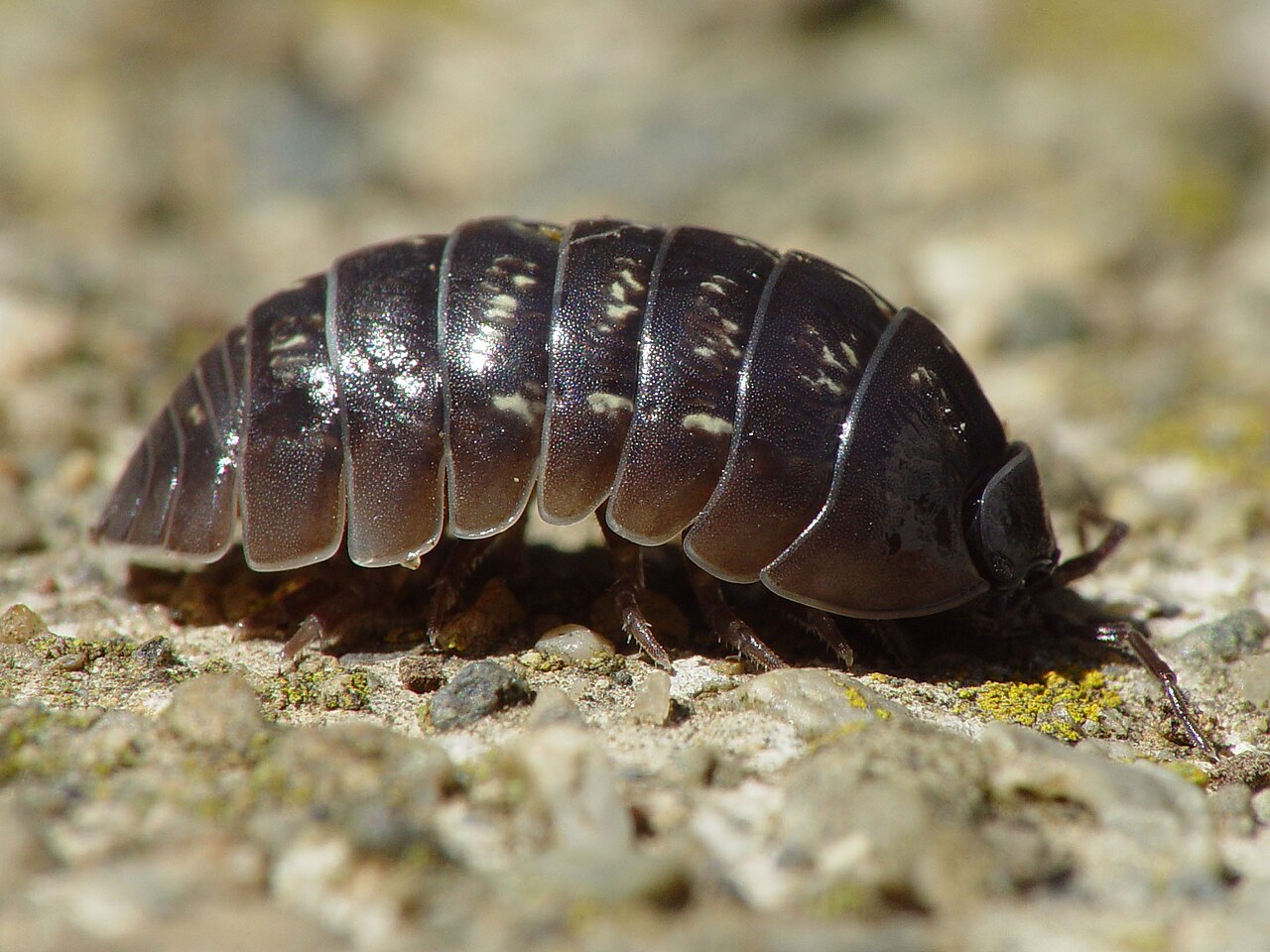
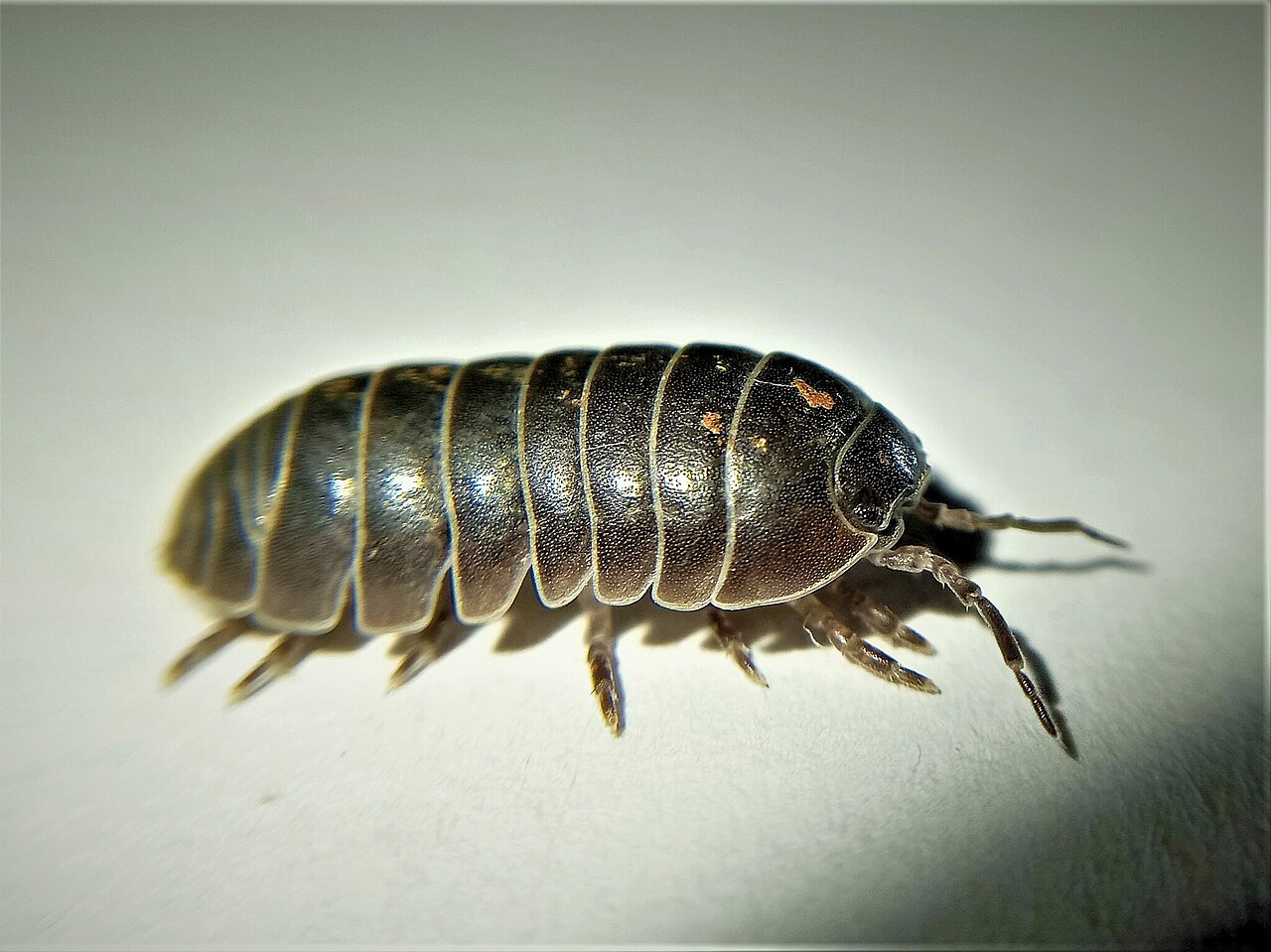
A pill bug is a crustacean, not an insect. The roly-poly under your flowerpot is a terrestrial isopod (order Isopoda), in the class Malacostraca with crabs, shrimp and lobsters. Count the legs: it has seven pairs (fourteen legs), where every insect has exactly three pairs (six). It breathes through modified gill-like structures (pleopodal "lungs"), which is why it needs damp places. It is, functionally, a crab that moved onto land — and it is the reason Capcom's "Carapaceon" reclassification of Konchu is correct.
A pill bug and a pill millipede are not the same animal. They make near-identical balls but are not close relatives — a textbook case of convergence. Tell them apart by the legs: the isopod has two legs per segment; the pill millipede has the millipede signature, two pairs per body ring, so it carries far more. One is a crustacean, the other a myriapod.
Rolling a ball of dung is not the same as rolling yourself up. A dung beetle rolls an external object; conglobation is folding your own body into armor. Don't let "beetle that rolls a ball" and "animal that rolls into a ball" blur together — they are completely different behaviors.
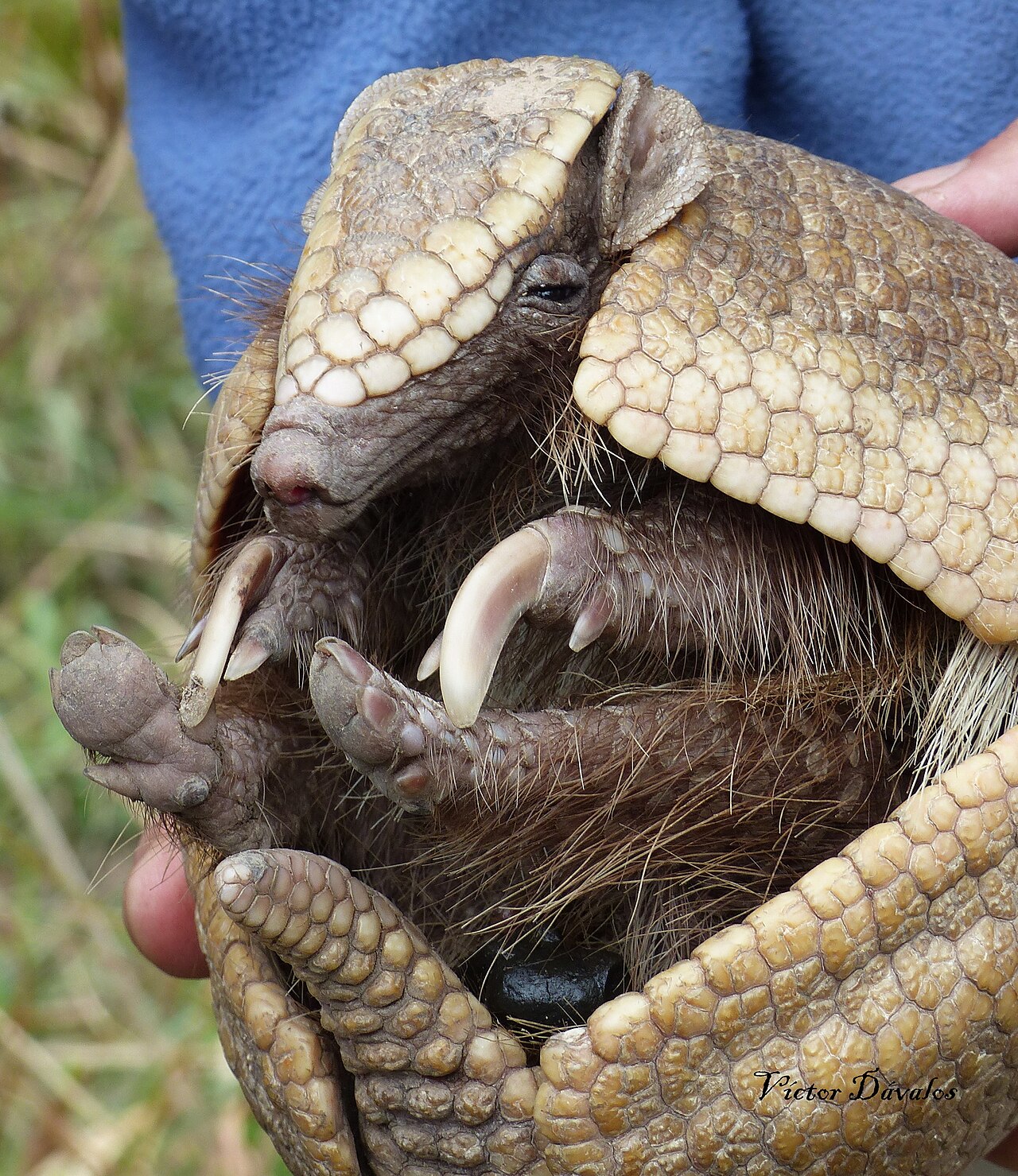
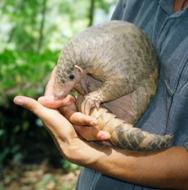
Most armored mammals can't actually seal up. Among the ~20 armadillo species, only the three-banded armadillo (Tolypeutes) can close into a fully sealed ball — its shell plates are loose enough that head and tail shields snap flush, making a sphere a jaguar often can't open. Pangolins roll up too (their name comes from the Malay pengguling, "one that rolls up"), using overlapping keratin scales. A hedgehog, famously, only curls and raises spines — it does not form a sealed sphere. So the "rolls into a ball" club is more exclusive than cartoons suggest.
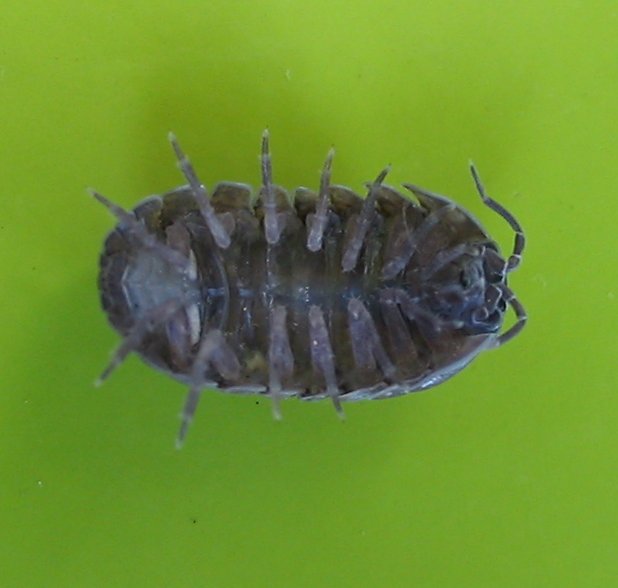
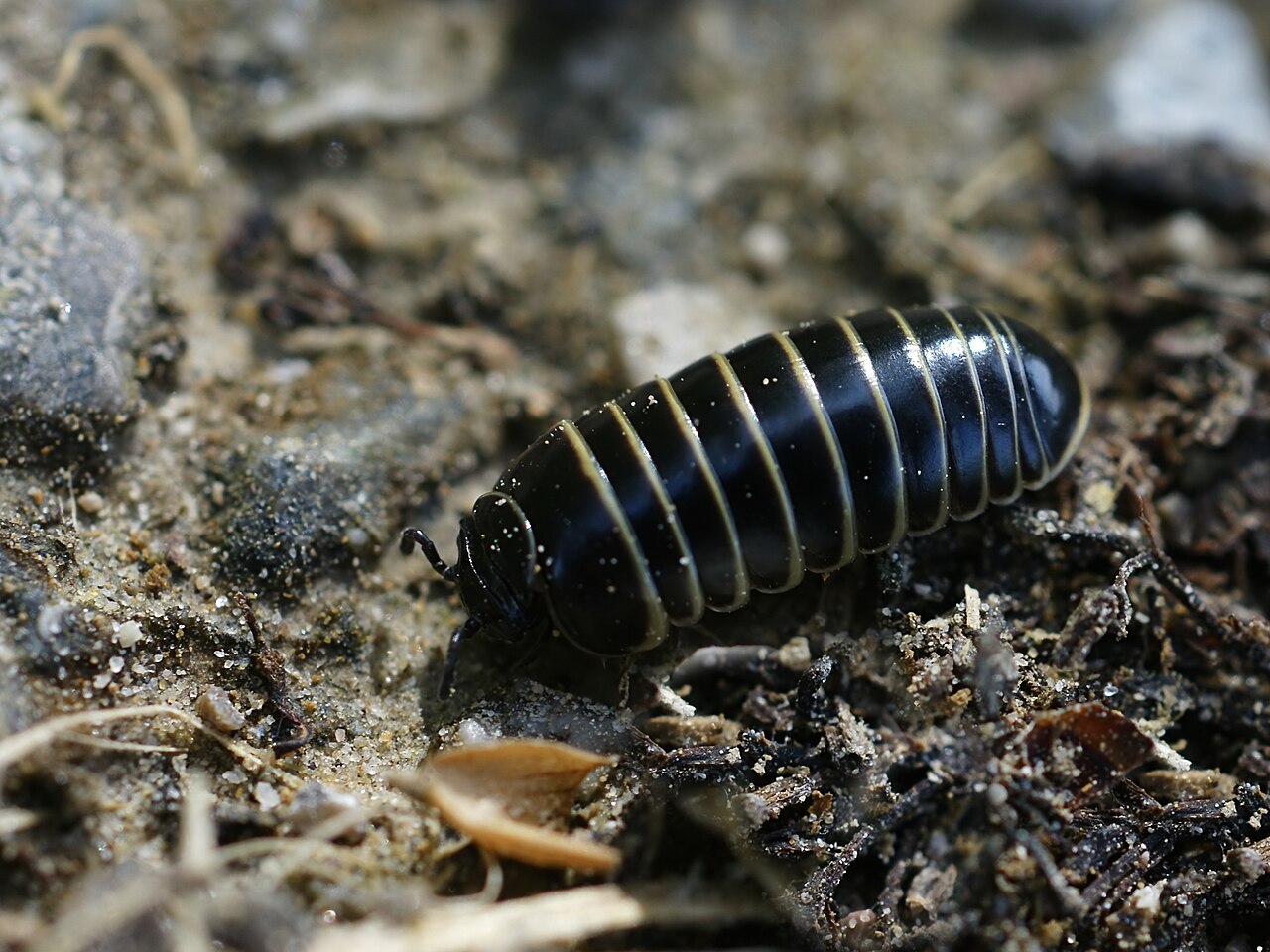
If conglobation is an isopod/millipede/trilobite trick, where does that leave a beetle-bodied monster? Almost alone — but not quite. There is exactly one lineage of true beetles that rolls into a tight, sealed ball: the pill scarabs, subfamily Ceratocanthinae (Coleoptera: Hybosoridae). They fold their head and thoracic plates over the abdomen into a near-perfect sphere, and a 2022 study traced the ability to a single origin in the Mesozoic, around 99 million years ago, locked in amber, complete with allometrically thickened dorsal cuticle to make the ball strong (Lu, Ballerio et al. 2022).
That is the taxonomically honest anchor for Konchu. The vast majority of beetles do not conglobate — they run, fly, or spray defensive chemicals instead. Out of the hundreds of thousands of beetle species, the sealed ball evolved essentially once. So when Capcom drew a beetle that rolls up, they drew something that in real beetles is vanishingly rare — and then, tellingly, reclassified it toward the crustaceans that do it routinely. The monster sits right on the seam between "what a beetle is" and "what a beetle almost never does."
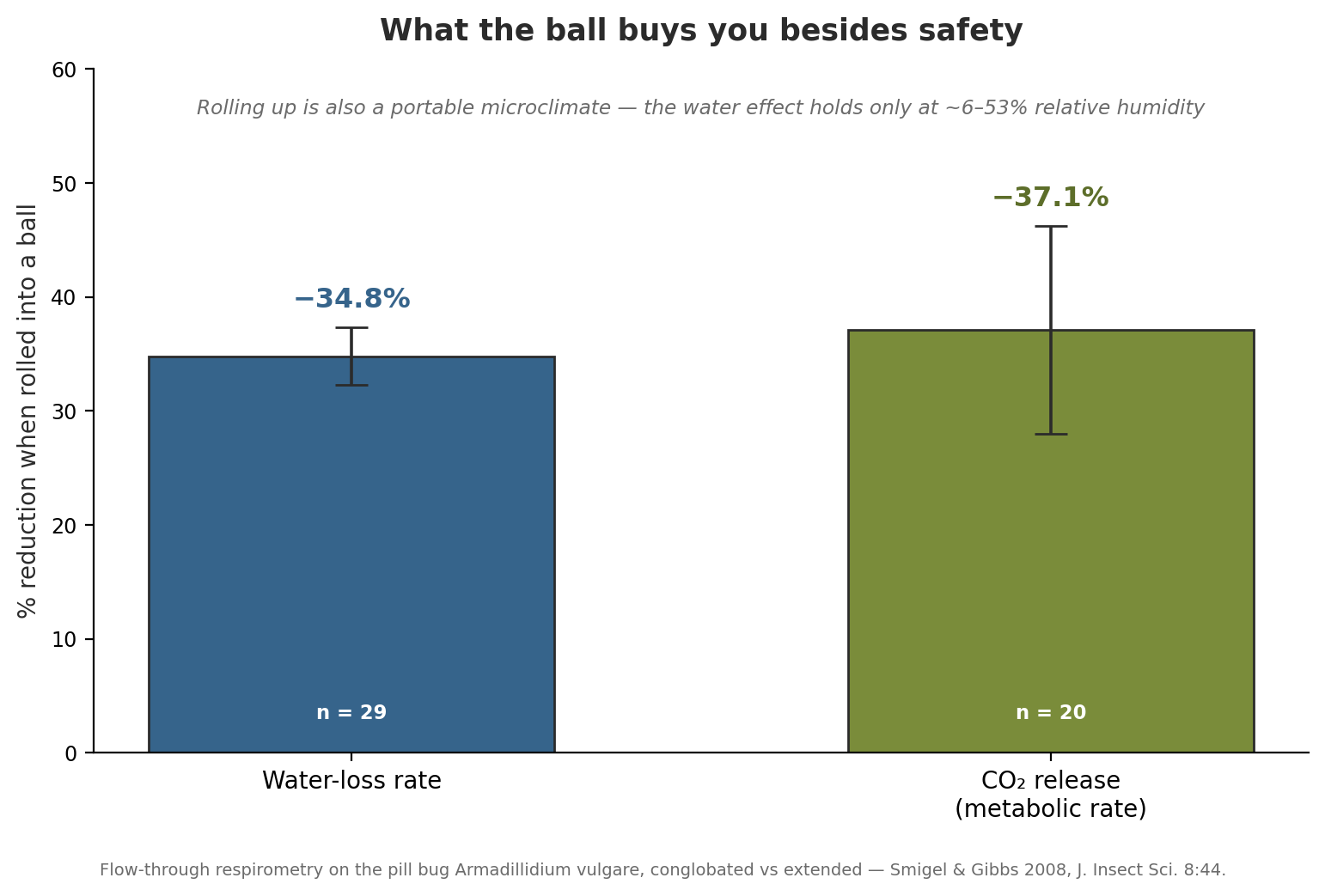
Here is the part even most biology explainers miss: rolling up is not only defense. When Smigel and Gibbs put pill bugs in a respirometer, a conglobated Armadillidium vulgare lost water 34.8% slower and released CO₂ (a proxy for metabolic rate) 37.1% slower than an unrolled one — the sealed ball covers the moist, gill-like breathing surfaces and shrinks the exposed area (Smigel & Gibbs 2008). The catch is revealing: the water saving only mattered in dry-to-moderate air, vanishing at high humidity — exactly when a small, water-permeable land crustacean most needs it. So one posture does triple duty: it stops predators, it conserves water, and it buffers temperature.
That reframes Konchu's "survives in almost any environment" line. A real roll-up animal would be habitat-flexible precisely because the ball is also a portable microclimate — and it would roll up not just when attacked but whenever the air got dangerously dry. The behavior is also tunable: in pill millipedes, a hard squeeze triggers a stronger, longer roll than a light touch, and repeated prods make the animal roll more readily over time — a simple form of learning (Tuf et al. 2016).
A sealed ball defeats almost every generalist predator — which is exactly why it breeds specialists, and this is the part I find irresistible. The masters of opening woodlice are the woodlouse-hunting spiders, genus Dysdera, and their fangs (chelicerae) have evolved into purpose-built tools. Řezáč, Pekár and Lubin showed that different Dysdera fang shapes map onto different attack tactics: one morph has elongated chelicerae that slide one fang under the soft belly while the other grips the armored back; a "forked" morph spears the woodlouse through the underside before it can roll up; a flattened morph slips its fangs between the dorsal plates (Řezáč et al. 2008). Armor on one side, a key cut to fit the lock on the other — coevolution in miniature.
So if Konchu were real, the interesting animal in its world would not be Konchu — it would be the predator built to open it: something with a ventral spear to catch it mid-roll, or a wedge to pry between its plates. (And note the irony for this series: the real can-opener is a spider, the lineage three earlier articles were about.) A perfectly sealed ball is never the end of an arms race; it is an invitation.
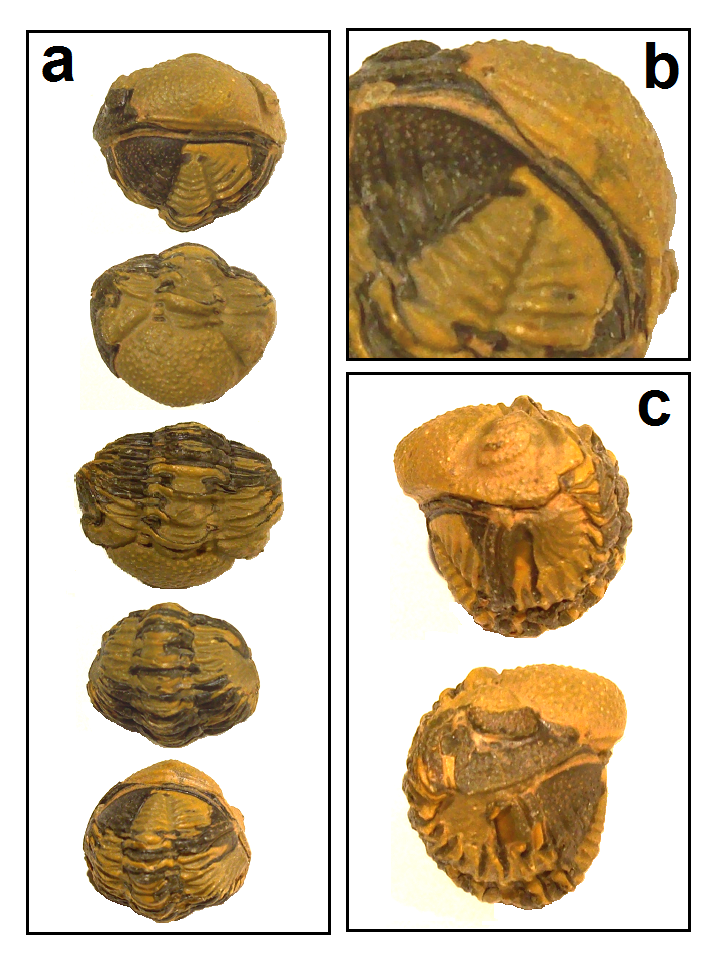
Konchu's defense is not just convergent — it is ancient. Trilobites were enrolling in the Cambrian, well before insects, isopods, or armadillos existed, and the fossil record shows the locking hardware being refined over time: early trilobites could only curl loosely, while later groups (the Phacopina) evolved coaptive devices — a groove and notches on the underside of the head that received the tail margin and each thoracic segment, snapping the ball shut (Esteve, Hughes & Zamora 2011; Esteve & Hughes 2023). The rise of enrollment, alongside defensive spines, tracks the appearance of the first shell-crushing predators — the opening move of the oldest predator–prey arms race we can read in stone.
So when a little monster tucks into a ball on a Monster Hunter map, it is reinventing a solution that is older than backbones. The sealed sphere is one of evolution's most-repeated good ideas, and Konchu is just its latest, fictional draft.
Explicitly speculative — a hypothesis from known mechanisms, each step with a real precedent.
So four of five steps are ordinary arthropod evolution; only the weaponized, glowing roll is invented.
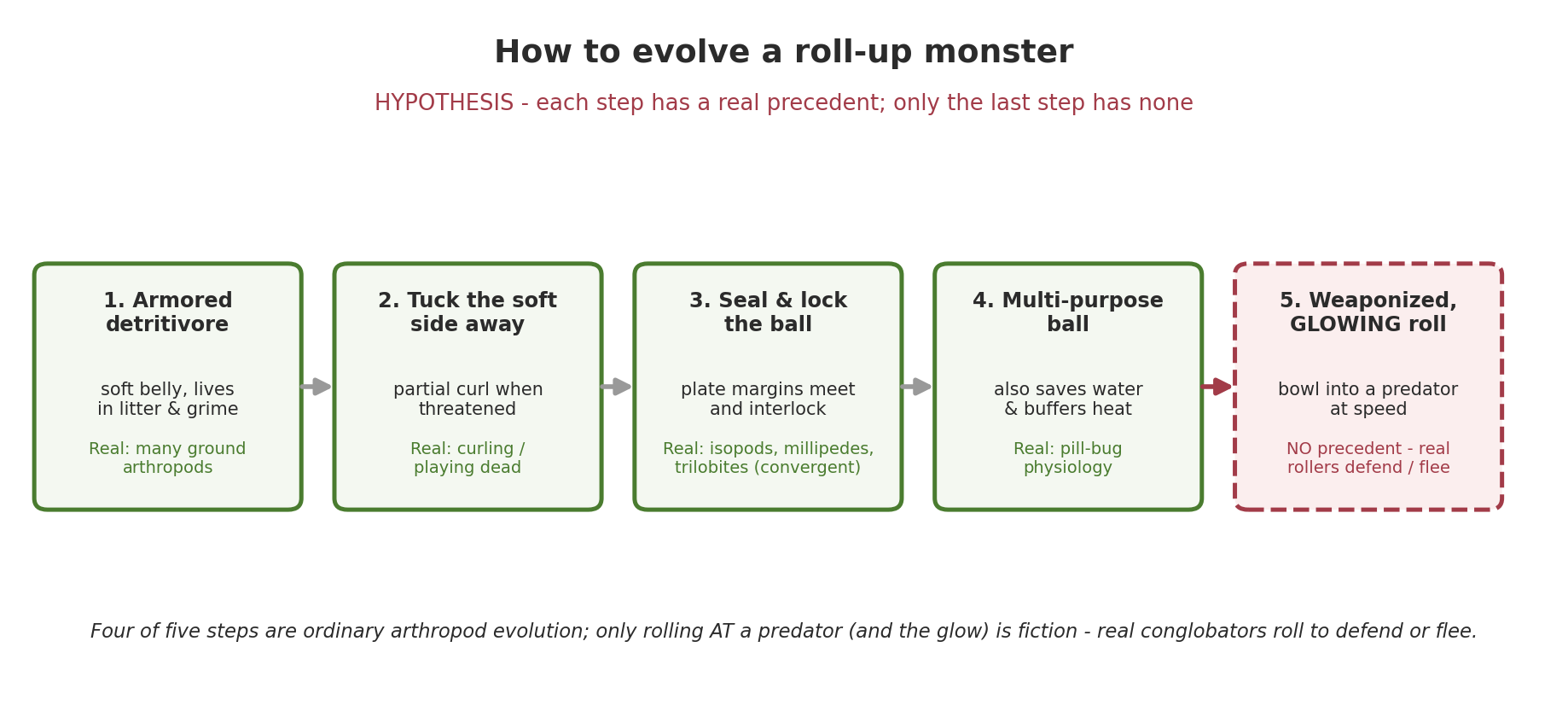
Speculative, each from a general rule in real conglobators.
None of this is in the game. All of it follows from how real roll-up animals live.
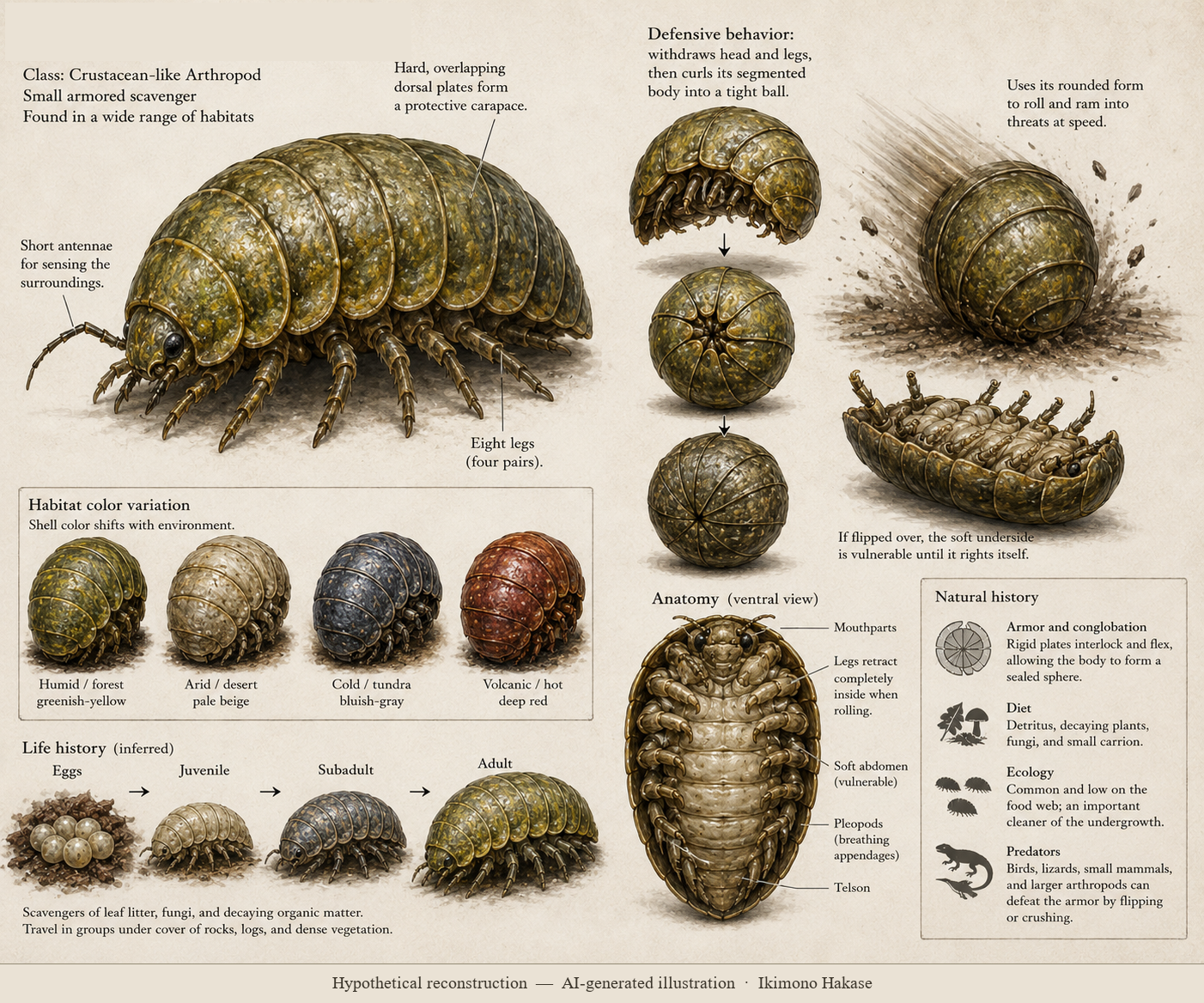
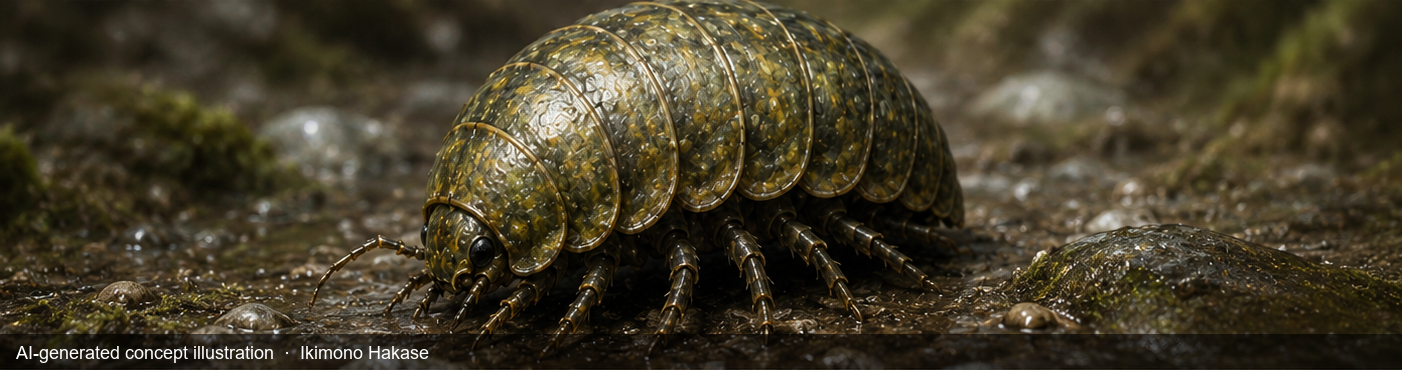
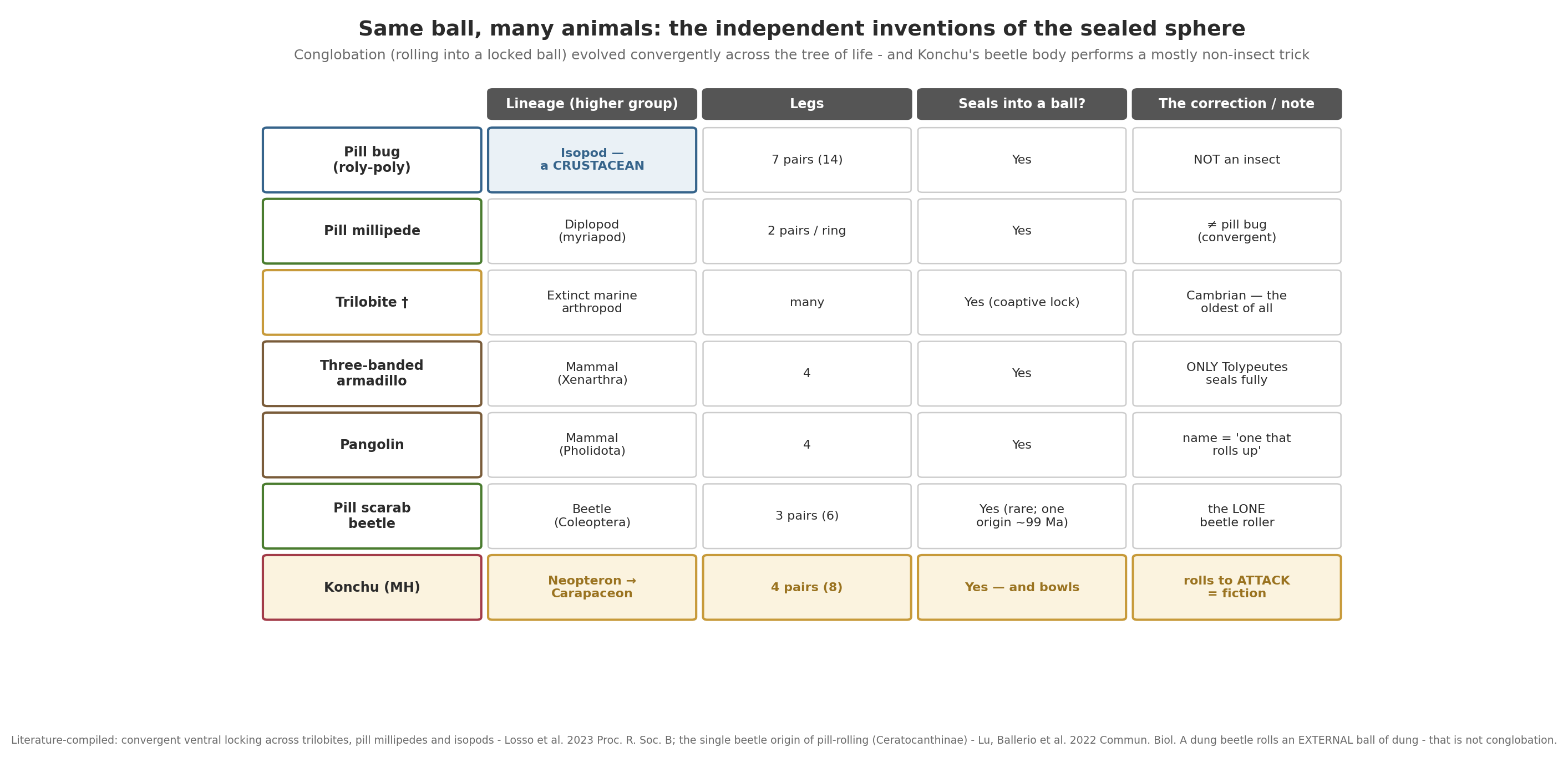
Built like the earlier figures: original, citable, and explicit about which cells are measured fact versus reasoned speculation. Figure 1 is the convergence table — pill bug (isopod / crustacean), pill millipede (diplopod / myriapod), trilobite (extinct arthropod), three-banded armadillo (mammal), pangolin (mammal), and pill scarab beetle (insect / Coleoptera), with Konchu added as a flagged fictional row, scored by lineage, leg count, whether it seals into a true ball, armor type, and the popular error each one corrects — showing that conglobation evolved convergently across the whole tree of life, and that Konchu's beetle body performs a mostly non-insect trick. Figure 2 is the measured payoff: water loss reduced 34.8% (±2.5 SE, n=29) and CO₂/metabolic rate reduced 37.1% (±9.1 SE, n=20) in Armadillidium vulgare, with the note that the water effect holds only at ~6–53% relative humidity (Smigel & Gibbs 2008) — a reminder that rolling up is defense and a portable microclimate. Figure 3 is the five-step scenario from section 9, each step tagged with its real precedent and the final "weaponized, glowing offensive roll" flagged as the break from biology. And the AI plate above is the hypothetical reconstruction — clearly tagged, an original creature, not the game monster.
What Capcom got right — and they got the deep idea right twice. Conglobation is a real, repeatedly-evolved defense, and they drew it cleanly: a hard dorsal shell, a soft underside that becomes the weak point when the animal is flipped, a ball that doubles as escape and protection, and a colour that tracks habitat. Best of all, they noticed that the roly-poly is a crustacean and reclassified Konchu to match — a level of taxonomic care most fiction never reaches.
Where they bent it: real roll-up animals roll to defend and flee, not to bowl offensively into a predator; true insects essentially never form a sealed ball (it took one rare beetle lineage, once, in 99 million years); and the glow is invention.
The real cast is easy to meet, and better than the monster. The roly-poly in your garden is a landlocked crab that rolls into a ball to keep from drying out. The pill millipede beside it invented the same ball independently, from a different phylum. The enrolled trilobite in a museum drawer was doing it before fish had jaws. The three-banded armadillo does it well enough to shrug off a jaguar. And the pill scarab is the one beetle that joined the club. The overwhelming majority of beetles never learned the trick — they run and spray instead — which is exactly why the one beetle that rolls is worth pointing at. Konchu is a small monster carrying one of evolution's greatest hits.
A roly-poly (pill bug). Konchu rolls its armored shell into a sealed ball, the signature trick of a terrestrial isopod. No developer interview names a species, so it is a well-founded reading of its shape and behavior, treated as analogy. Tellingly, in the Monster Hunter Stories spin-offs Capcom reclassified Konchu from the insect class into its crustacean class, on the logic that it is modeled on woodlice — which are crustaceans.
No. A roly-poly (pill bug) is a terrestrial isopod, a crustacean in the class Malacostraca with crabs, shrimp and lobsters. It has seven pairs of legs (fourteen), where every insect has exactly three pairs (six), and it breathes through gill-like pleopodal structures, which is why it needs damp places.
Conglobation (or volvation) is curling into a sealed sphere so the hard outer plates meet and lock, leaving only armor exposed and the soft underside, gut and legs sealed inside. It evolved independently many times — in isopods, pill millipedes, trilobites, some armadillos and pangolins, and one beetle lineage (Losso et al. 2023).
Almost none. Exactly one lineage of true beetles conglobates: the pill scarabs (subfamily Ceratocanthinae), with a single Mesozoic origin around 99 million years ago (Lu, Ballerio et al. 2022). The vast majority of beetles run, fly or spray chemicals instead.
Yes. In the pill bug Armadillidium vulgare a conglobated animal lost water 34.8% slower and released CO₂ 37.1% slower than an unrolled one, because the ball covers the moist breathing surfaces and shrinks exposed area — though the water saving only mattered in dry-to-moderate air (Smigel & Gibbs 2008). The sealed ball is also a portable microclimate.


.jpg)


