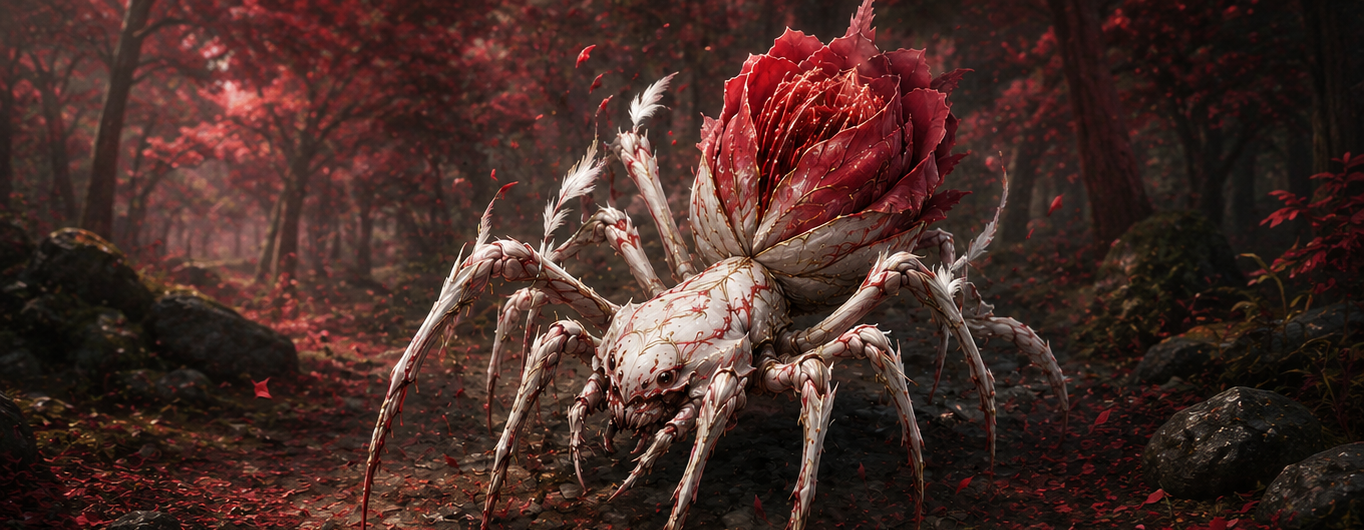
In one sentence: Lala Barina is a Temnoceran (spider-type) monster introduced in Monster Hunter Wilds (2025), a Scarlet Forest predator whose rose-shaped abdomen unfurls into red, paralysis-inducing bristles.
Search "what is Lala Barina based on" and you will quickly meet a confident, wrong answer: the orchid mantis. It is an easy mistake — a beautiful, flower-colored ambush predator; of course people reach for the most famous flower-mimic in biology.
But it is wrong, and the way it is wrong is the whole reason I wanted to write this. Coloration and mimicry are my field. Lala Barina, the rose-themed monster from Monster Hunter Wilds, is not a mantis. It is not even an insect. It is a spider — and once you put it back in the right branch of the tree of life, the real biology it points to is stranger and better than the orchid-mantis cliché.
Let me sort out what the game actually says, then show you the real spiders that earn the comparison.
As always, I will tag each claim by how solid it is.
Canon, official class. Lala Barina is a Temnoceran — Monster Hunter's class for arachnid-type monsters (the same class as Nerscylla and Rakna-Kadaki), the in-universe analog of real spiders and their kin, not of insects. It debuted in Monster Hunter Wilds (worldwide release 28 February 2025) and lives in the Scarlet Forest. "Temnoceran" is a Capcom coinage, not a real taxonomic rank; the real-world counterpart is Arachnida (the spiders, order Araneae), not Insecta.
Canon, official design intent. This is the part that kills the orchid-mantis myth at the source. The game's executive director and art director, Kaname Fujioka, has said in interviews that the team "didn't really focus on making it related to an actual spider," that it moves "kind of like a ballerina," has "very thin legs, so the silhouette really does resemble a ballerina," that they "added white birds into the design," and that they merged all this with a separate concept of a monster "that resembled a rose." So the official triad is spider body plus rose plus ballerina/white-bird silhouette. There is no orchid in it, and no mantis. The orchid-mantis association is fan extrapolation, not design intent.
Canon, ecology text. The in-game Hunter's Notes describe Lala Barina as "Temnocerans native to the Scarlet Forest with distinctive, pirouette-like movements. Their fluids contain a neuroplegic agent which they mix with water to produce red, petal-like bristles on their abdomens." The rose-shaped abdomen is normally closed and unfurls during its paralyzing attacks, scattering those red "florets" — bristles carrying a paralytic agent — into the air.
One honest anatomy note. Real spiders have eight legs; Lala Barina is drawn with six. That is stylization, not biology — a small tell that the designers were after a silhouette (ballerina, rose) rather than an arachnid anatomy lesson. I will hold the game to the spider it claims to be, and flag where it departs.
So the question is not "is it an orchid mantis" (it isn't). The better question is: do real spiders do any of this — lure with color, wear a flower, paralyze with a scattered agent? The answer, three times over, is yes.
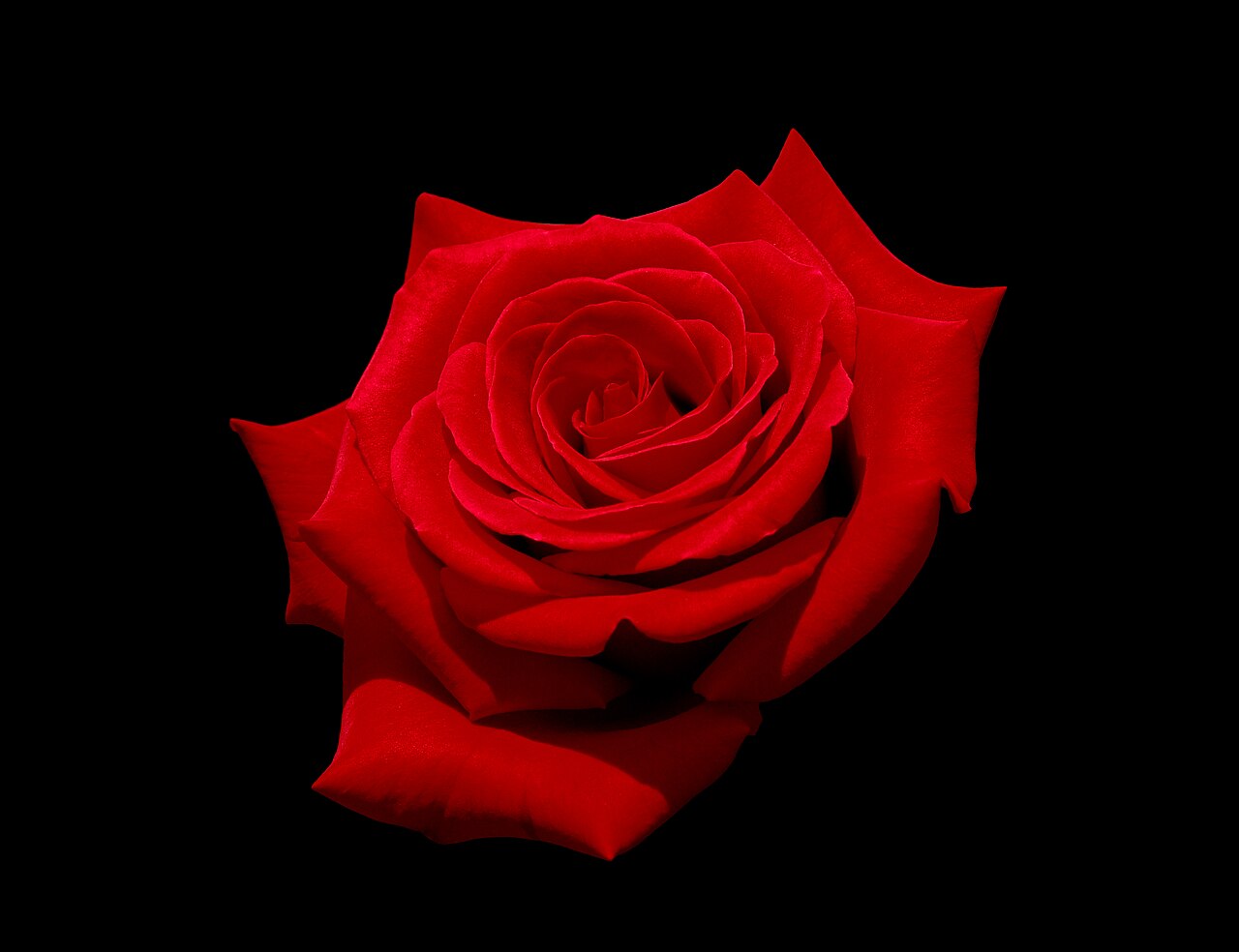
My research is on animal coloration and mimicry — how color signals work, when they warn, when they deceive, and how to tell the difference. Lala Barina is, almost on purpose, a coloration-and-mimicry exam question: a conspicuous red display, a flower-shaped body, and a predatory payoff. So let me grade it the way I would grade a claim in a manuscript.
Yes — and the textbook case is not a mantis but a spider.
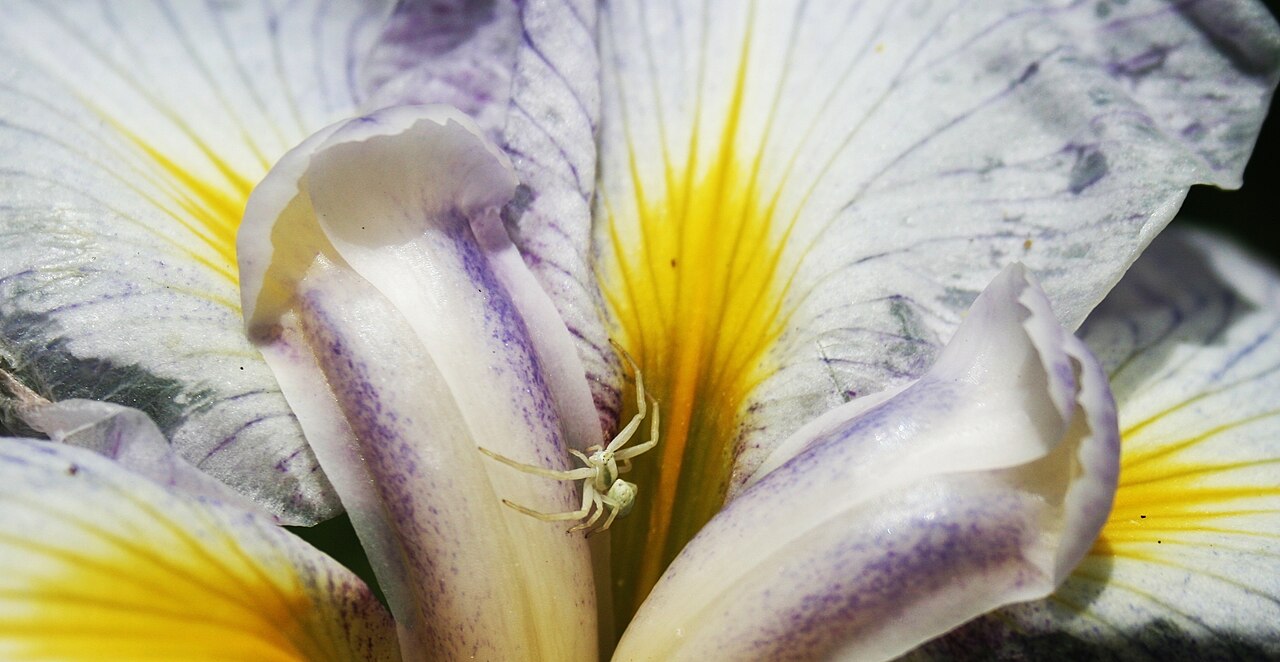
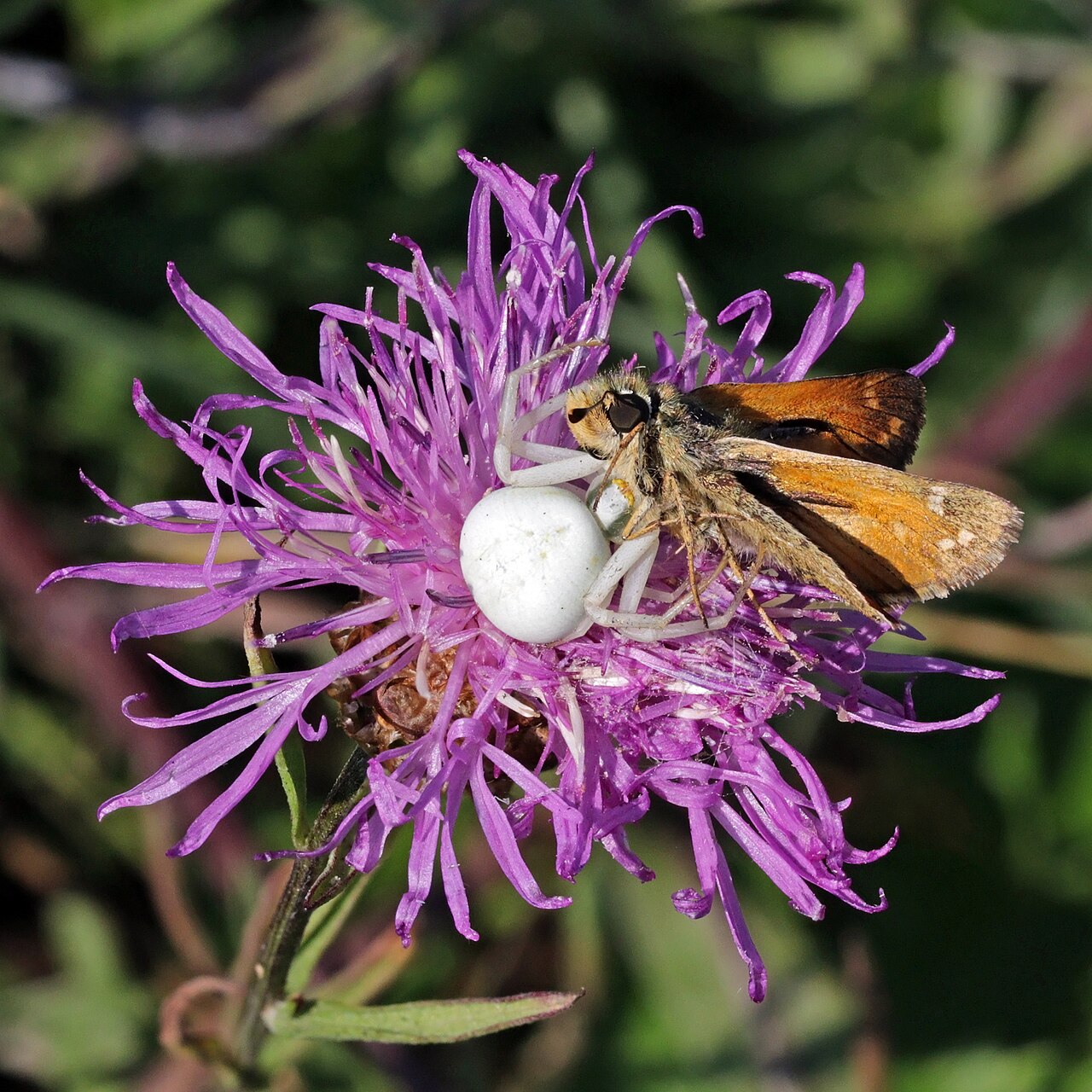
Australian crab spiders (Thomisus spectabilis) sit on white daisies and ambush the pollinators that visit. To our eyes the spider looks cryptic on the flower. But the spider reflects ultraviolet light while the petals do not, and bees see UV. That UV contrast does not scare bees off; it makes the flower more attractive, because it taps into bees' pre-existing preference for UV-patterned blooms. The spider is not hiding — it is exploiting the bee's senses to pull prey in (Heiling, Herberstein & Chittka 2003, Nature). Follow-up experiments confirmed the causal role of UV by removing the spider's UV reflectance and watching bee behavior change (Heiling et al. 2005, Journal of Experimental Biology).
Two honest caveats, because precision is the brand. First, that contrast is in the bee's UV channel, not in human vision — so "the spider glows to a bee" is right, "the spider looks bright to you" is not. Second, real crab spiders that change color do it slowly — over days, shifting white to yellow with ommochrome pigments — not in a dramatic instant. So a spider flushing rose-red on cue is game fiction, even if the underlying idea (a spider using conspicuous color as a lure) is real.
There is also a deeper distinction that matters for Lala Barina specifically. Most flower-associated spiders are spider-on-flower: they sit on a real bloom and exploit its signal. A rarer mode is spider-as-flower, where the spider's own body is the lure — seen in the lobed, flower-like abdomens of Epicadus, and in a striking 2024 report of a male and female crab spider positioning together to resemble a single flower (Wu et al. 2024, Frontiers in Ecology and the Environment; treat this as one intriguing study, not settled consensus). Lala Barina's rose is part of its body, not a plant it perches on — so the right real-world bin for it is the rarer, more remarkable spider-as-flower mode, not the common ambush-on-a-daisy.
Here is where my field gets fussy, and where most "real animals behind X" articles get lazy. A bright red is not automatically a warning.
In arthropods the same red can mean three completely different things: a warning that the animal is defended (aposematism, like a ladybird); a sexual signal to mates (many jumping spiders flash red in courtship); or a lure that pulls prey in (the crab-spider trick above). You cannot tell which from the color alone. The only way to know is to watch the receiver: a warning should make predators avoid it; a courtship signal should track mating success; a lure should attract the prey it targets (Stevens & Ruxton 2012; Briolat et al. 2019).
Lala Barina's rose blooms specifically during its paralyzing attacks — a sudden reveal of intense color paired with a weapon. In real-animal terms, that pattern reads most naturally as a deimatic (startle/warning) display rather than a quiet lure: conspicuousness deployed at the moment of threat. But — and this is the honest scientist's punchline — you genuinely could not settle warning-versus-lure for any real animal from a red body and a guess. You would have to run the experiment. The game gives us a gorgeous, ambiguous signal, which is exactly what real coloration so often is.
Spiders really do paralyze prey — it is the core of how most of them eat — and the chemistry is its own marvel.
Spider venom is a cocktail. Peptide neurotoxins jam the voltage-gated ion channels that run nerves; small molecules called acylpolyamines plug the glutamate receptors at insect muscles, causing limp (flaccid) paralysis; in widow spiders, latrotoxins blow open the nerve terminals (Lüddecke et al. 2022, Biological Reviews; King & Hardy 2013, Annual Review of Entomology). Many venoms pair a fast, reversible knock-down with a slow, lasting immobilization — which is a real biological echo of Lala Barina's game design, where a single floret barely paralyzes you but repeated contact stacks until you cannot move.
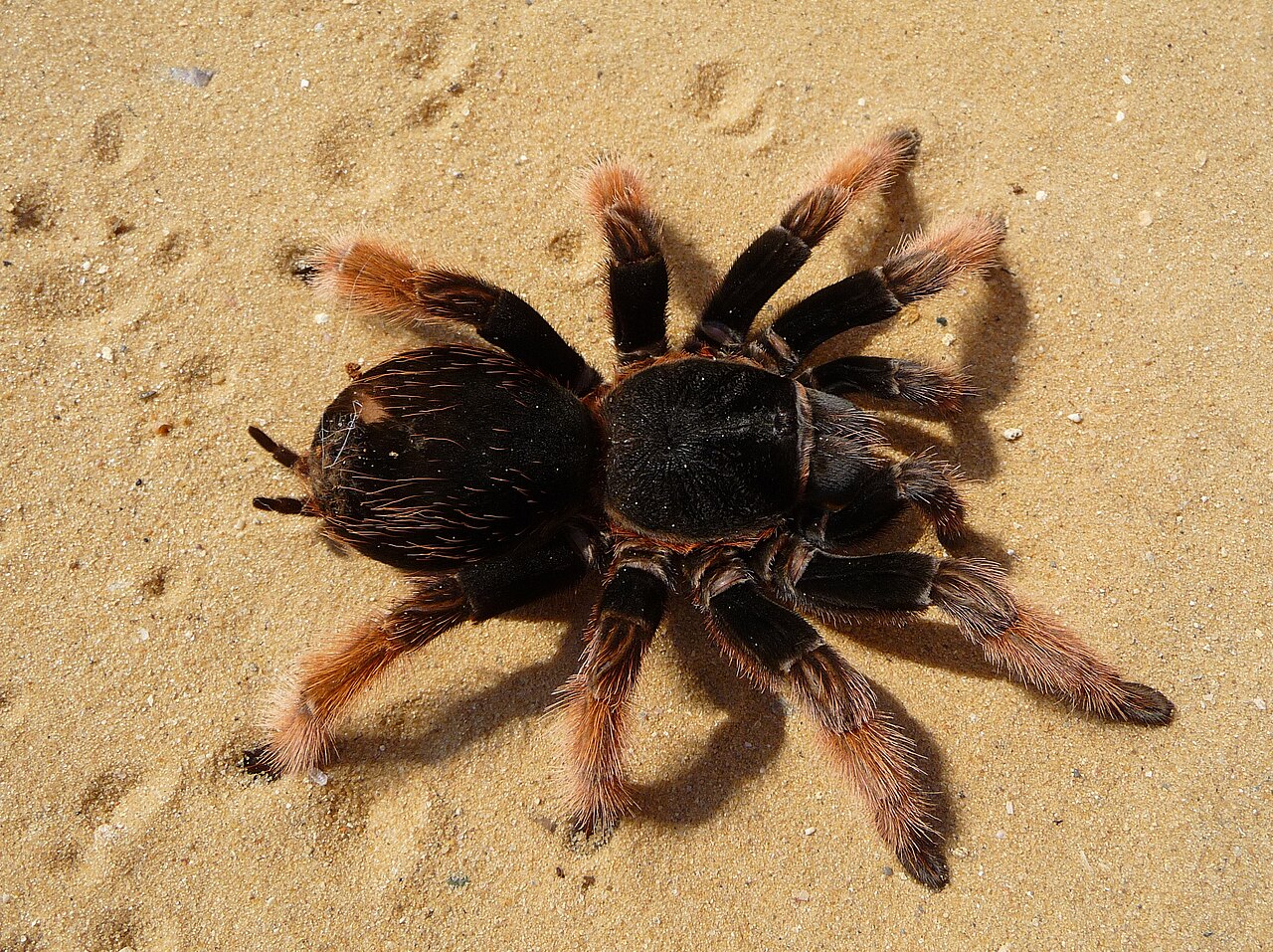
Where the game invents: real spiders inject venom through fangs, in a bite. They do not shed paralytic petals into the air. The closest real analog to Lala Barina's airborne, body-flung weapon is not a spider's venom at all but a tarantula's urticating setae — barbed abdominal hairs that New World tarantulas kick into the air with their hind legs to drive off attackers. So the monster's "scatter a cloud of irritating, incapacitating bristles from the abdomen" is a real arachnid behavior — just borrowed from tarantula defense and fused onto a paralytic-venom premise. Two real spider tricks, recombined.
So where does the orchid mantis fit? As the foil — the animal Lala Barina is not.
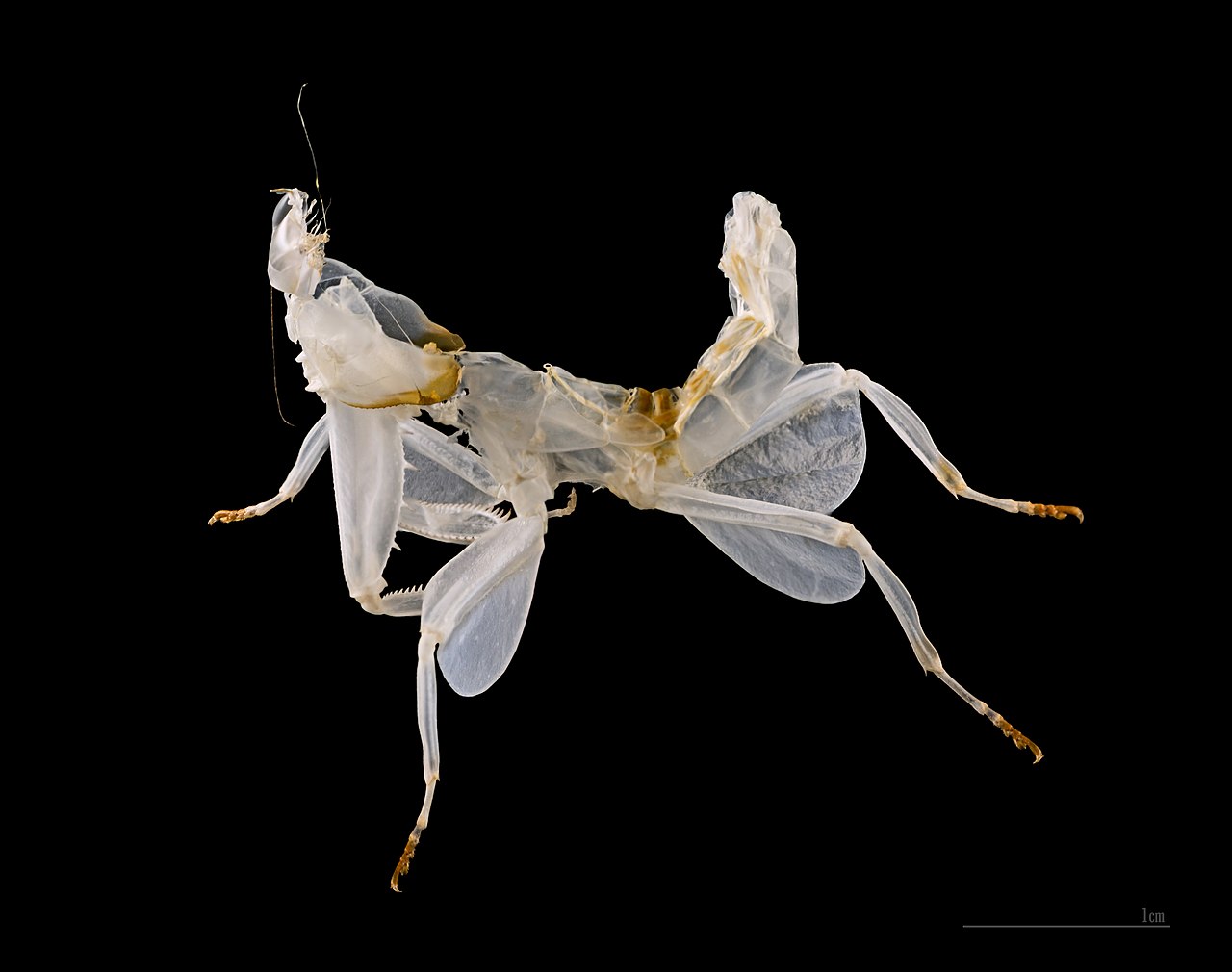
The orchid mantis (Hymenopus coronatus) is the most famous aggressive flower-mimic in biology, and it is an insect, a mantis, on a completely separate branch from spiders. And it is even more extreme than the crab spiders: isolated mantises, with no flower present at all, attract wild pollinators at a higher rate than real flowers do, and then eat them. The mantis's own body is a supernormal flower — a better "flower," to a pollinator, than the real thing (O'Hanlon, Holwell & Herberstein 2014, The American Naturalist). (A side note for accuracy: it mimics a generalized flower, not a specific orchid, and the dramatic size-dimorphism numbers often quoted for it are clade-level averages for the flower-mantis lineage, not measurements of that one species — Svenson et al. 2016.)
Here is the satisfying part. The reason people confuse Lala Barina with the orchid mantis is that both are flower-colored predators — and that is real convergent evolution. A flower-shaped, flower-colored body has evolved as a predatory strategy independently in a mantis (an insect) and in crab spiders (arachnids). Lala Barina sits on the spider side of that convergence. Calling it an orchid mantis isn't just a taxonomy slip; it misses the more interesting fact that two unrelated lineages arrived at "be the flower" on their own.
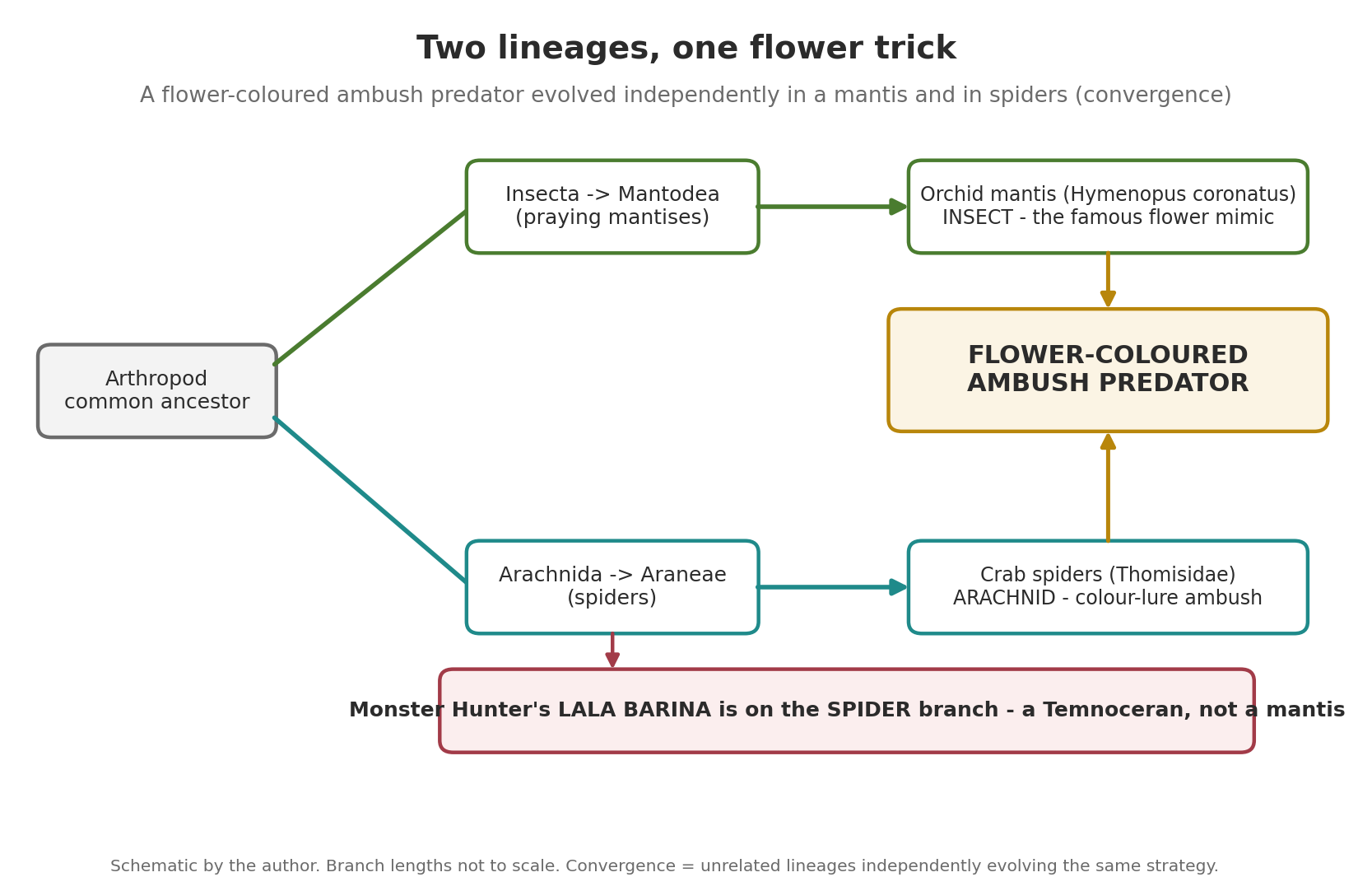
That diagram is the whole article in one picture: the flower-colored predator is not one invention but two, evolved separately in a mantis and in spiders, and the rose-spider belongs to the spider side.
Explicitly speculative — a hypothesis from known mechanisms. Each step has a real precedent.
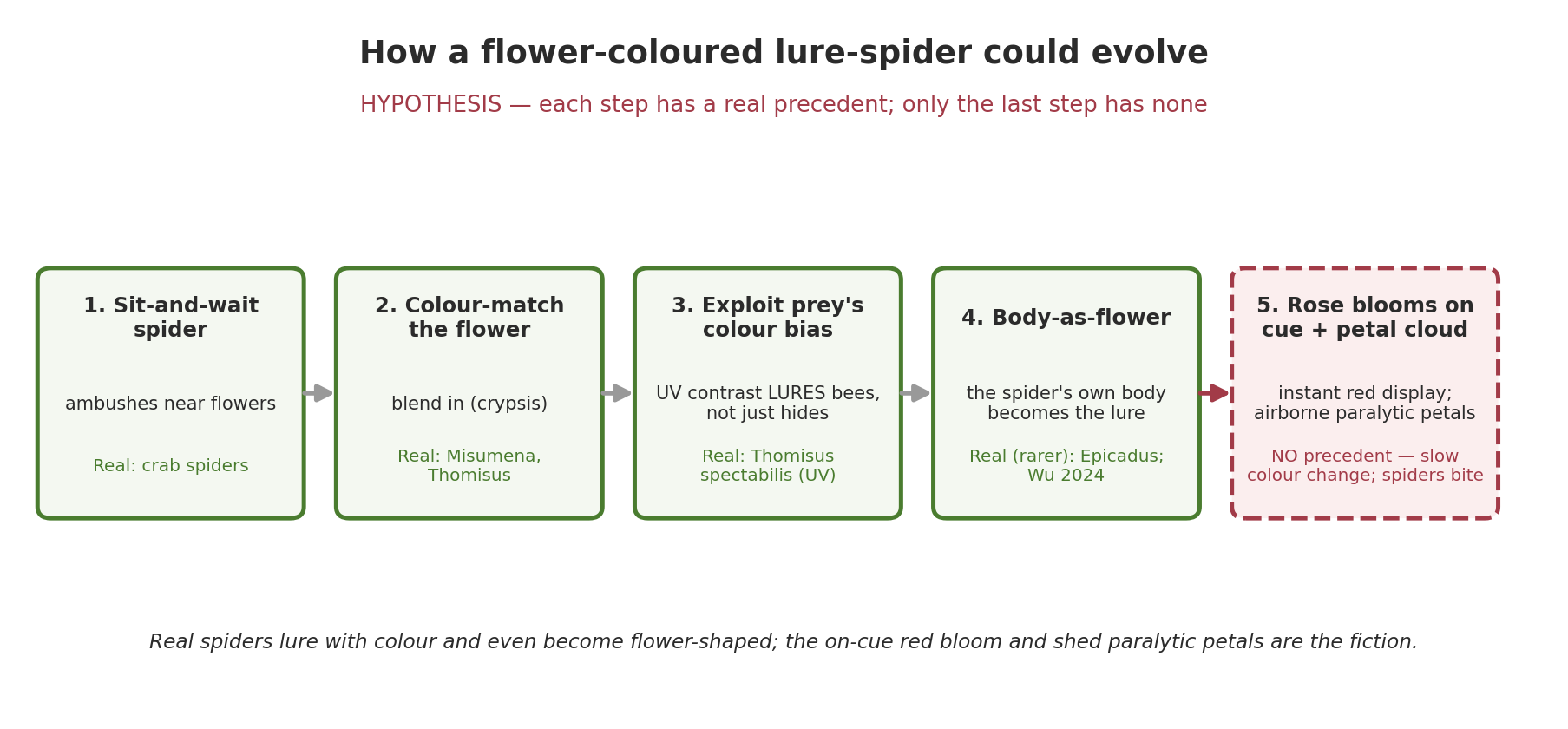
So the lure — colour, and even a flower-shaped body — is real; the instant bloom and the shed paralytic petals are the invention.
Also speculative — from how real lure-and-ambush spiders live.
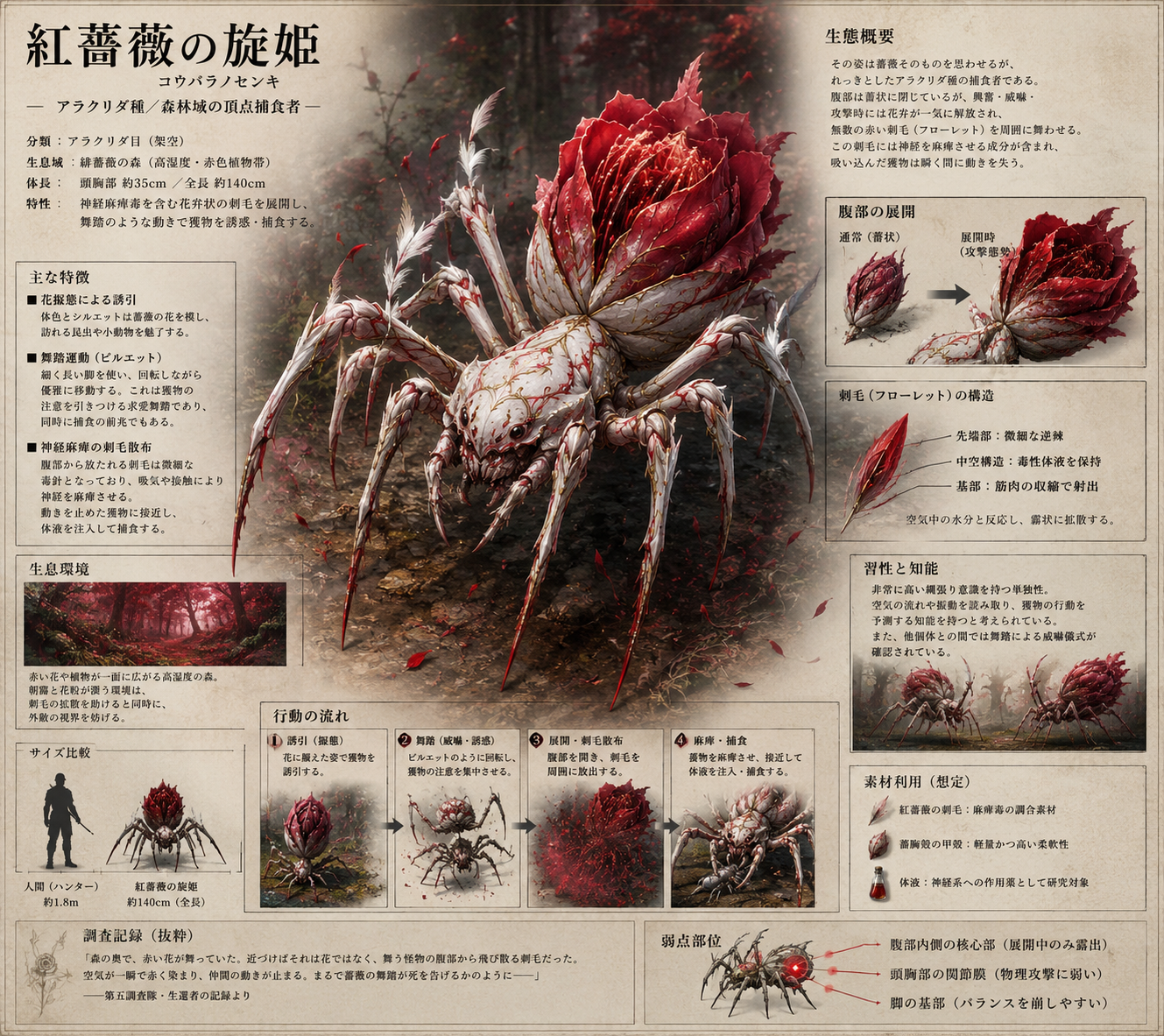
What Capcom got right: a predator that weaponizes conspicuous color; a paralytic chemistry that stacks from weak to incapacitating, just like real venoms; and an airborne bristle attack that really does exist in arachnids (tarantula urticating hairs). For a "spider built from a rose and a ballerina," that is a lot of accidental biology.
Where they bent it: the rose is body, not a flower it sits on (the rarer mimicry mode); the color change is instant theater, not the slow pigment shift real crab spiders manage; the weapon is shed petals, not a bite; and it has six legs, not eight. None of that is a flaw — it is design. But it is worth knowing which parts are real, and the real parts are not the orchid mantis everyone names.
If you want to meet the real cast: look for crab spiders (Thomisus and kin) sitting motionless on flowers in your own garden in summer — the ambush predator that hides in plain sight by matching, and sometimes out-signaling, the bloom. That, not a mantis, is the lineage Lala Barina belongs to.
No. Lala Barina is a Temnoceran — Monster Hunter's class for arachnid/spider-type monsters — not a mantis and not even an insect. The orchid-mantis tag is fan extrapolation; the developers describe the design as a spider body fused with a rose and a ballerina/white-bird silhouette, with no orchid and no mantis in it.
Yes. Australian crab spiders (Thomisus spectabilis) sit on white daisies and reflect ultraviolet light the petals do not; bees see UV, so the spider's contrast makes the flower more attractive and draws pollinators in (Heiling, Herberstein & Chittka 2003). The contrast is in the bee's UV channel, not in human vision.
You can't tell from colour alone. The same red can be a warning (aposematism), a sexual signal, or a lure; only watching the receiver settles it. Because Lala Barina's rose blooms during its paralyzing attack, it reads most naturally as a deimatic (startle) display rather than a quiet lure — but you'd have to run the experiment to know.
No. Real spiders inject venom by biting with fangs. The closest real analog to an airborne, body-flung weapon is a tarantula's urticating setae — barbed abdominal hairs New World tarantulas kick into the air to deter attackers. Lala Barina fuses that tarantula defence onto a paralytic-venom premise.
The orchid mantis (Hymenopus coronatus) is an insect on a separate branch; isolated mantises attract pollinators at a higher rate than real flowers do (O'Hanlon, Holwell & Herberstein 2014). Lala Barina belongs to the spider side of a real convergence: a flower-coloured ambush predator evolved independently in a mantis and in crab spiders.


_with_prey_silver-spotted_skipper_(Hesperia_comma).jpg)

