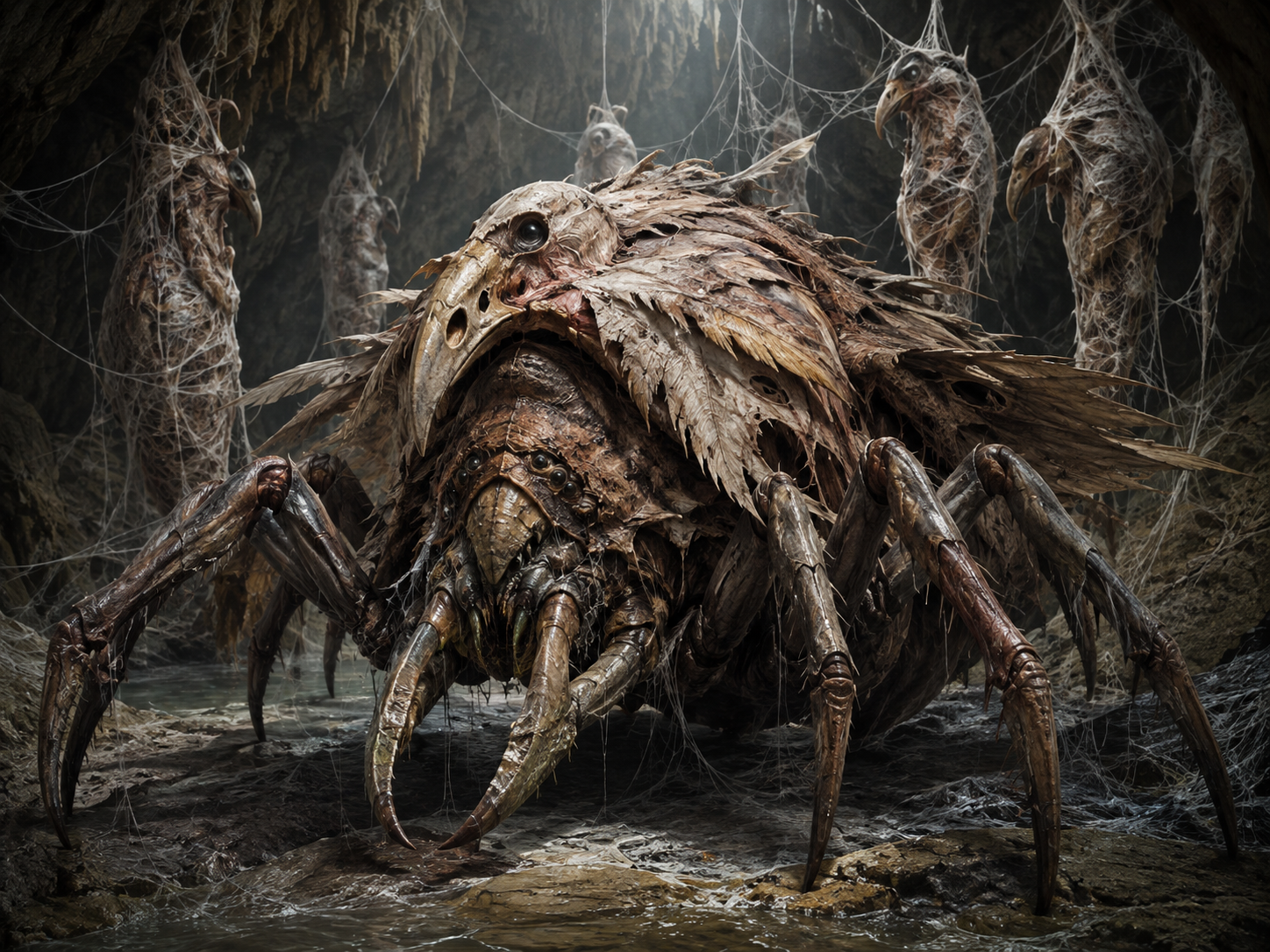
In one sentence: Nerscylla is a Temnoceran (Monster Hunter's spider-type class) that debuted in Monster Hunter 4 and returned in Monster Hunter Wilds — a web-spinning ambush predator that drapes itself in the flayed hide of its favored prey, the bird-wyvern Gypceros, and subdues victims with poison, sleep, and silk.
A giant spider kills a creature, skins it, and wears the skin. It is one of the most genuinely unsettling things in Monster Hunter — and the part most people assume is pure horror-design is, in fact, the part with the best real-world pedigree. Wearing the body of something you killed is a documented strategy in real animals, and explaining when and why it works is squarely my field: I study camouflage, coloration, and the difference between hiding and lying. So let me take Nerscylla apart, then do the two things this series does that a wiki won't — reason out how such an animal could evolve, and predict what it would do when no hunter is watching.
Tagging each claim by how solid it is.
Canon. Nerscylla is a Temnoceran — the franchise's spider-like, arachnid-derived class (the same class as Lala Barina and Rakna-Kadaki) — introduced in Monster Hunter 4 (2013/2014) and back in Monster Hunter Wilds. It spins sticky webs in caves and near settlements, hunts the bird-wyvern Gypceros, skins it, and wears the hide draped over its back as armor and camouflage, hanging silk-wrapped carcasses in its nest. It subdues prey with Poison and Sleep and finishes with elongating pincer-like jaws. A subspecies, Shrouded Nerscylla, wears Khezu hide instead and inflicts Paralysis.
Dev-confirmed. Unusually, the name has an official gloss: Capcom's own localization team has said Nerscylla combines Nergal (a Mesopotamian god of plague and war) with Neoscona scylla — the scientific name of a real orb-weaving spider (family Araneidae) native to East Asia, including Japan. So the design points, by name, straight at real orb-weavers.
Where the design takes liberties (so I won't overclaim). It is an arachnid analogy, not a real spider: real spiders deliver venom by a bite through fang-like chelicerae, whereas Nerscylla also uses an abdominal stinger, which is not a spider trait — treat the sting as fiction. And the leg count is genuinely game-specific: the Monster Hunter 4 model reads as six limbs (four walking legs plus two mantis-like forelimbs), while the Wilds redesign reads as four legs; either way it has fewer leg-like appendages than a true spider, which has eight walking legs plus a separate pair of pedipalps. I will not hang an argument on a tidy "6 versus 8," because that mixes categories — but the honest summary is: not anatomically a real spider.
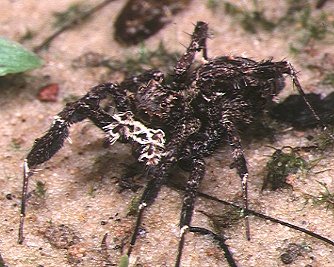
My research is on coloration and camouflage — and specifically on the boundary between being unseen and being misread. Nerscylla is built on exactly that boundary. Wearing a hide could be three different things — hiding (crypsis), being mistaken for something else (masquerade), or borrowing someone else's defense — and they are not the same. Sorting out which is which is the whole job, so this is the monster I have been waiting for.
Yes — and the closest real analog is small, six-legged, and astonishing.
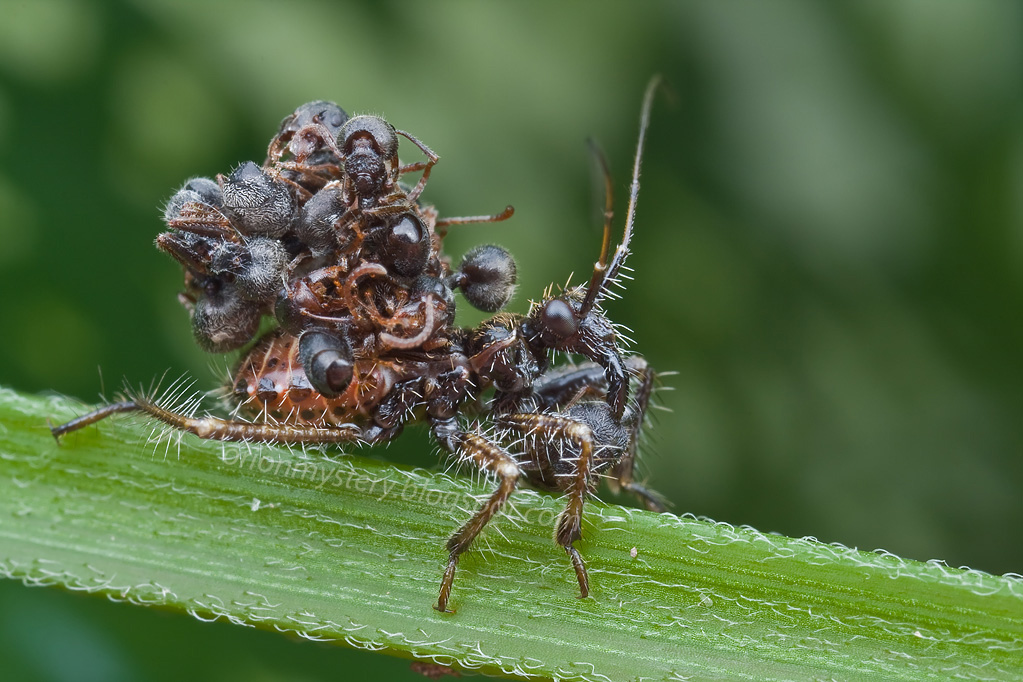
The assassin-bug nymph Acanthaspis petax cements a "backpack" of dead ant corpses onto its own body. And in a clean experiment, Brandt and Mahsberg (2002) separated what that does: a coat of fine dust masks the bug's chemical and tactile cues so it can ambush ants, while the corpse backpack specifically improves the bug's survival against vision-guided predators such as spiders. One animal, wearing its dead prey, getting two different payoffs — ambush and protection — which is precisely the dual role Nerscylla's hide plays.
This sits inside two broader real phenomena I work with. The first is masquerade: resembling a specific, uninteresting object so that a predator misidentifies you rather than simply failing to see you. Skelhorn and colleagues (2010) gave the first experimental proof that masquerade is distinct from crypsis — predators genuinely mistake the masquerader for the thing it mimics. The second is decoration: actively attaching outside material to your body, best known in decorator crabs, which fix algae, sponge, and debris to hooked hairs on their shells for camouflage and even borrowed chemical defense (Hultgren & Stachowicz 2011). A comparative review of decorating concludes it functions mostly in anti-predator defense and is overwhelmingly aquatic — because water's buoyancy offsets the cost of carrying your disguise (Ruxton & Stevens 2015). That last point is a real, honest knock on Nerscylla: a land animal hauling a whole skinned hide pays a serious load cost that a decorator crab mostly does not.
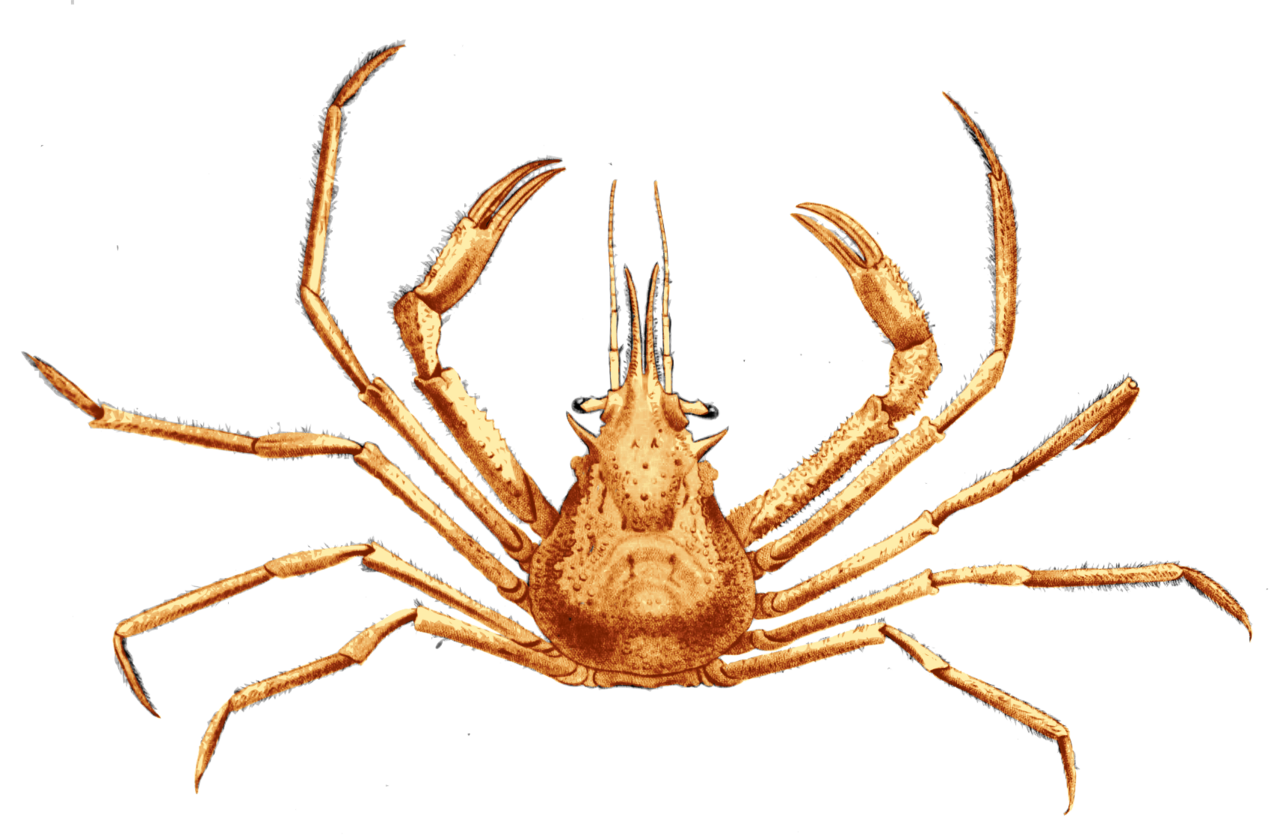
And the canon detail that the Gypceros hide also resists thunder and carries retained poison is not just flavor — it is borrowed defense, the same logic as a decorator crab gluing a stinging anemone onto its shell. The hide is armor, disguise, and a stolen weapon at once.
Two more parts are solid spider biology.
The web. A spider's capture web is an extended phenotype — a built trap that reaches beyond the body. And the stickiness is cleverer than it looks: the glue droplets on capture silk behave as a viscoelastic solid, so adhesion gets stronger the faster the prey struggles (Sahni, Blackledge & Dhinojwala 2010). A web that grips harder the more you fight it is exactly the "cornered by silk" mechanic, and it is real.
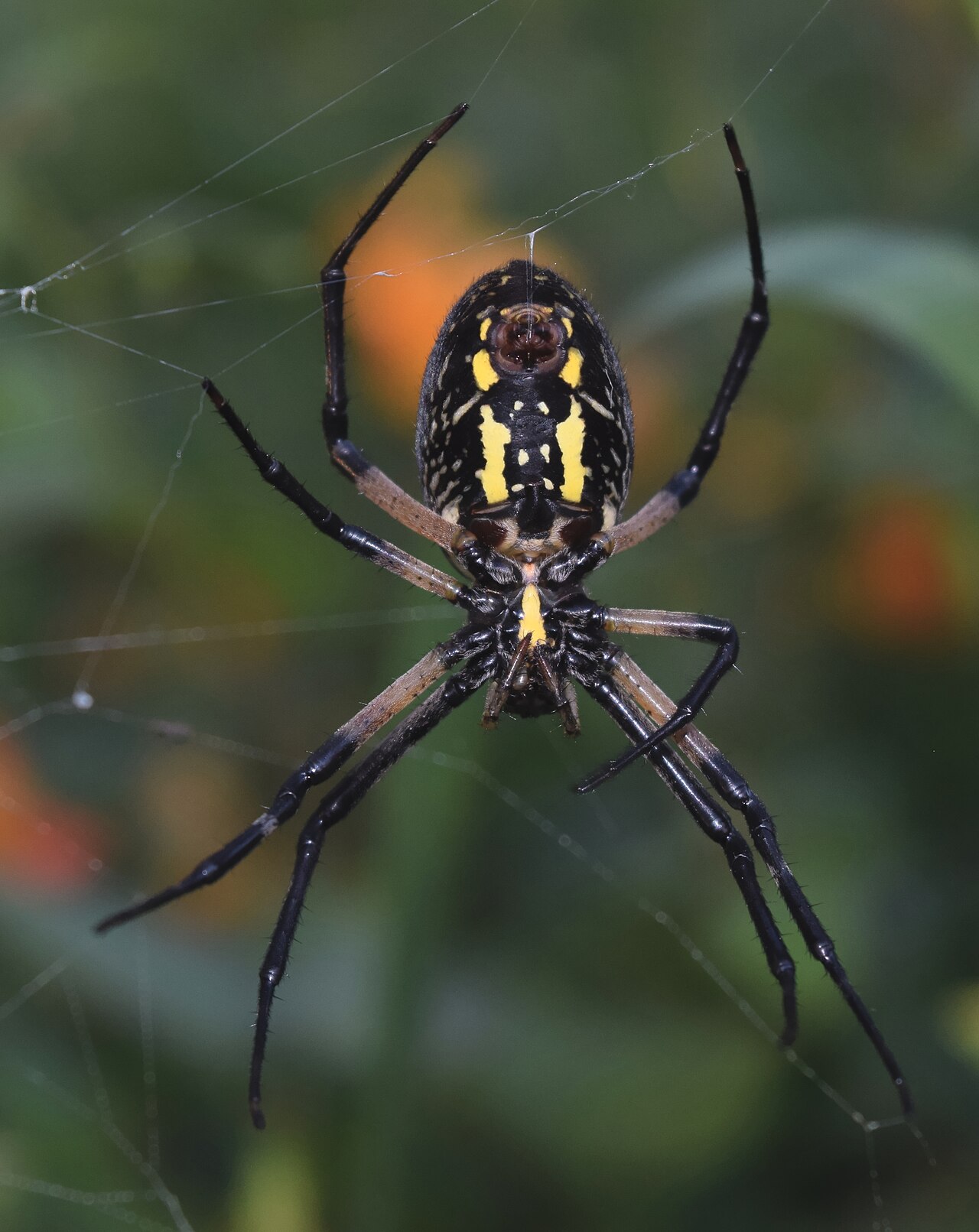
The venom. Spiders paralyze prey with a chemical cocktail, and the fast-acting prey-paralysis chemistry is dominated by acylpolyamines — small toxins that plug the glutamate receptors at insect muscles, cutting the nerve-to-muscle signal and causing limp paralysis (Lüddecke et al. 2022; Rádis-Baptista & Konno 2024). One of the textbook examples, JSTX, comes from the Joro spider (Trichonephila clavata), a large orb-weaver common in Japan — a fitting real relative for a Japanese-designed spider monster. So Nerscylla's "paralytic poison" maps onto named, real toxins. Its separate "sleep," though, has no single known spider toxin behind it; I would label that one an extrapolation — plausible only because venoms are complex cocktails, not because a sedative spider toxin is established. Note also that poison (tissue damage), paralysis (blocked muscles), and sleep (sedation) are three different things, and the game treats them as distinct — correctly.
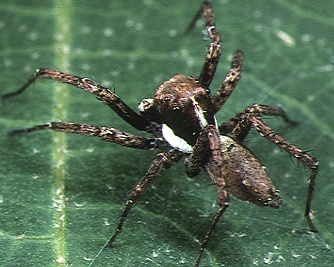
There is a precise distinction here that I care about, and that the monster embodies twice over. Masquerade and warning coloration deceive a predator (don't eat me / I'm just a twig). Aggressive mimicry deceives the victim (come closer). The master of the second is Portia, a jumping spider that invades other spiders' webs and plucks the silk to fake the vibrations of trapped prey or a courting mate, luring the resident spider to its death (Jackson & Wilcox 1990). Nerscylla is unusual in spanning both columns: it wears a hide to fool predators (and prey at a distance), and it uses its web to corner victims. Most real animals specialize in one kind of deception; the monster does both — which is exactly the sort of thing I would flag as the designers stacking two real strategies into one creature.
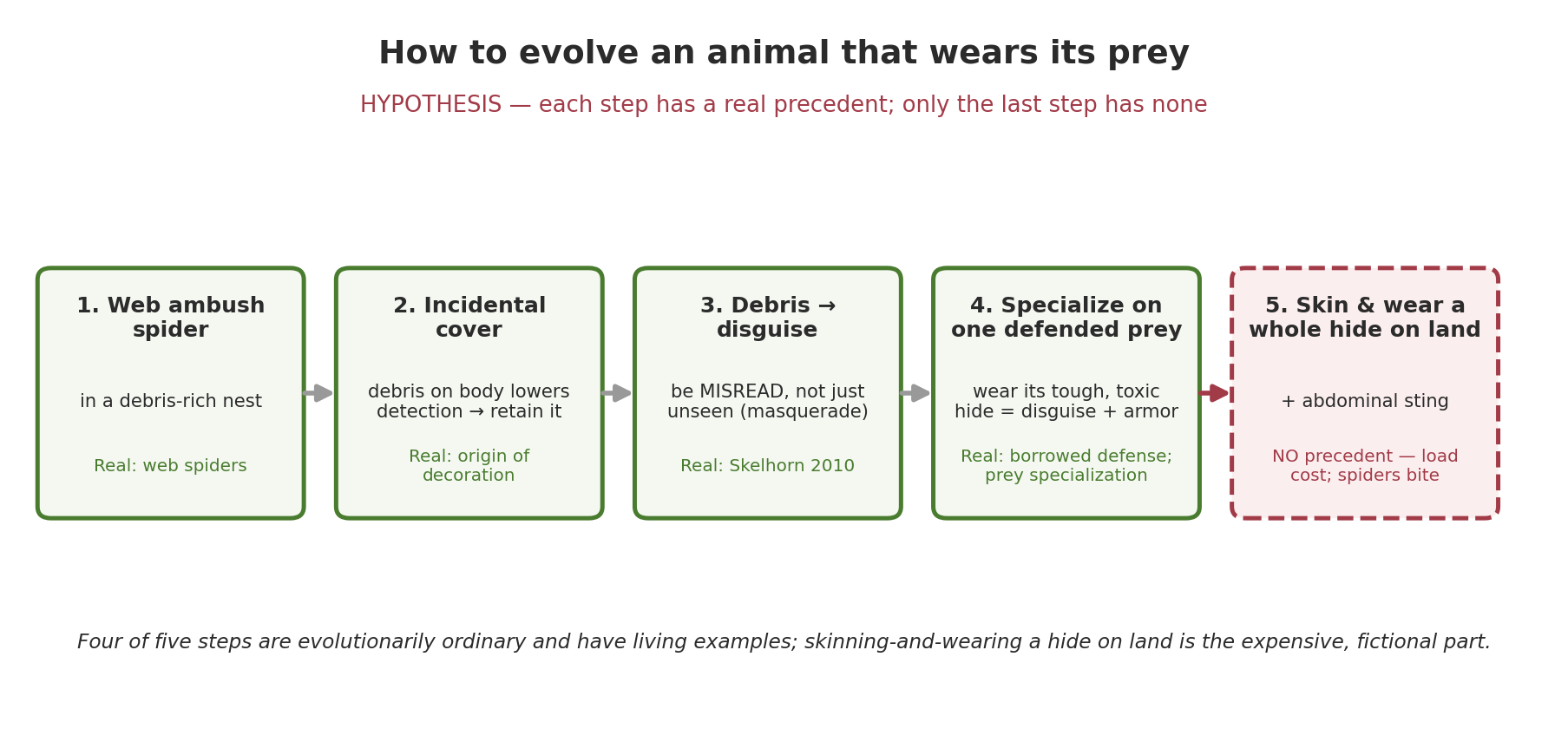
This section is explicitly speculative — a hypothesis assembled from known mechanisms, not a claim about a real species. Each step has a living precedent.
So four of five steps are evolutionarily ordinary, each with real examples; the skinning-and-wearing at that scale, on land, is the expensive, fictional part — and tellingly, the subspecies that wears a different prey's hide (Khezu, not Gypceros) is exactly what real prey-specialization would predict if two populations tracked two different abundant prey.
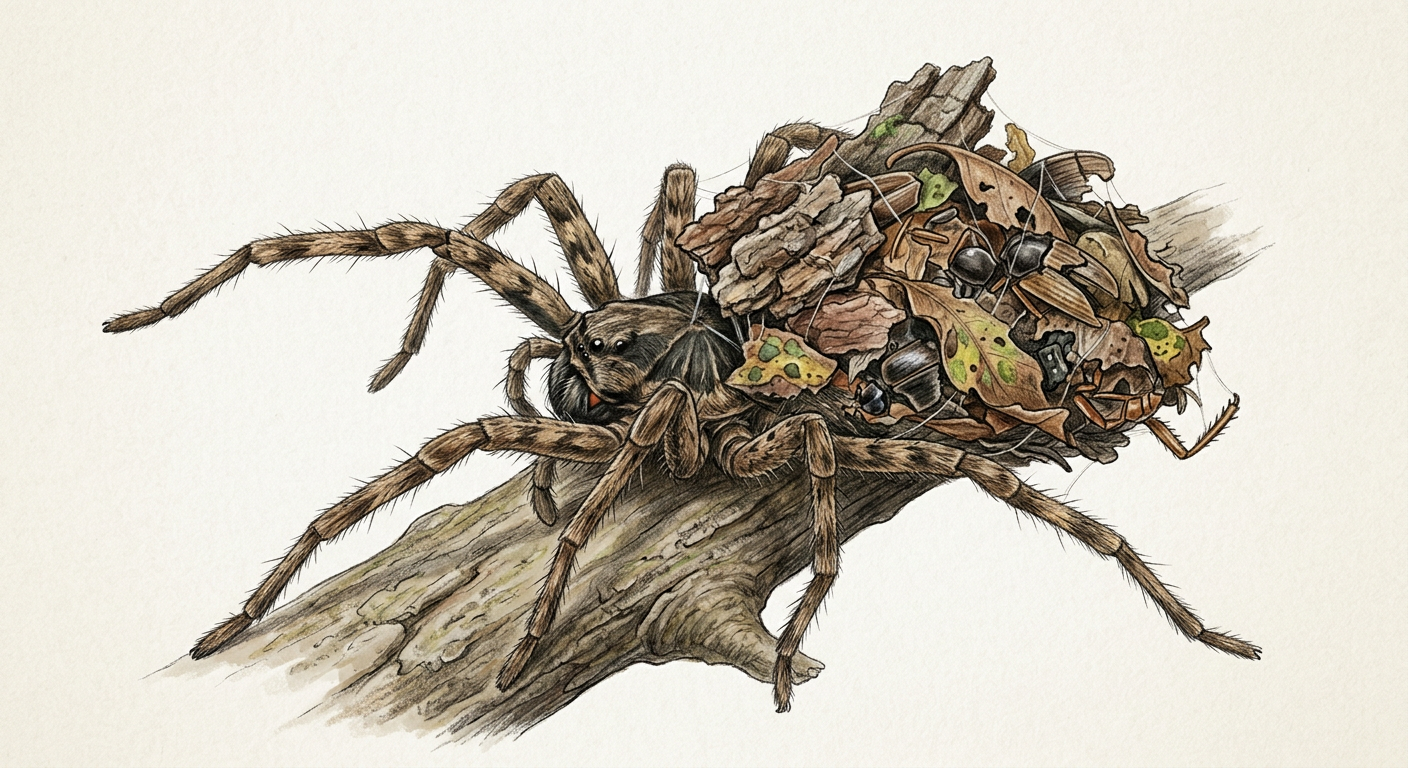
Also speculative — but these are the behaviors I would bet on if Nerscylla were real and we only ever met it mid-fight. Each follows a general rule in related animals.
None of this is in the game. All of it follows from how real web spiders and real decorators live.
The comparison below is built the same way as the earlier figures in this series: original, citable, and explicit about which cells are measured fact versus reasoned speculation. It sets the real decorators and masqueraders — the assassin bug Acanthaspis petax, the decorator crab, case-makers, and a twig-masquerade caterpillar — side by side with Nerscylla, sorted by the material worn, the demonstrated function (crypsis / masquerade / borrowed defense), who is deceived (predator versus prey), and habitat (with the aquatic-versus-terrestrial cost note).
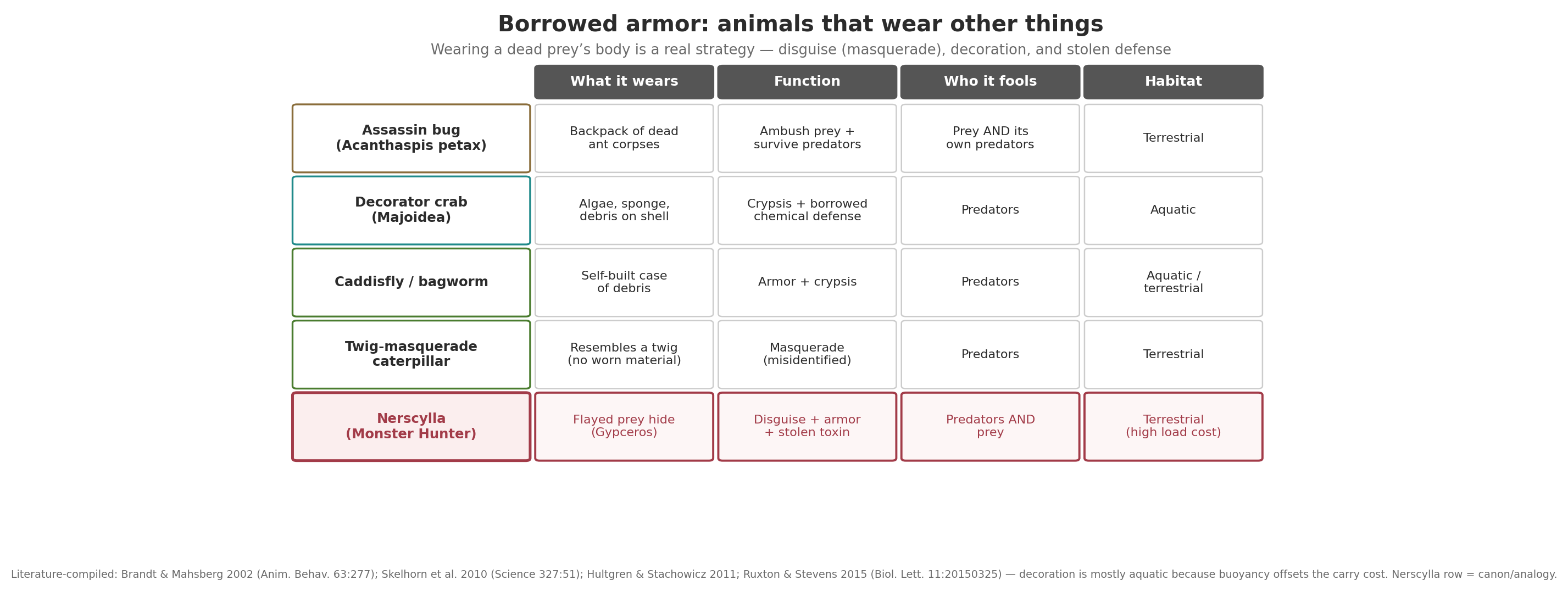
What Capcom got right: a predator named, on purpose, after a real orb-weaver; a sticky capture web that really does grip harder the more prey struggle; a paralytic venom that maps onto real acylpolyamine toxins; and — the centerpiece — wearing a dead prey's body, which is a genuine, experimentally studied strategy.
Where they bent it: skinning and wearing a whole hide on land (real decoration is mostly aquatic for a reason — the load cost), the abdominal stinger (spiders bite), and the leg count.
The real cast is worth meeting. The assassin bug Acanthaspis petax wears a backpack of its dead prey. Decorator crabs build disguises on their own shells. The Joro spider in a Japanese garden carries the kind of venom Nerscylla's paralysis is built on. And the chemical defenses Nerscylla "borrows" from its hide are the sort many beetles make for themselves.
It is named, on purpose, after a real orb-weaving spider. Capcom's localization team has confirmed that Nerscylla combines Nergal (a Mesopotamian god of plague and war) with Neoscona scylla, the scientific name of a real Araneidae orb-weaver native to East Asia, including Japan. But it is an arachnid analogy, not an anatomically real spider.
Yes. The assassin-bug nymph Acanthaspis petax cements a backpack of dead ant corpses onto its body. In a controlled experiment, Brandt & Mahsberg (2002) showed the corpse backpack specifically improves survival against vision-guided predators such as spiders, while a coat of dust masks the bug's cues for ambush.
Not exactly. Hiding (crypsis) is failing to be seen; masquerade is being seen but misidentified as an uninteresting object. Skelhorn et al. (2010) gave the first experimental proof that masquerade is distinct from crypsis — predators genuinely mistake the masquerader for the thing it resembles.
The paralysis maps onto real chemistry: spider prey-paralysis is dominated by acylpolyamines that block insect glutamate receptors, causing limp paralysis (Lüddecke et al. 2022). JSTX comes from the Joro spider, a Japanese orb-weaver. The separate "sleep" status has no single established sedative spider toxin and should be treated as an extrapolation. The abdominal stinger is fiction — real spiders envenomate by a bite through fangs.
The glue droplets on capture silk behave as a viscoelastic solid, so adhesion gets stronger the faster the prey pulls (Sahni, Blackledge & Dhinojwala 2010). A web that grips harder the more you fight it is real biology.


.png)

