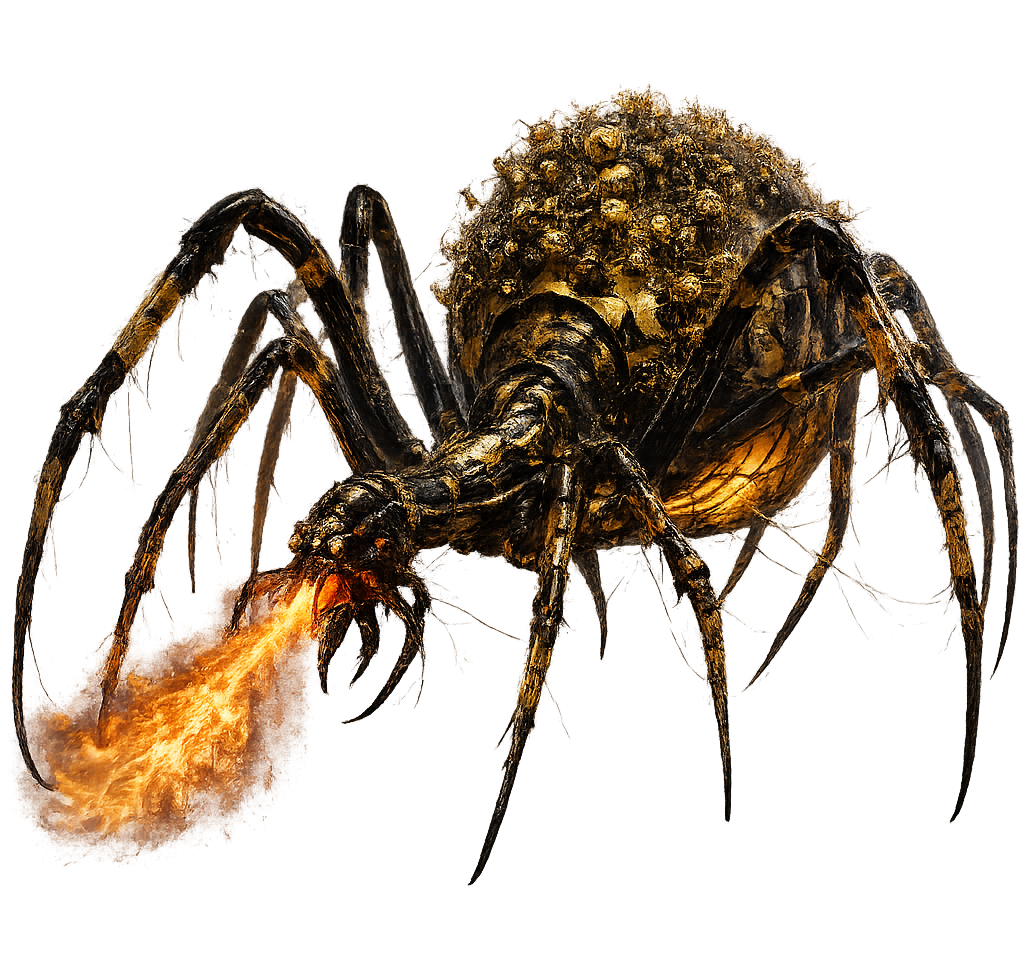
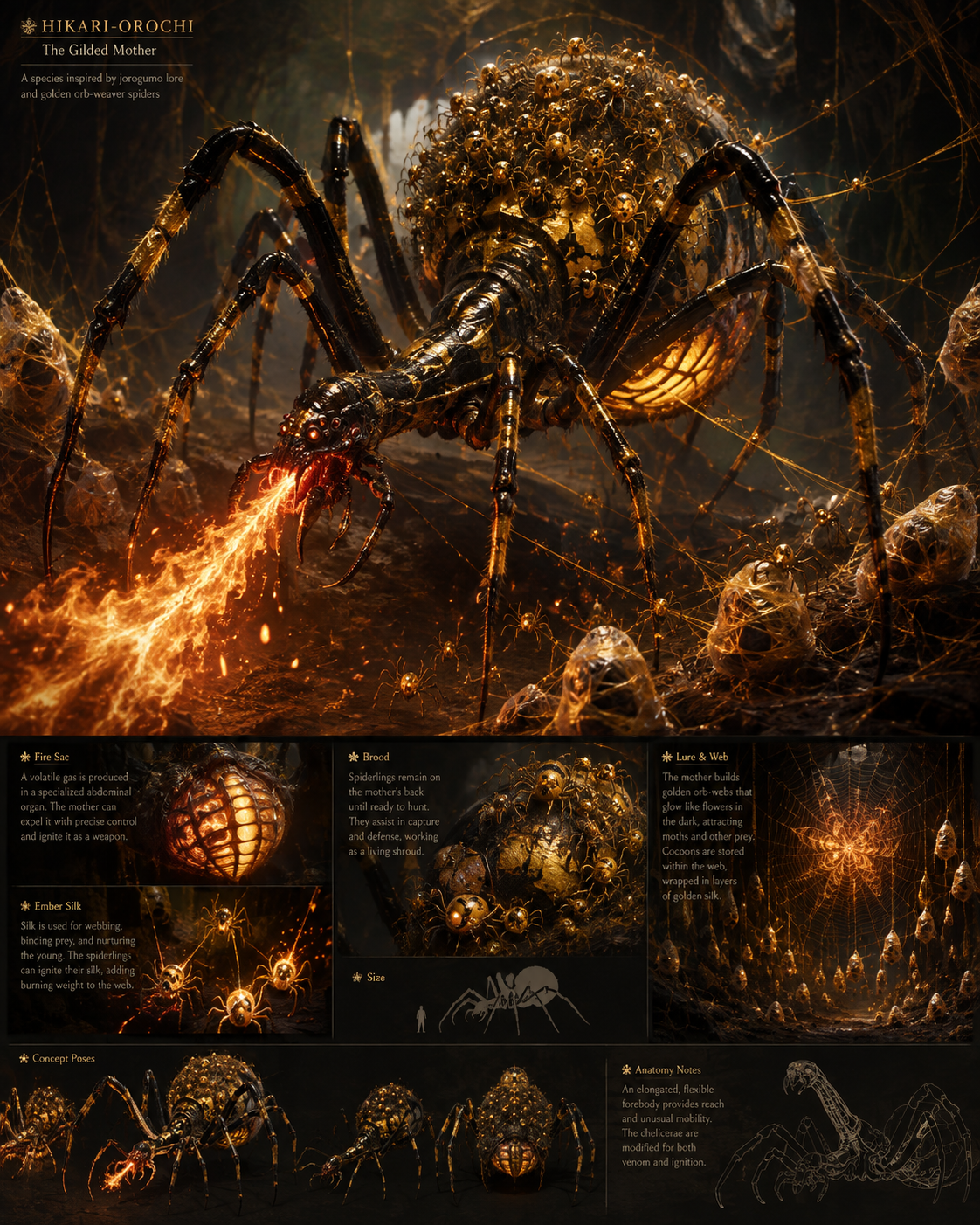
In one sentence: Rakna-Kadaki is a flagship Temnoceran (Monster Hunter Rise's spider-type class) — a fire-wielding queen of hot, arid caverns that drapes itself in gown-like webbing and carries a brood of fire-spitting offspring, the Rachnoid, on its abdomen.
A giant golden spider in a gown of silk, carrying a swarm of babies that fight for her and hold up her body. It is a striking image, and Capcom has been open about where it comes from: the jorogumo, the Japanese spider-yokai. But the part that should stop a biologist is the brood. Real spider mothers really do carry their young — and in some species the relationship runs the other, darker way: the mother is eaten by her own children, on purpose, and it is good for everyone involved. That is the story I want to tell, because the game inverted it, and the real version is more astonishing than the monster.
Tagging each claim.
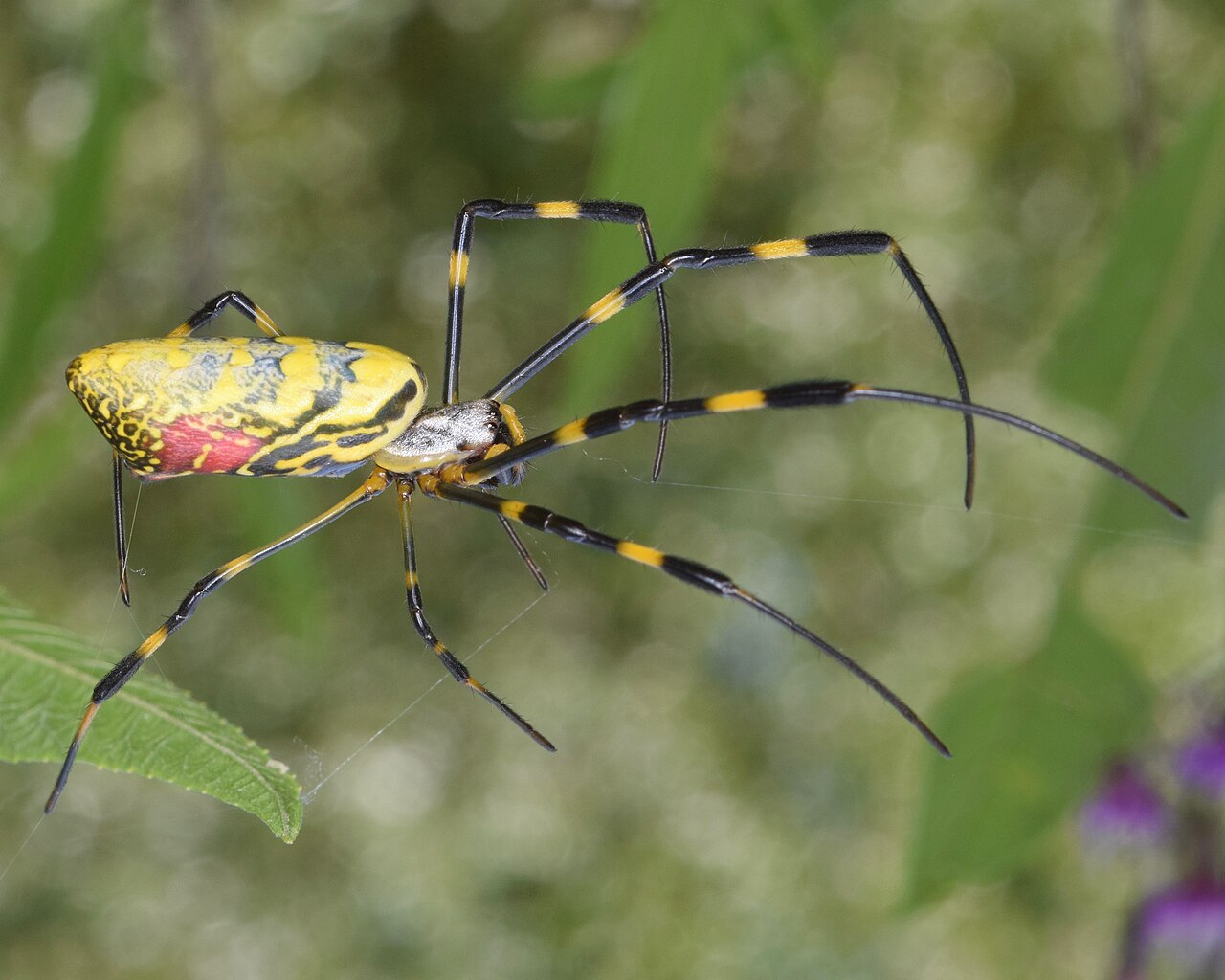
Canon, dev-confirmed. Rakna-Kadaki is a Temnoceran — Monster Hunter's spider-type, arachnid-analog class (the same class as Nerscylla and Lala Barina) — and a flagship monster of Monster Hunter Rise (2021), with a subspecies, Pyre Rakna-Kadaki, added in Sunbreak. Capcom's official monster spotlight states it is inspired by the jorogumo yokai; the tsuchigumo (giant spider demon) is a commonly cited secondary influence. Its real-world namesake is unmistakable: jorogumo is the Japanese common name of a real golden orb-weaver, the Joro spider (Trichonephila clavata) — so the design points at the folklore, and the folklore is named after the real spider. (I'll treat the real species as "the animal behind the legend," not as a stated in-game taxonomy.)
Canon, behavior. It is a fire monster: it stores a flammable gas in an abdominal organ and ignites it to breathe fire and inflict Fireblight — note, not poison. It carries a brood of small offspring (Rachnoid) on its abdomen, and in the game it directs them to spit fire, capture prey, and even help bear its weight; more hatch as they are lost.
Where the design takes liberties (so I won't overclaim). The fire is pure fiction — no real spider makes, stores, ignites, or controls fire; keep it firmly separate from the real venom chemistry below. The anatomy is stylized-arachnid rather than textbook-correct: the eight eyes and the long, retractable "neck" (a real feature of pelican spiders, family Archaeidae) genuinely echo real arachnids, but I will not assert a tidy "eight walking legs," because the body plan folds the pedipalps into its limb count and is fan-described, not officially specified. And real spiders do not command their young — so the Rachnoid as a directed strike force is the biggest stylization of all.
I work on coloration and on life-history — how animals signal, and how they spend their bodies on reproduction. Rakna-Kadaki is built on both: a conspicuous golden body that the folklore calls a lure, and a mother covered in her own brood. So I'll do the real coloration analysis the monster invites, then tell you what real spider motherhood actually looks like — and it is not what the game shows.
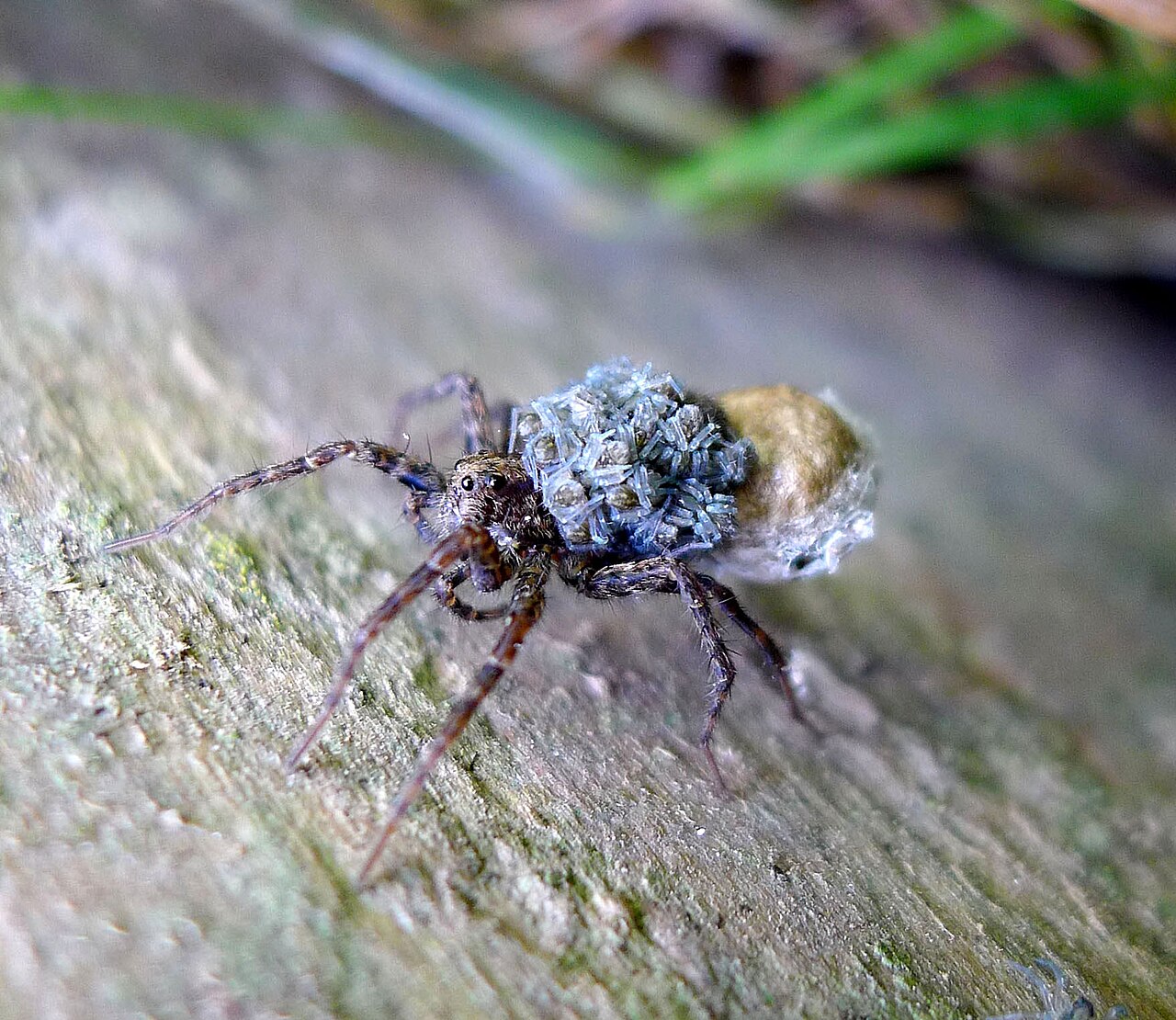
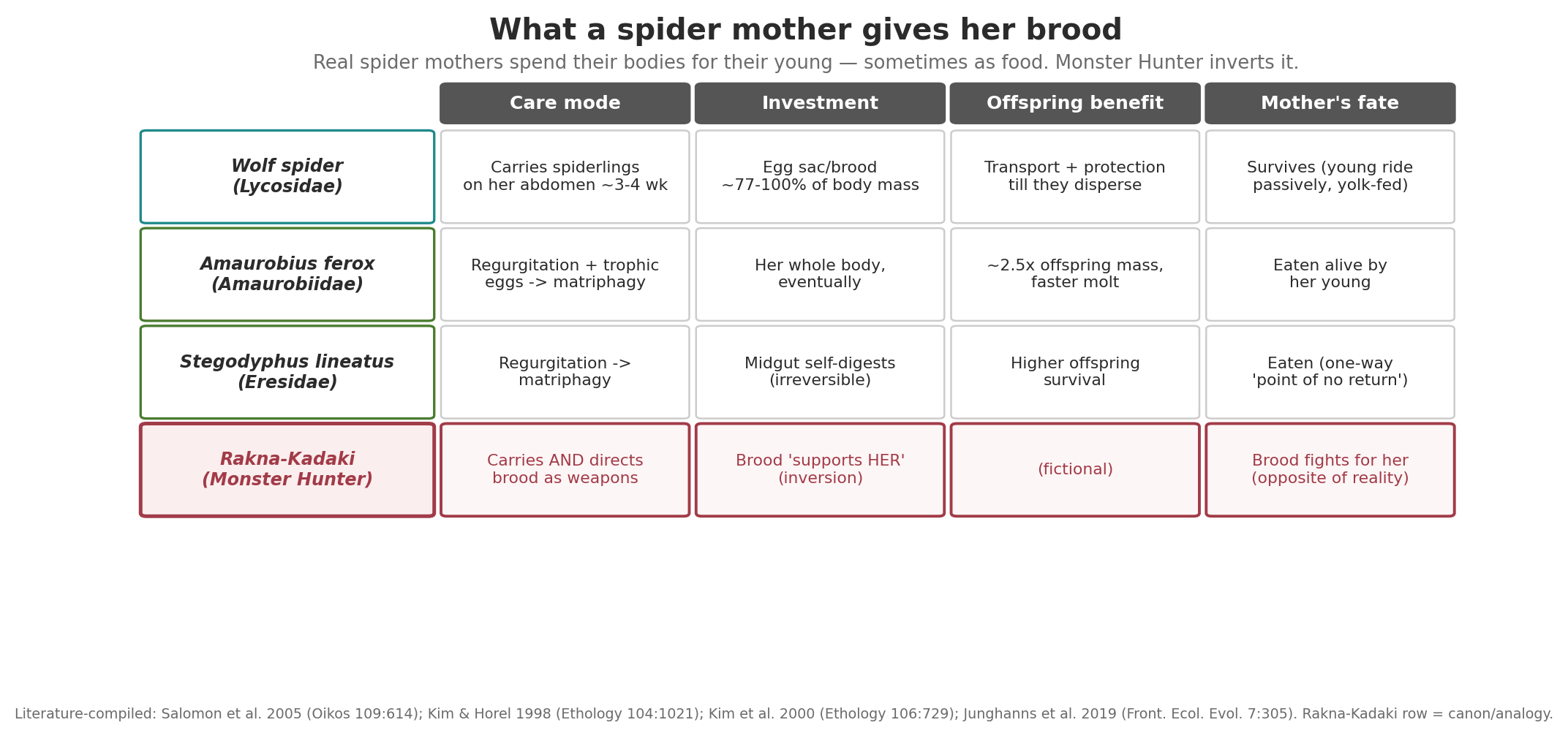
Real spider mothers carry their young, and the closest match to Rakna-Kadaki is the wolf spider (family Lycosidae): the female fastens her egg sac to her spinnerets, and once the spiderlings hatch they climb onto the top of her abdomen and ride there, piled dozens deep, for about three to four weeks until they disperse. It is genuinely costly — an egg sac can be most of the mother's body mass, and a carried female loses condition and moves worse. But one honest correction: those spiderlings ride passively, living on yolk reserves; they are not directed, and they certainly do not fight for her. The Rachnoid "supporting the mother" is the inverse of the real arrangement.
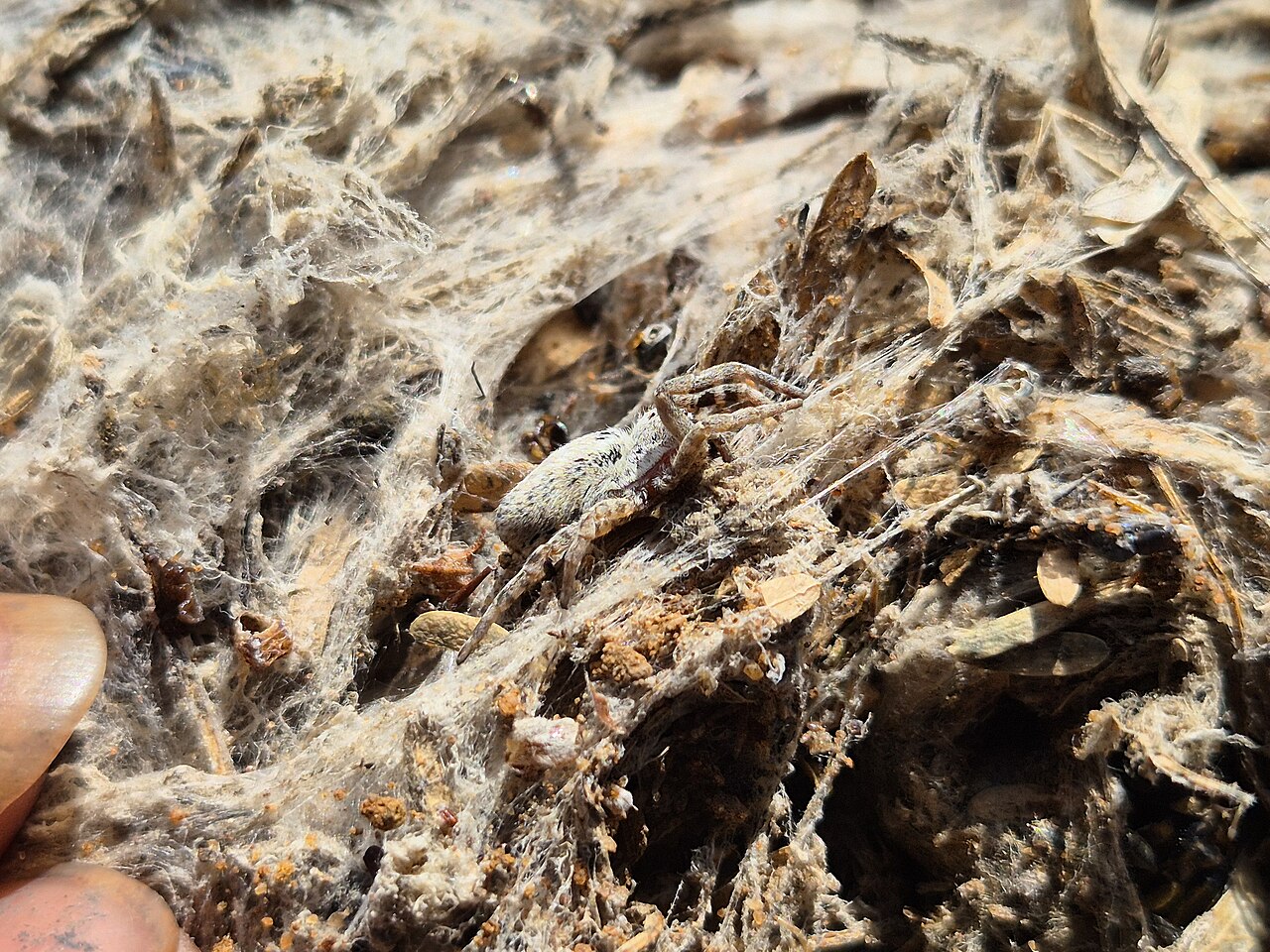
And the real arrangement, in some spiders, is extraordinary. In subsocial species — Stegodyphus in the family Eresidae, Amaurobius ferox in the Amaurobiidae — the mother feeds her young by regurgitating liquefied food, then lays trophic (food) eggs for them, and finally lets them eat her alive. This is matriphagy, and it is not a tragedy or a malfunction: in Amaurobius ferox, broods that consume the mother gain on the order of two and a half times more mass, molt sooner, and survive better (Kim & Horel 1998; Kim, Roland & Horel 2000). In Stegodyphus the mother's own midgut dissolves on a one-way schedule, so that by the time she is eaten she has already, biochemically, become food (Salomon, Schneider & Lubin 2005; Junghanns et al. 2019). The mother does not support the brood by fighting beside it. She supports it by becoming it.
That is the line the game had backwards, and it is the heart of this piece: real spider motherhood is one of the most extreme cases of parental sacrifice in the animal kingdom — the mother spends her body, sometimes literally, on her children.
Now the coloration, which is my home turf and where the folklore needs correcting.
The jorogumo legend says the spider lures men by appearing as a beautiful woman. The real golden orb-weavers do lure — but they lure insects, with color. In Trichonephila and Nephila, the bright yellow-and-black body and golden silk are not camouflage; they are a foraging signal that exploits prey insects' innate attraction to flower-like color. Paint the yellow out and prey capture drops sharply; the colorful spider's web intercepts far more insects than a plain one, by day and even more strongly by night, and the effect is stronger in large adults — juveniles are cryptic and only become conspicuous lures as they grow (Chuang, Yang & Tso 2007; Gálvez et al. 2018; Tso et al. 2004).
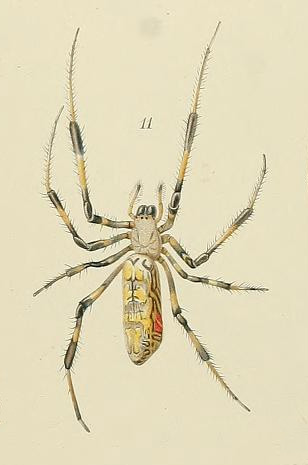
The precise point — and exactly the distinction I care about — is that this color talks to prey, not predators. It is a prey-attraction signal (a sensory trap), not aposematism and not Batesian or Müllerian mimicry. So the honest translation of the jorogumo is satisfying: the legend says it lures with beauty, and the real spider does lure with a visual signal — just aimed at pollinators, not men. Rakna-Kadaki's gold is, biologically, a hunting advertisement.
Rakna-Kadaki stills prey; the real chemistry behind its namesake is elegant and, notably, harmless to us.
The Joro spider gives its name to JSTX — Joro Spider Toxin — one of the founding spider acylpolyamine toxins. JSTX-3 is an open-channel blocker of glutamate receptors (the AMPA/quisqualate type). Because glutamate is the main excitatory signal at an insect's nerve-to-muscle junction, the toxin causes rapid limp paralysis in prey, and it became a standard neuroscience tool for dissecting those receptors in mammalian brains (Kawai, Niwa & Abe 1982; Saito et al. 1989). So the real "incapacitation" is a precise molecular key, not heat — keep the venom (real) and the fire (fictional) separate.
And one myth worth killing: despite the headlines, the real Joro spider is essentially harmless to humans — its fangs rarely even pierce skin, and a bite is compared to a bee sting. The venom is a tool for subduing insects and a gift to pharmacology, not a danger to people.
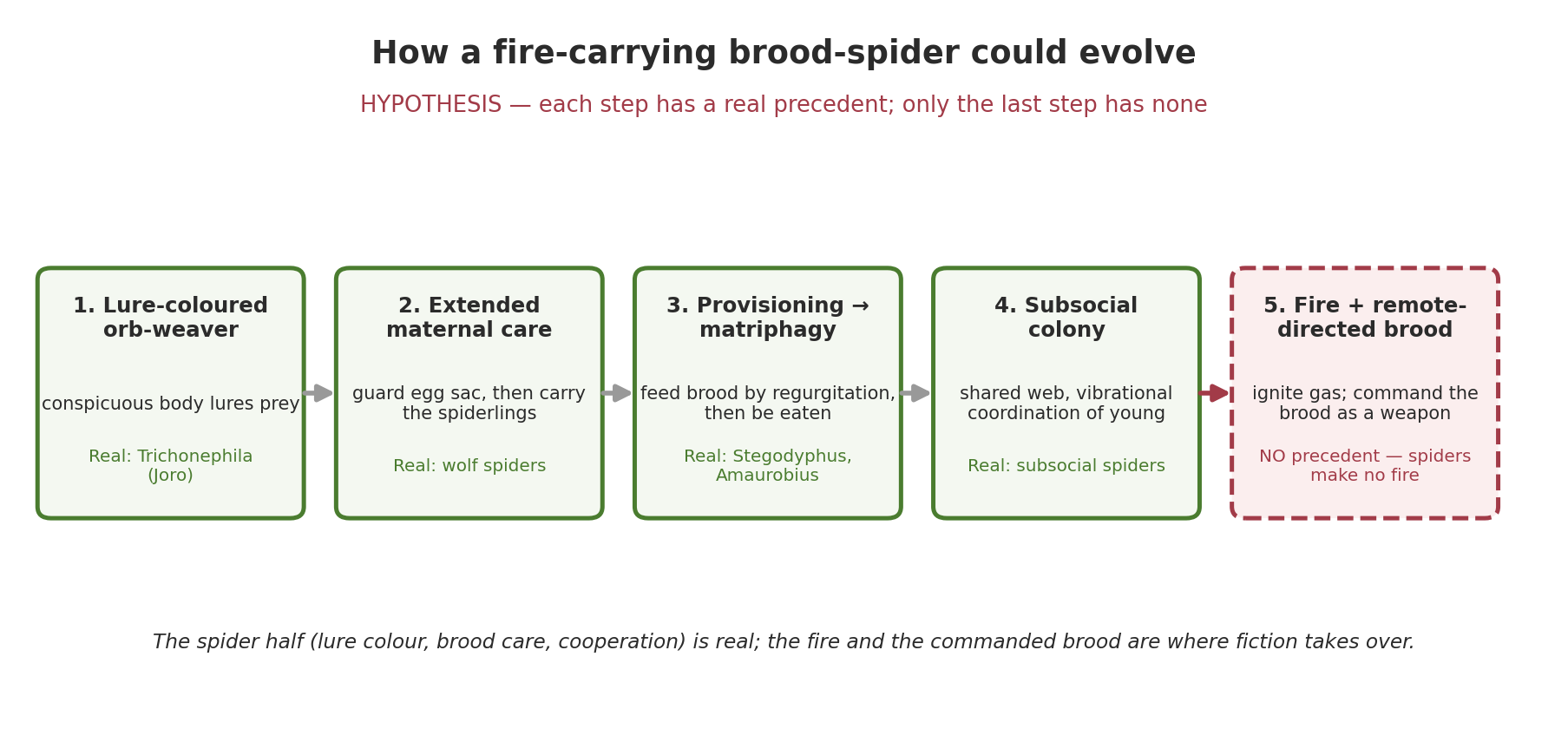
This section is explicitly speculative — a hypothesis from known mechanisms, not a claim about a real species. Each step has a living precedent.
So the spider half of Rakna-Kadaki (lure coloration, brood care, even cooperative young) is a stack of real, well-studied biology; the fire and the tactical control of offspring are where the monster leaves the tree of life entirely.
Also speculative — but these are the behaviors I would bet on if it were real, each from a general rule in spiders.
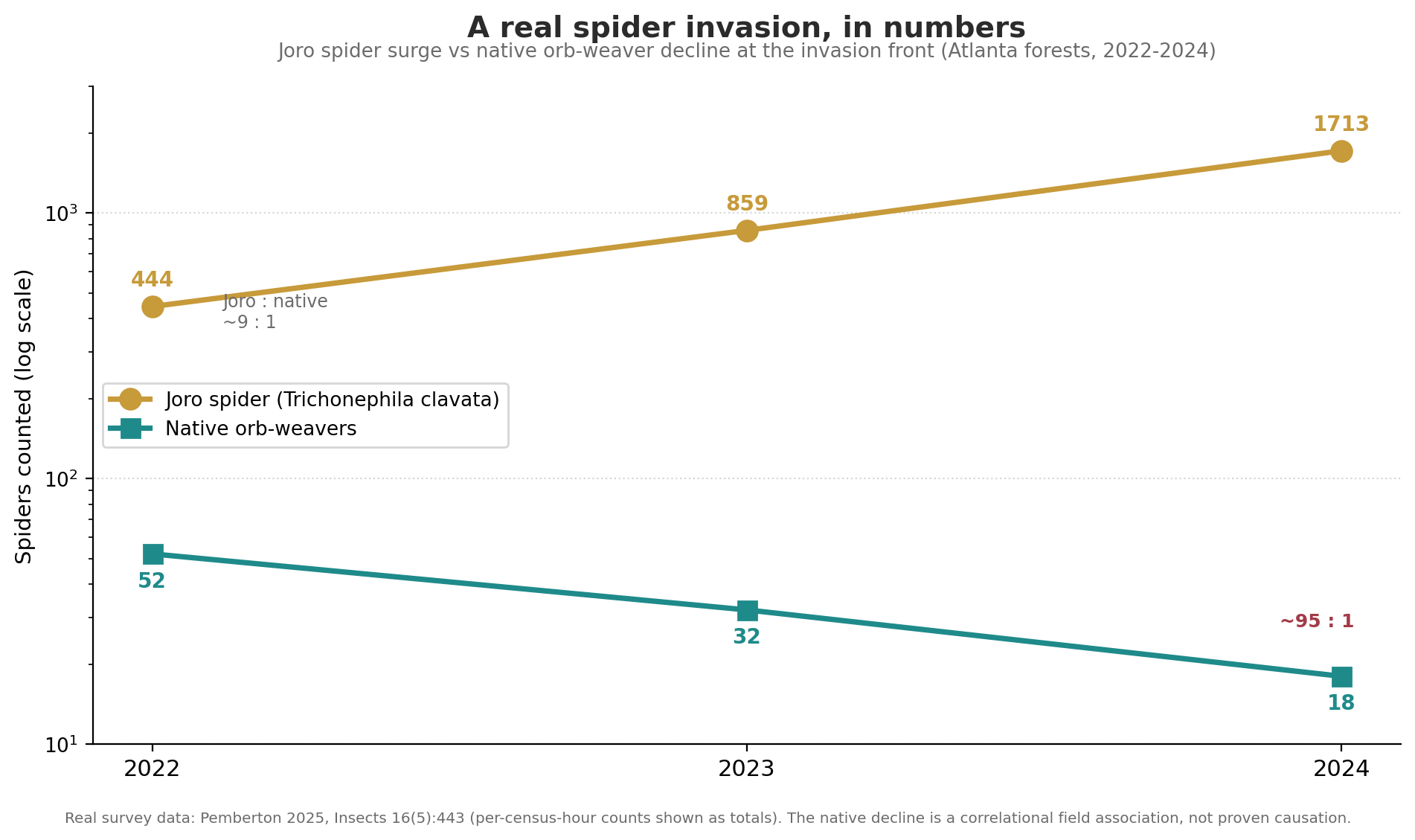
Both figures are built like the earlier ones: original, citable, and explicit about which numbers are measured fact versus reasoned framing. The maternal-care comparison (Figure 1, above) sets real spider investment — up to matriphagy — against the game's inversion. The second is the live invasion.
At a leading edge in Atlanta forests, the Joro spider surges against native orb-weavers year on year: Joro counts climbing 444 → 859 → 1,713 across 2022-2024 while native orb-weavers fall 52 → 32 → 18 (Pemberton 2025). The Joro counts are real survey data; the native decline is a correlational field association, and I label it as such.
What Capcom got right: a spider explicitly drawn from the jorogumo, whose real namesake genuinely lures prey with color; an orb-weaver that carries its brood; and an animal whose proliferating numbers overwhelm the locals — which is, eerily, the real Joro spider's invasion story.
Where they bent it: the fire (no real spider makes it), the brood as a directed weapon (real young are carried, not commanded), and the inverted maternal economy — real mothers spend their bodies for their young, not the reverse.
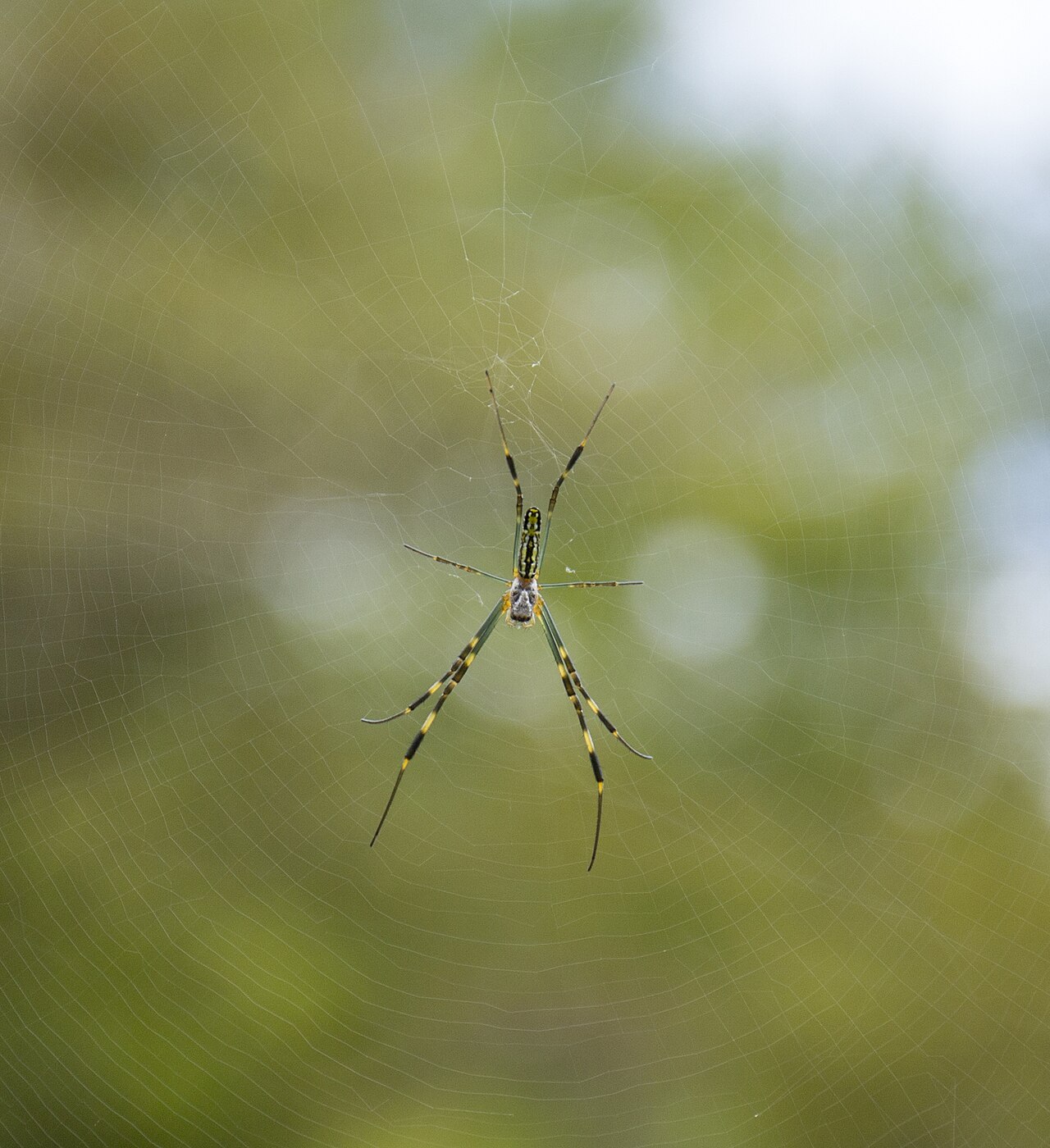
The real cast is worth meeting, and one of them may be near you. The Joro spider (Trichonephila clavata) — the animal behind the legend — sits in a meter-wide golden web across Japan and, now, much of the southeastern United States. A wolf spider in your garden carries her spiderlings on her back. And in a Stegodyphus nest, somewhere, a mother is being eaten by her children, which is the kindest thing she will ever do.
The jorogumo, the Japanese spider-yokai — Capcom's official monster spotlight confirms it. The jorogumo is named after a real golden orb-weaver, the Joro spider (Trichonephila clavata), so the design points at the folklore and the folklore is named after the real spider. The fire is fiction; real spiders make none.
Yes — it is called matriphagy. In subsocial spiders such as Stegodyphus and Amaurobius ferox the mother feeds her young by regurgitation and trophic eggs, then lets them eat her alive. In Amaurobius ferox, broods that consume the mother gain about two and a half times more mass, molt sooner, and survive better (Kim & Horel 1998; Kim, Roland & Horel 2000).
The bright yellow-and-black body and golden silk are a prey-attraction signal, not camouflage and not warning coloration. The color exploits prey insects' innate attraction to flower-like hues; painting the yellow out drops prey capture sharply (Chuang, Yang & Tso 2007; Tso, Lin & Yang 2004). It talks to prey, not predators.
No. The real Joro spider is essentially harmless — its fangs rarely even pierce skin and a bite is compared to a bee sting. Its venom, JSTX, is a precise blocker of insect glutamate receptors and a useful neuroscience tool, not a danger to people.
Yes. First recorded in North America around 2013-14 (Hoebeke, Huffmaster & Freeman 2015), it has spread across the southeastern United States. At a leading edge in Atlanta forests, Joro counts rose 444 → 859 → 1,713 over 2022-2024 while native orb-weavers fell 52 → 32 → 18 (Pemberton 2025); the native decline is a correlational association.
.jpg)


