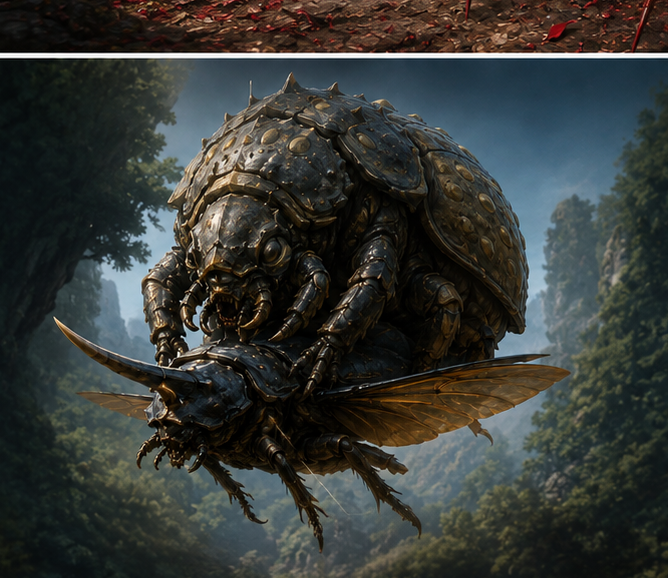
In one sentence: Seltas Queen is a giant, flightless beetle-type monster from Monster Hunter (since Monster Hunter 4 Ultimate) that lures a much smaller male, makes him carry her in flight, and eats him when she is hungry.
She is enormous, armored, and cannot fly. So she releases a scent, and a much smaller male comes to her. She grabs him, and from then on he carries her through the air. When she is hungry, she kills him and eats him — then calls another.
That is the life of the Seltas Queen, an insectoid monster from Monster Hunter. The first time you watch it happen in-game, the reaction is the same one I get in the field looking at a real beetle I cannot identify: wait — is that real?
So I did what I do for a living. I am an evolutionary ecologist; I study the evolution of animal coloration and mimicry, and how predators and prey shape each other. I went through the Seltas Queen the way I would review a manuscript. The short answer: no single real beetle lives like this. The longer, more interesting answer is that every separate piece of her — the giant flightless female, the disposable carried male, the horn, the cannibalism — is real somewhere in nature. Capcom didn't invent biology here. They assembled it.
Let me be precise, because precision is the whole point of this series. I will tag each claim by how solid it is.
Canon, from the in-game field guide. The Monster Hunter 4 Ultimate Hunter's Notes for the Seltas Queen read: she is a wingless female "unable to fly," who "release[s] pheromones to lure in male Seltas to serve as thralls." The pheromone lure is verbatim canon.
Canon, from Capcom's official material and observable play. The male then carries the flightless Queen in flight, and the two perform combined attacks — this is stated in Capcom's official monster spotlight and is what you see in the fight, rather than in the short field-guide blurb. When her stamina runs low, the Queen grabs the male, smashes him to death, eats him, and summons a replacement. That is an actual in-game behavior, not flavor text.
Where I'll stop you. You will find it repeated online that the male "lifts three times its own size." That number is not canon — it appears only in fan-wiki prose, and the item description it is sourced to says nothing of the kind. So I won't use it. What is true is qualitative and remarkable enough on its own: a smaller male carries a much larger female.
One detail makes this monster especially fun to take apart. The Monster Hunter Wiki's ecology page files Seltas under Order Coleoptera, Suborder Adephaga, Family Seltas. "Family Seltas" is invented, of course — that is a worldbuilding convention, not Linnaean taxonomy. But Adephaga is real: it is the largely predatory beetle suborder that contains the ground beetles.
Adephaga is the second-largest suborder of beetles — roughly 40,000 species of mostly predators, and it contains the Carabidae, the ground beetles: fast, hunting beetles. So the game has filed Seltas among the predatory beetles.
That is a useful starting point, because it lets me ask a sharp question instead of a vague one. Not "is Seltas realistic?" but: does Seltas behave like a real adephagan beetle — and where it doesn't, whose biology did Capcom borrow instead? Let's take her apart.
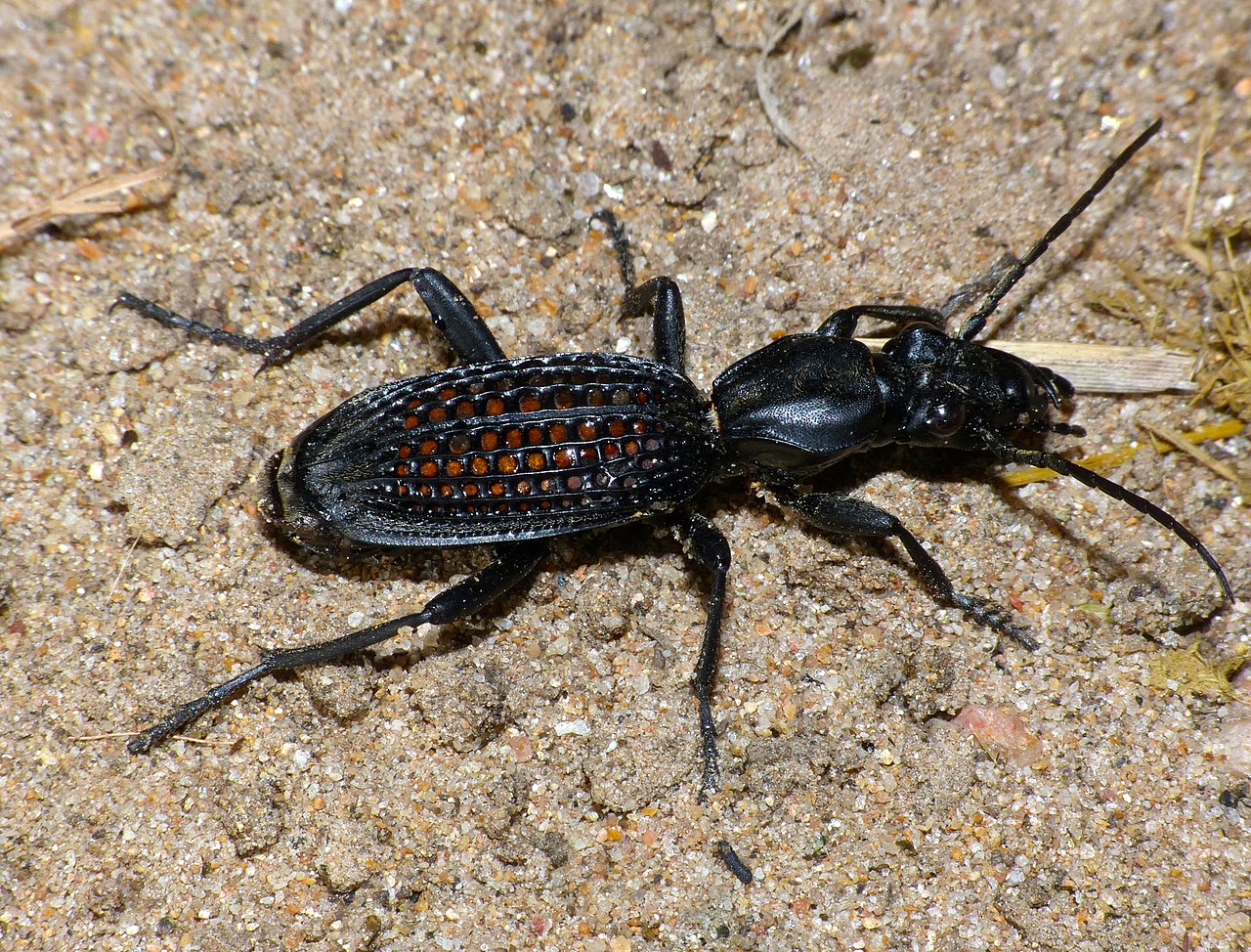
The male Seltas leads with a forward horn. Horns like this are not decoration; in real beetles they are weapons, and they are one of Charles Darwin's original examples of sexual selection — structures that exist because they win males access to mates, not because they help survival.
The model organism here is Japan's own rhinoceros beetle, kabutomushi (Trypoxylus dichotomus). Two facts about its horn matter for Seltas.
First, the horn scales with positive allometry: bigger males have disproportionately longer horns. In one Kyoto population, horn length scaled against elytron (wing-case) length with a slope of about 3.15 (95% confidence interval 2.90–3.46) (Buchalski et al. 2019, Insects). A slope above 1 means the horn grows faster than the body — exactly the runaway look an exaggerated sexual weapon should have. (That value is one population's estimate, not a fixed constant; horn allometry varies between populations.)
Second, the horn is an honest signal. Its growth is tied to how well the larva fed, through the insulin signalling pathway (Emlen et al. 2012, Science). A male cannot grow a big horn unless he was a well-fed, high-quality larva — so the horn cannot be faked, which is precisely what makes it useful in a fight before the fight even starts.
A common myth I want to head off: that such a giant weapon must be a crippling handicap. It mostly isn't. Even an enormous rhinoceros-beetle horn imposes negligible aerodynamic cost in flight (McCullough & Tobalske 2013, Proceedings of the Royal Society B). And positive allometry is not universal across horned beetles either (Bonduriansky 2007) — biology is messier than the textbook cartoon.
Verdict on the horn: biologically coherent. A condition-dependent sexual weapon on a beetle-like male is good evolutionary design. If the series stopped here, Seltas would just be a slightly stylized rhinoceros beetle.
It does not stop here.
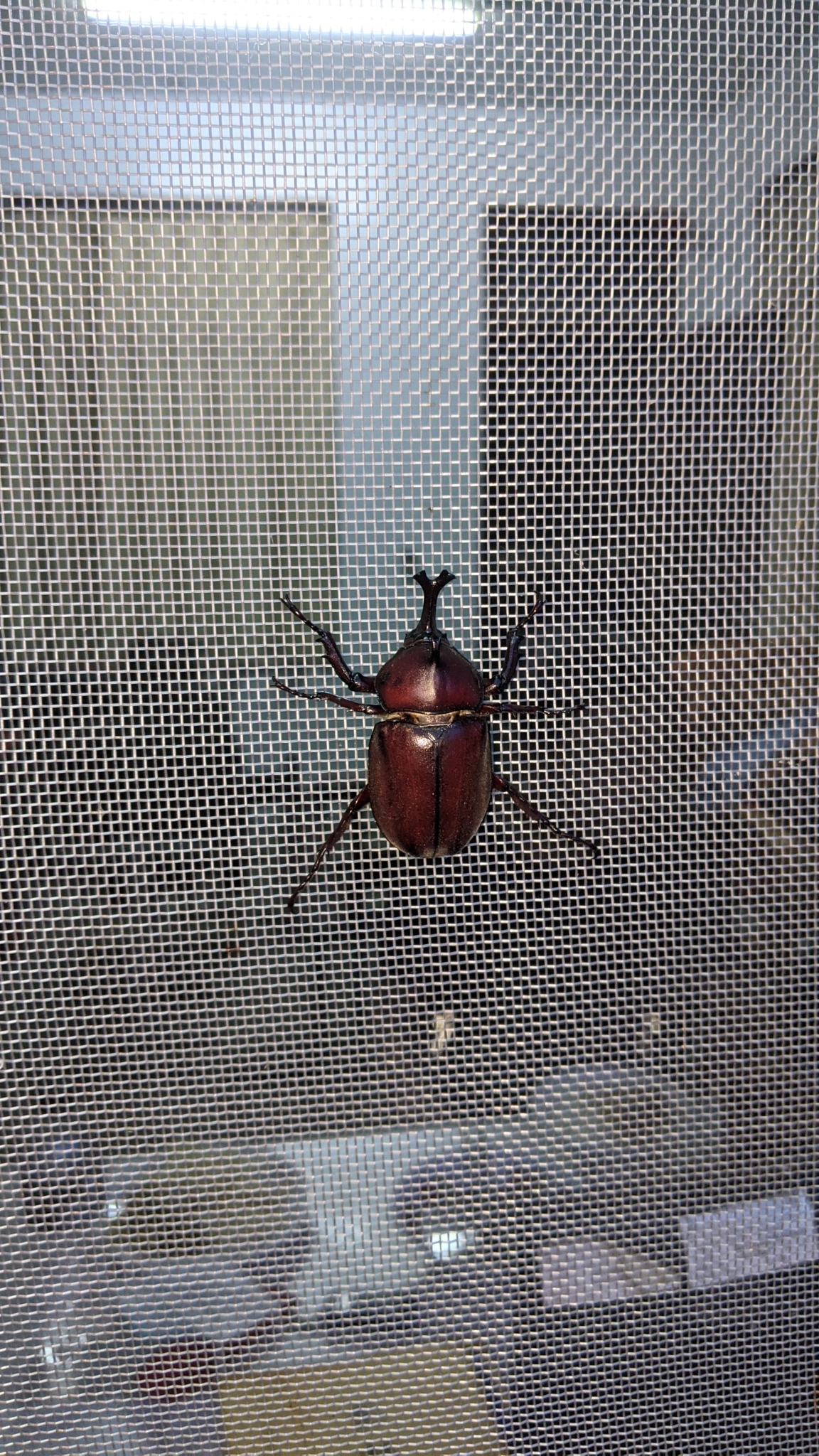
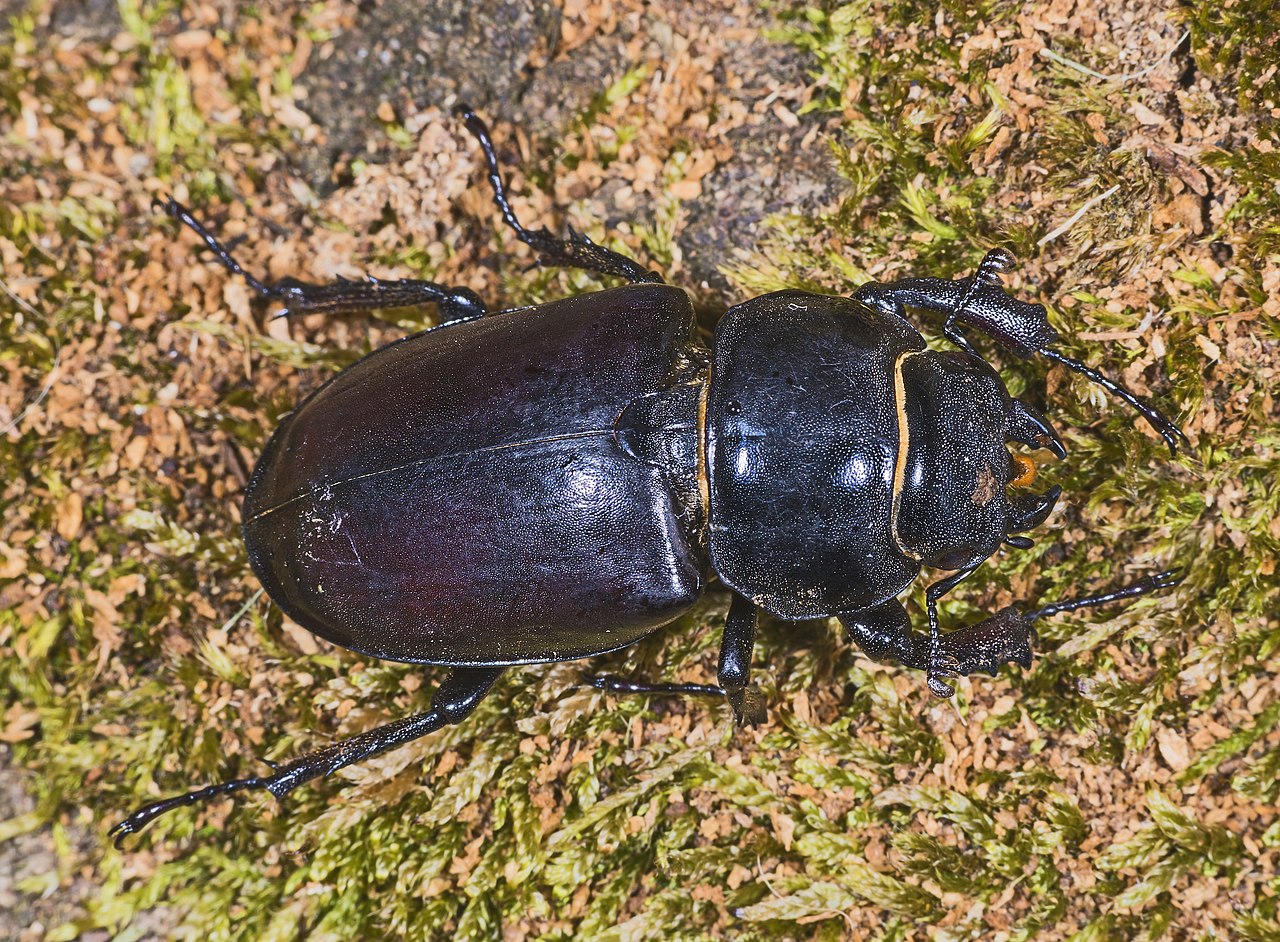
Here is where the design leaves the beetles entirely.
In the animal kingdom, the most extreme size differences between the sexes are female-biased — the female vastly larger than the male — and they are concentrated not in beetles but in spiders. Female-biased extreme dimorphism has evolved at least sixteen separate times in spiders, and it travels with a whole syndrome of traits: mate-guarding, males that sacrifice themselves, and sexual cannibalism (Kuntner & Coddington 2020, Annual Review of Entomology). If that list sounds familiar, it should — it is the Seltas Queen's entire life history.
Why do females get so big? There is no single reason; the leading explanations stack. Bigger females lay more eggs (fecundity selection). Bigger females can take larger prey and avoid competing with their own small males (niche divergence). And small males may simply be better at finding and reaching a rare, sedentary female. (One caution for the careful reader: female-biased dimorphism tends to break "Rensch's rule," the usual scaling pattern named for male-biased systems — so I won't pretend the standard rule applies here.)
Now the key point for Seltas. Real beetles are usually only mildly dimorphic, and where beetles are strongly dimorphic it is the males that are exaggerated, through weapons like that horn — not the females through sheer size. A beetle with a giant flightless female and a tiny male is not a beetle pattern at all. It is a spider pattern wearing a beetle's shell.
This is the figure I built to show exactly that.
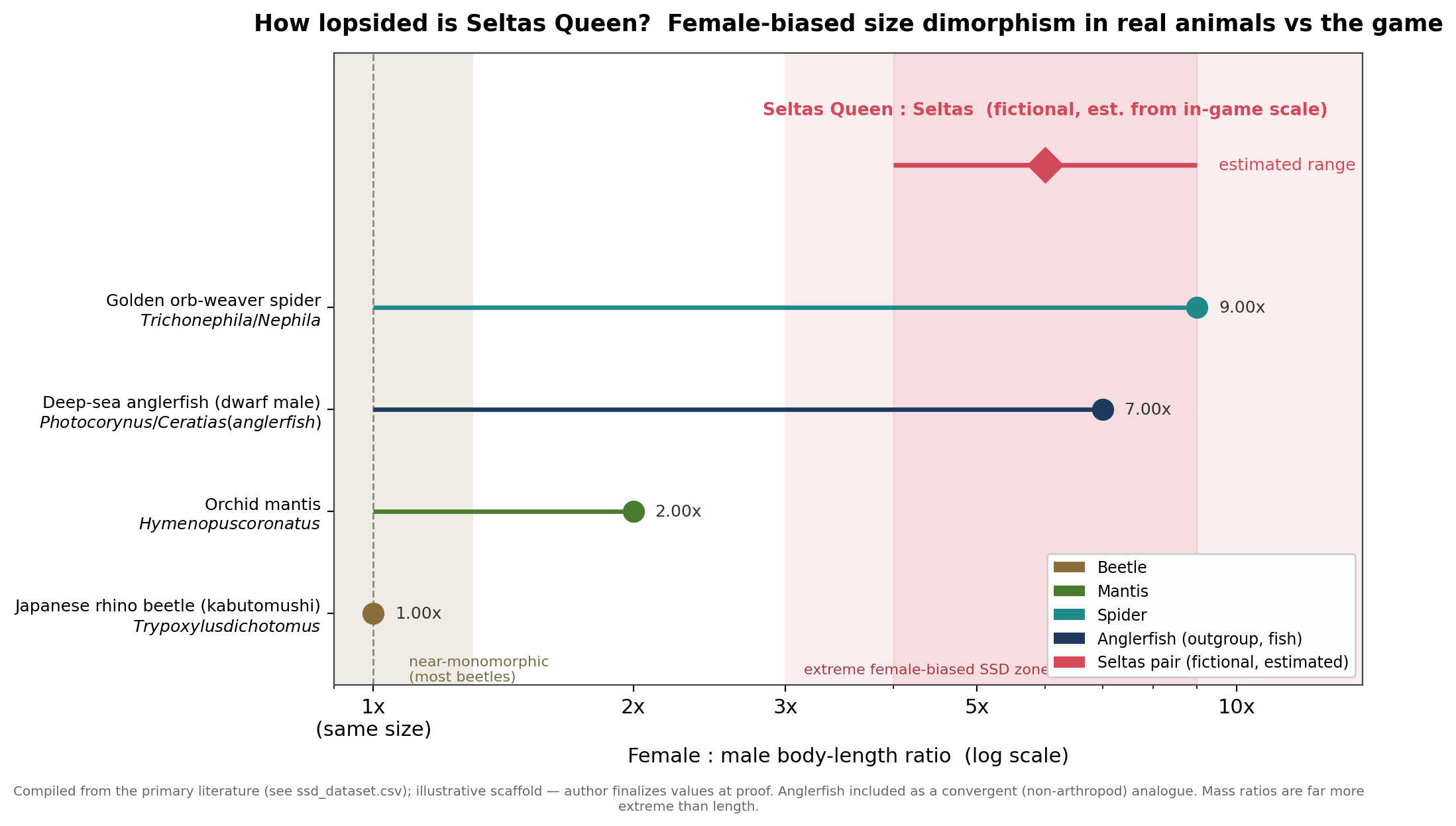
The picture makes the argument in one glance: on the axis of "how much bigger is the female," Seltas Queen doesn't sit with the beetles. She sits with the spiders.
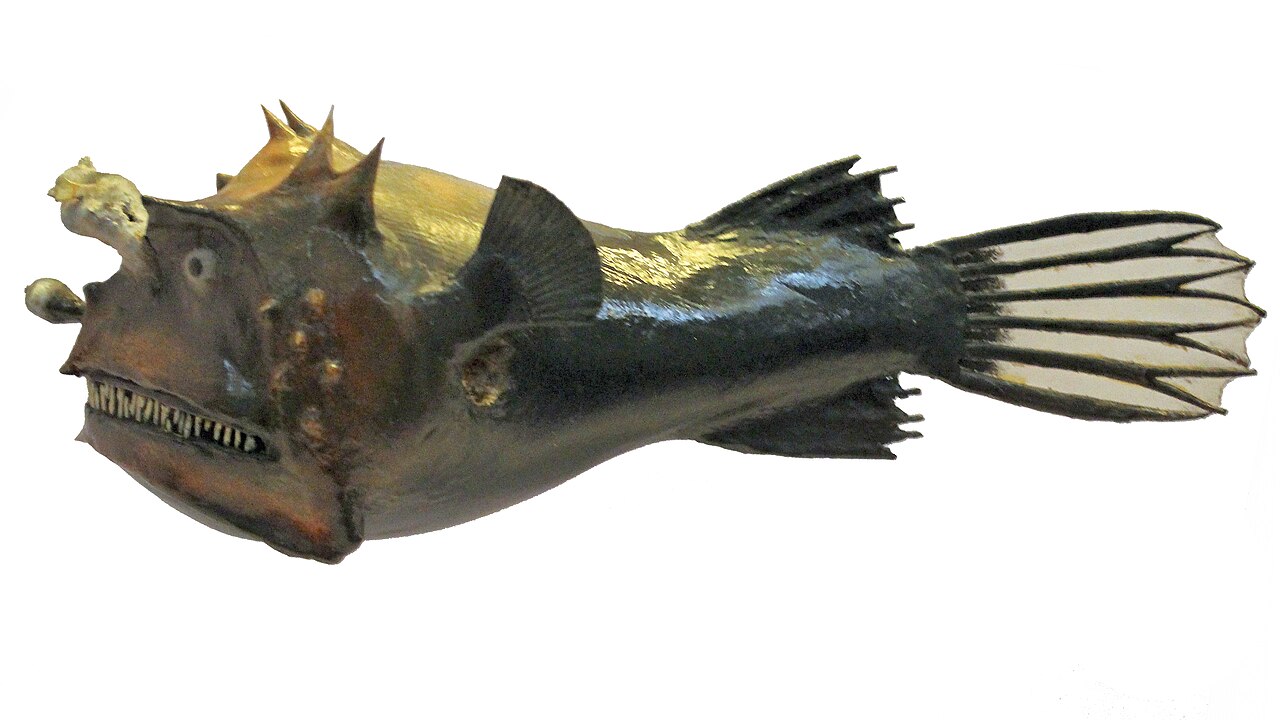
The strangest detail — a small male permanently attached to and carrying a giant female who may eat him — is also real, and it is one of the most extraordinary stories in biology. It just isn't an insect story.
In deep-sea anglerfishes, the tiny male finds a female in the dark, bites on, and fuses to her permanently — their tissues join, he is nourished by her blood, and he becomes little more than an attached source of sperm (Pietsch 2005, Ichthyological Research). This is true sexual parasitism. To tolerate another individual's fused tissue, some anglerfish have even lost parts of their adaptive immune system — they gave up immune defense to keep a husband (Swann et al. 2020, Science).
The evolutionary logic is the same problem Seltas Queen poses: when females are large, scattered, and hard to find, selection stops favoring big competitive males and starts favoring small males who locate a female, attach, and never let go. Different lineage, same solution — this is convergence, not relationship. (Anglerfish are fish; Seltas is drawn as a beetle. I am pointing to a shared selective pressure, not a family tree.)
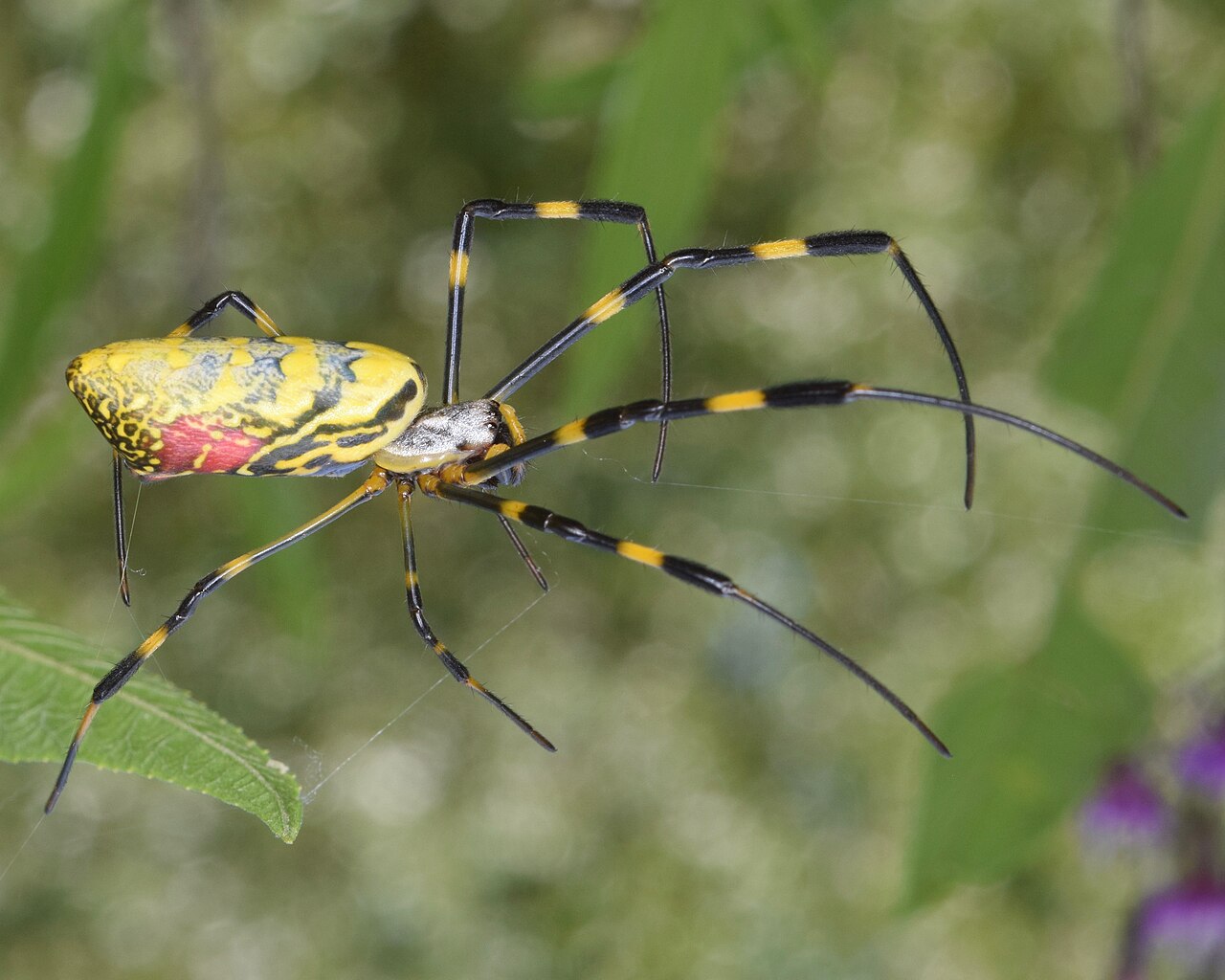
The closest arthropod version is, again, the golden orb-weaver spiders: a tiny male, a giant female, and a real risk of being eaten during or after mating. Sexual cannibalism there is not malfunction — it can be a last meal that funds the female's eggs, sometimes with the male's tacit cooperation. The Seltas Queen eating her spent mate and calling the next one is a video-game-blunt version of an old, real evolutionary bargain.
Putting it together (Figure 1): on the spectrum of real female-to-male size ratios, the beetles cluster near parity, and only distantly related lineages — spiders, anglerfish — reach the lopsidedness the game gives the Seltas pair. I assembled those comparison values from the published literature; the underlying table, with a source and a confidence flag for every number, is downloadable.
That is the honest scientific finding: Seltas Queen is not a real beetle, and not impossible either. She is a chimera — a beetle's horned male spliced onto a spider-and-anglerfish female.
This is explicitly speculative — a hypothesis built from known mechanisms, not a claim about a real species. Each step has a living precedent.
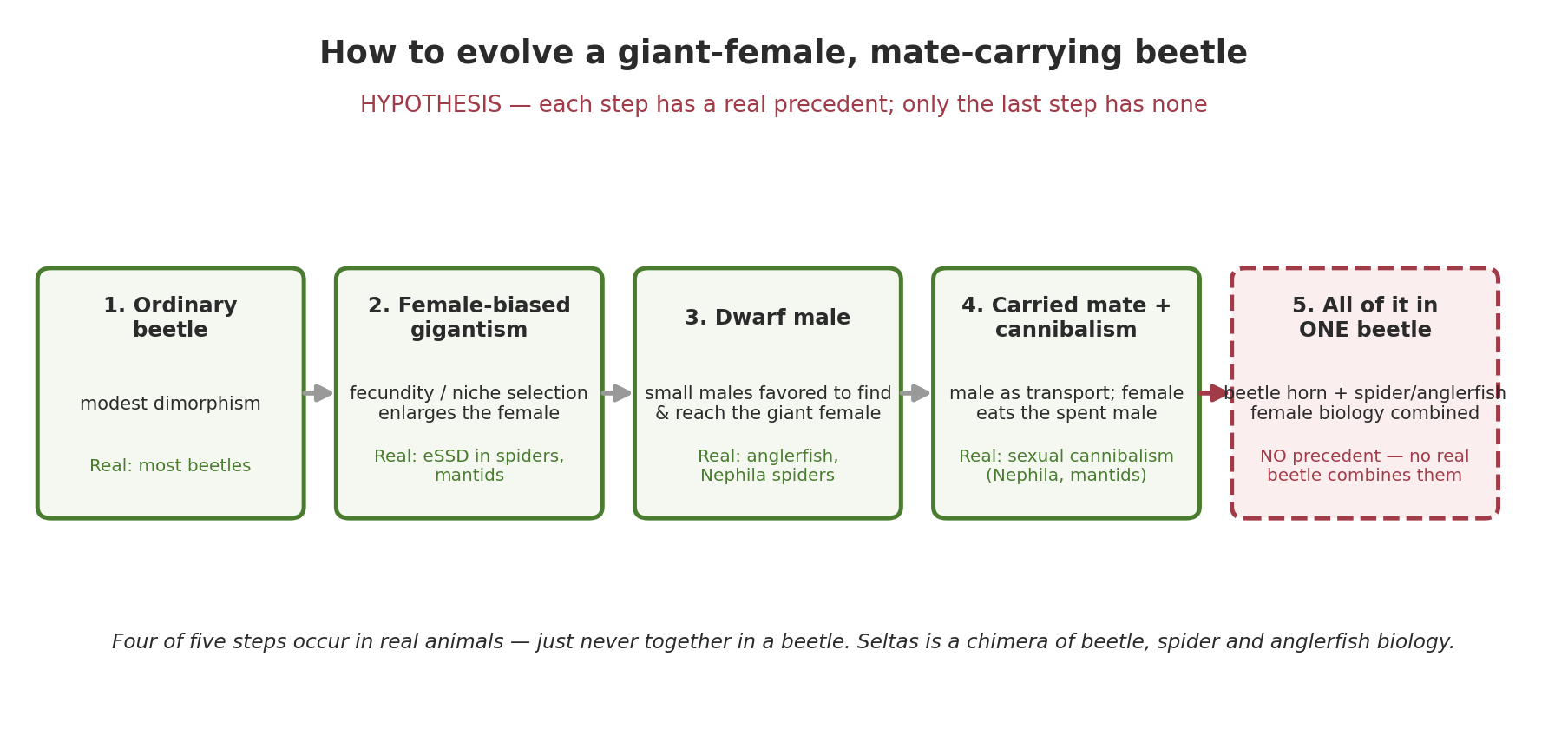
So four of the five steps occur in real animals; only their combination in a beetle is invented — which is what makes Seltas Queen a chimera rather than an impossibility.
Also speculative — but these follow from how real, strongly female-biased, cannibalistic animals live.
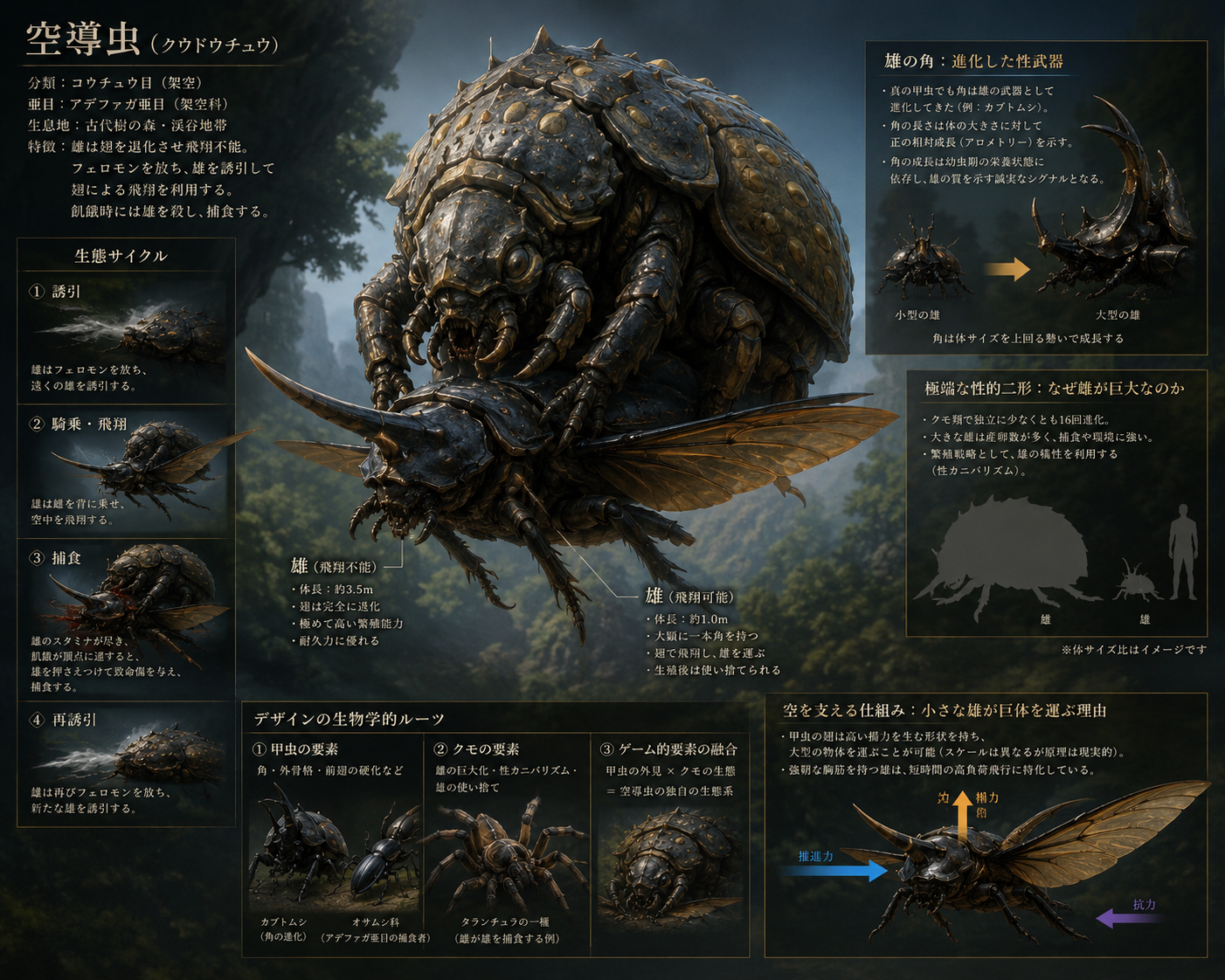
What Capcom got right: the horn as a sexual weapon; the pairing of female gigantism with cannibalism and a self-sacrificing male, which is a genuine, repeatable evolutionary package; the pheromone lure, which is exactly how many real insects find mates in the dark.
Where they bent biology for a good monster: they put the female-gigantism syndrome of spiders and the carried-dwarf-male of anglerfish onto an animal they classified as a beetle. Real adephagan beetles — predatory, fast, modestly dimorphic — don't live this way. And honestly, that splice is why she's a great monster. Good monster design, like good speculative biology, takes real parts and recombines them past where any real lineage went.
That is the recurring lesson of this series: the Monster Hunter team are not ignoring biology. They are remixing it — and you can hear the original tracks if you know the music.
If this made you want to meet the real cast: the horn belongs to kabutomushi (Trypoxylus dichotomus), which you can find on sap-running oaks across Japan in midsummer and which children here have reared for generations. The female-gigantism-and-cannibalism story belongs to the orb-weavers in your own garden. And the suborder the game filed Seltas under — Adephaga — is the ground beetles you can find under logs.
No single real animal. Seltas Queen is a chimera: a rhinoceros-beetle-style horned male spliced onto a female whose extreme gigantism, carried dwarf male, and sexual cannibalism come from spiders and deep-sea anglerfish. The game files Seltas under Adephaga, the real predatory beetle suborder, but no real beetle lives this way.
Yes. A forward horn on a beetle-like male is a real sexual weapon, like the horn of Japan's rhinoceros beetle (Trypoxylus dichotomus). It scales with positive allometry (slope about 3.15 in one population; Buchalski et al. 2019) and is an honest, condition-dependent signal tied to larval feeding through insulin signalling (Emlen et al. 2012).
Yes — but mostly in spiders, not beetles. Extreme female-biased size dimorphism has evolved at least sixteen times in spiders and travels with mate-guarding, self-sacrificing males, and sexual cannibalism (Kuntner & Coddington 2020). A giant flightless female with a tiny male is a spider pattern, not a beetle one.
Yes — deep-sea anglerfish. A tiny male finds a female in the dark, bites on, and fuses permanently, nourished by her blood (Pietsch 2005); some species even lost parts of their immune system to tolerate the fused tissue (Swann et al. 2020). It is convergence on the same selective pressure, not a shared family tree.
Yes. In golden orb-weaver spiders a small male risks being eaten during or after mating; it is not a malfunction but can be a last meal that funds the female's eggs, sometimes with the male's tacit cooperation. The Seltas Queen eating her spent mate is a blunt version of that real evolutionary bargain.
_(12033544904).jpg)


.jpg)
